When economic headlines begin warning of a downturn, investors and traders worldwide ask the same fundamental question: what happens to financial markets during a recession?
A recession is broadly defined as a significant, widespread decline in economic activity that lasts for several months or more, impacting industrial production, employment, real income, consumer spending, and business investment. Because financial markets are forward-looking mechanisms, they do not simply wait for economic data to confirm a downturn—they react continuously to shifting expectations about corporate earnings, inflation, interest rates, central bank policy, and overall risk appetite.
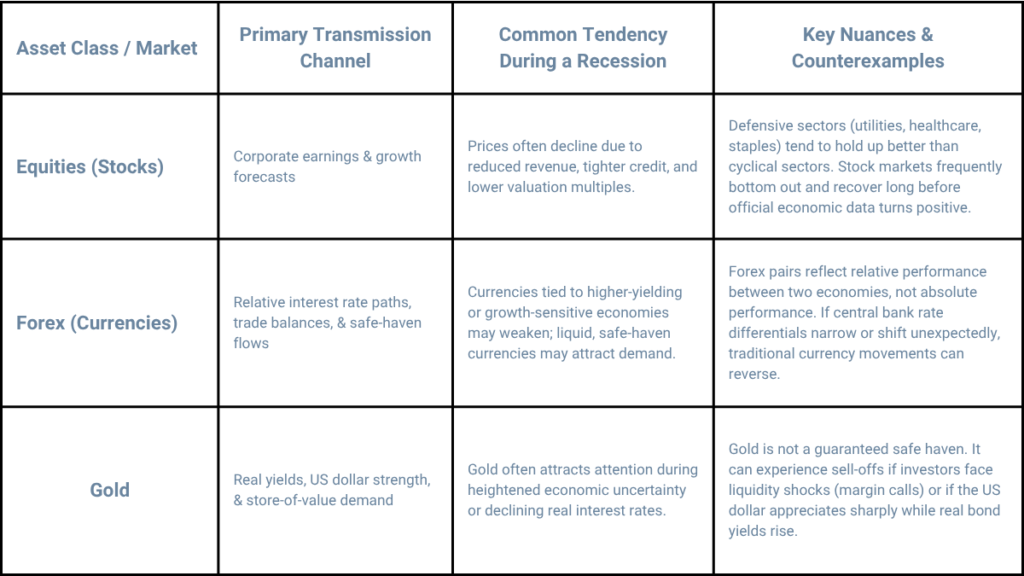
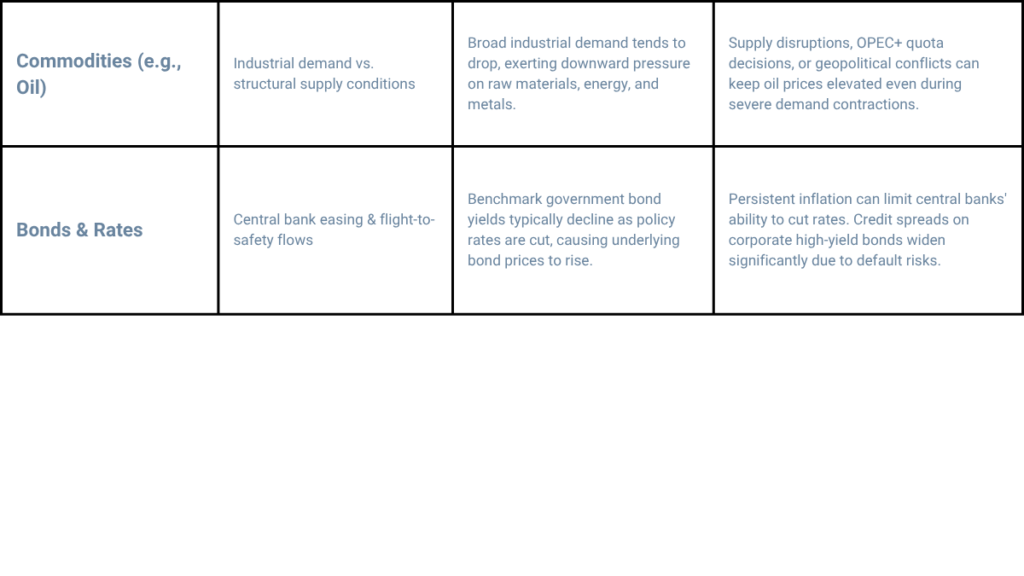
However, a recession does not affect every market in the same way, nor does every downturn follow the same script. While equities may experience valuation pressure, government bond yields may fall, and gold or safe-haven currencies may attract liquidity, no single asset class automatically rises or falls during every economic slowdown. How financial markets perform during a recession depends heavily on what investors previously priced in, the root causes of the contraction, inflation dynamics, central bank responses, and changes in global risk sentiment.
Quick Summary: Potential Recession Impact Across Asset Classes
What Is a Recession, and What Causes One?
An economic recession represents a macroeconomic contraction across key sectors. However, economic agencies worldwide use varied metrics and definitions some rely on two consecutive quarters of negative real gross domestic product (GDP) growth, while others evaluate broader indicators like payroll employment, real personal income, and retail trade.
Common Causes of a Recession
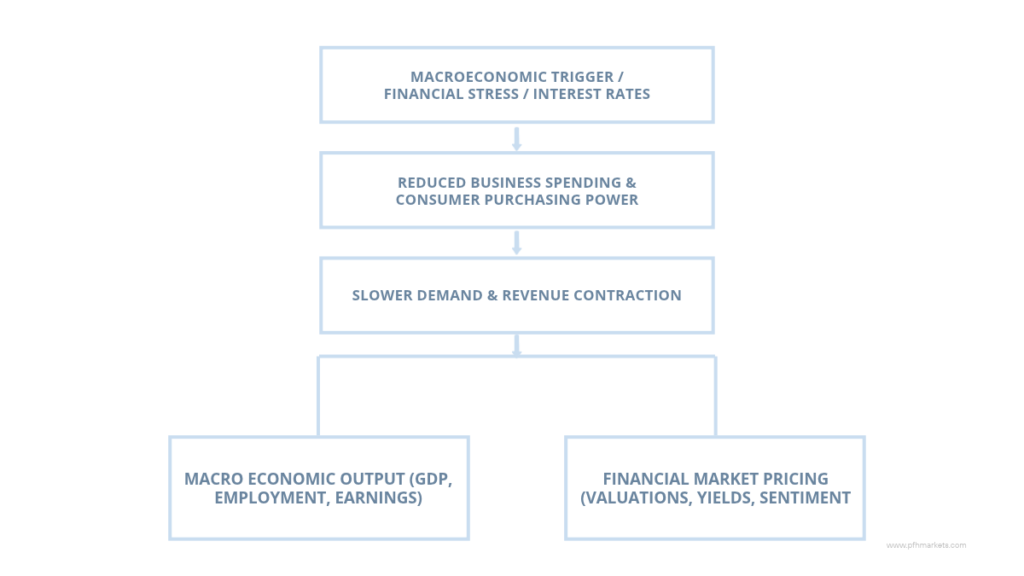
Economic contractions rarely stem from a single variable. Instead, they typically arise from a combination of macro factors:
- Falling Consumer and Business Spending: Retrenchment in household budgets and corporate capital expenditures reduces broader demand.
- Higher Borrowing Costs and Tighter Financial Conditions: Aggressive central bank rate hikes designed to curb inflation can restrict credit access, slowing real estate, investment, and hiring.
- Persistent Inflation: High input and living costs erode purchasing power, suppressing consumer demand.
- Weak Employment and Industrial Output: Falling factory activity and rising unemployment create negative feedback loops.
- Financial Stress or Major External Shocks: Banking panics, supply-chain dislocations, or geopolitical conflicts can trigger sudden downturns.
How a Recession Differs From a Market Correction
It is crucial for market participants to distinguish an economic slowdown from an asset price decline:
- A market correction is a market-specific pricing adjustment—typically defined as a 10% to 20% drop in an asset price or index from recent highs.
- A recession describes a broad-based macro decline across the real economy.
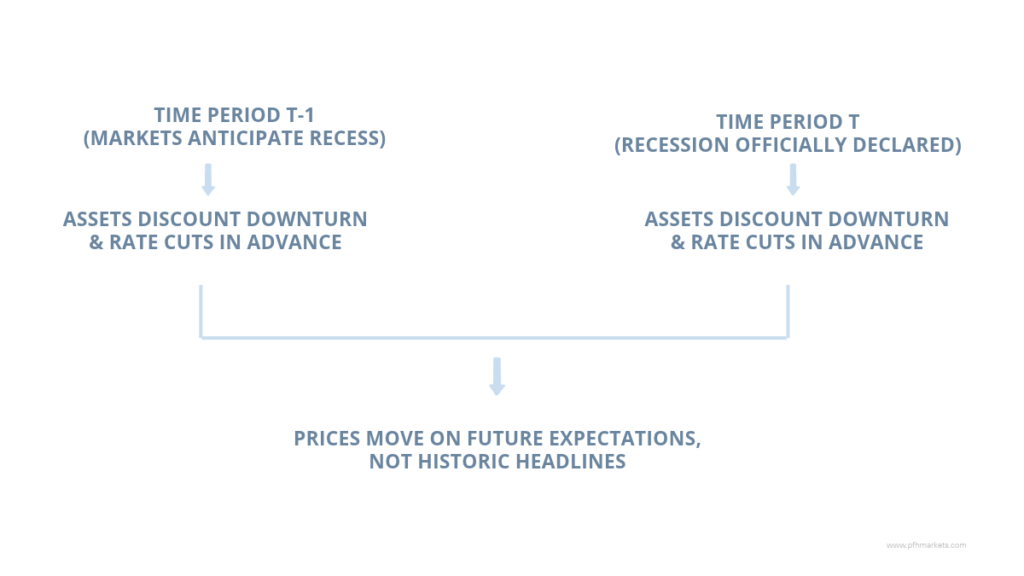
Because financial markets price in future expectations, equity indices can enter a bear market months before an official recession is declared. Conversely, equity markets can rally significantly while unemployment figures and GDP metrics are still deteriorating.
Why Each Recession Affects Markets Differently
No two economic downturns present identical trading conditions:
- Stagflationary Recession (e.g., the 1970s or 2022 slowdowns): High inflation forces central banks to keep interest rates elevated even as growth slows, putting simultaneous pressure on both equities and fixed-income assets.
- Demand Shock / Financial Crisis (e.g., 2008): Sharp drops in aggregate demand and credit availability prompt swift interest-rate cuts, boosting government bonds and driving severe sell-offs in high-beta equity sectors.
How Do Financial Markets React When a Recession Begins?
When an economic slowdown transitions from a theoretical threat to a reality, transmission mechanisms spread the impact across asset classes.
Corporate Earnings and Economic Growth Expectations
As aggregate demand softens, corporate revenue growth slows or turns negative. Companies face lower profit margins, leading analysts to downgrade future earnings-per-share (EPS) estimates. Lower expected earnings reduce the discounted cash flow (DCF) valuation of equity securities, prompting price declines across major market indices.
Interest-Rate Expectations and Central Bank Policy
Financial markets continually evaluate how monetary authorities will respond to slowing growth. Historically, central banks ease monetary policy by cutting benchmark interest rates to lower borrowing costs and stimulate lending. However, if inflation remains above target, monetary policymakers may be forced to keep policy rates restrictive, frustrating market participants hoping for monetary stimulus.
Risk Sentiment and Demand for Liquidity
Uncertainty prompts shifts in overall market psychology. Investors often pivot from high-yielding or growth-sensitive assets toward highly liquid holdings or perceived safe havens. Understanding these shifts requires tracking risk-on and risk-off behaviour
, where capital flows fluidly between speculative assets and capital-preservation instruments based on prevailing fear and greed.
What Happens to the Stock Market During a Recession?
Stock markets are often the most visible barometers of economic stress, but price movements vary widely across sectors and timeframes.
Why Stock Prices May Decline
During an economic contraction, equity prices face multiple headwinds:
- Lower Corporate Earnings: Reduced consumer demand cuts into revenues across retail, travel, manufacturing, and tech.
- Margin Compression: Higher fixed operating costs combined with falling sales suppress net profit margins.
- Tighter Credit Terms: Difficult credit environments increase refinancing costs for heavily indebted corporations.
Why Some Sectors May Be More Resilient Than Others
Not all equities suffer equally during economic downturns:
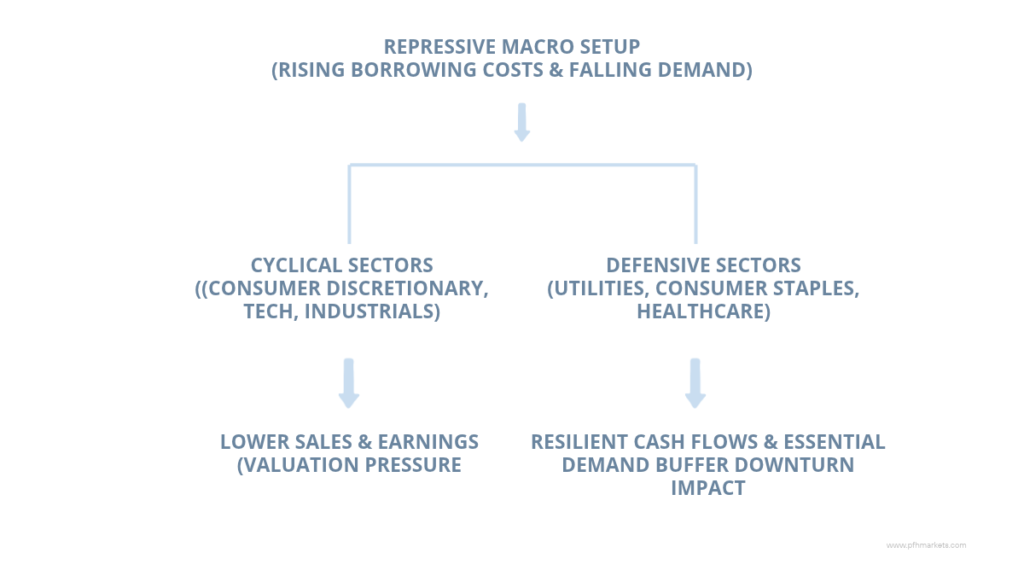
- Cyclical Sectors (Consumer Discretionary, Technology, Industrials): Highly sensitive to economic health. When consumers and businesses cut back on non-essential spending, these revenues fall fast.
- Defensive Sectors (Healthcare, Utilities, Consumer Staples): Provide essential goods and services that consumers buy regardless of the economic environment (e.g., electricity, basic foods, pharmaceuticals). While defensive stocks are not immune to market-wide liquidations, they often exhibit lower volatility and drawdowns.
Why Stock Markets Can Recover Before the Economy
Stock indices frequently bottom out while macroeconomic news headlines remain negative. Because stock prices reflect expected future corporate cash flows 6 to 12 months ahead, equity markets begin pricing in eventual economic recovery, policy easing, and profit rebounds long before official recession metrics show improvement.
How Does a Recession Affect the Forex Market?
Foreign exchange dynamics during a recession require analyzing pair-wise relationships. Currencies do not trade in isolation; they reflect the relative strength, monetary policy path, and economic outlook of one nation compared to another.
Why Currencies Respond Differently to Economic Slowdowns
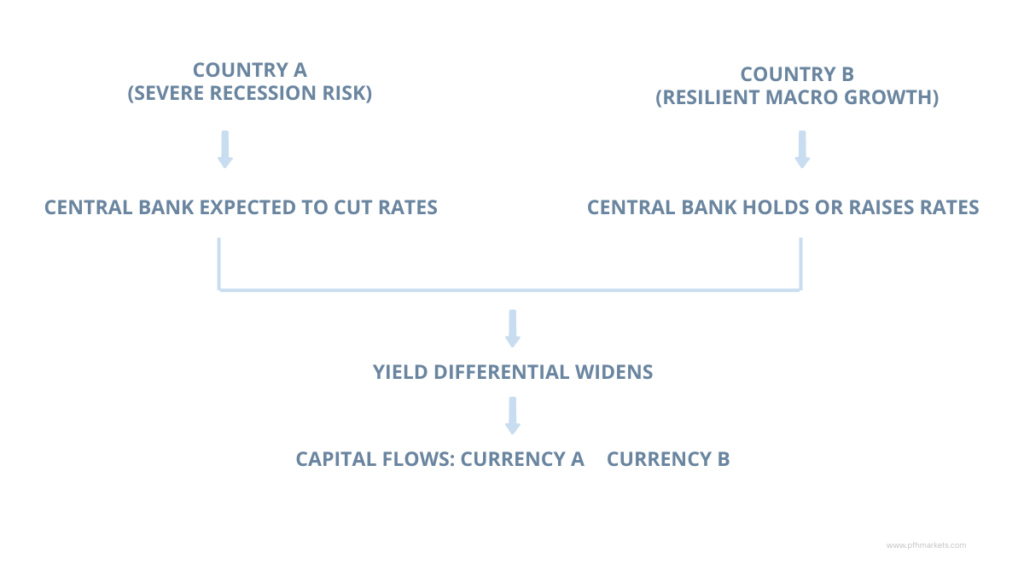
When evaluating recession and forex, traders analyze relative economic divergence. If Country A enters a severe recession while Country B experiences mild growth, Currency A will likely depreciate relative to Currency B. Key factors include:
- Relative GDP growth differentials.
- Divergent central bank interest rate trajectories.
- Country-specific trade balances and capital flows.
How Interest-Rate Expectations Move Currency Pairs
Interest rate differentials serve as a primary driver of exchange rates:
- If a central bank is expected to cut rates rapidly to combat a domestic slowdown, its currency may face selling pressure as foreign capital seeks higher yields elsewhere.
- If a central bank maintains elevated rates due to sticky inflation despite slowing growth, its currency may remain unexpectedly supported.
Traders looking to navigate changing macroeconomic trends can follow major and minor currency pairs using an advanced forex trading platform to monitor real-time policy shifts and economic releases.
Why Risk Sentiment Influences Currency Demand
During broader financial panics, currency markets experience safe-haven liquidity flows. Assets and currencies denominated in global reserve standards such as the US Dollar (USD), Swiss Franc (CHF), and Japanese Yen (JPY) frequently attract capital inflows due to deep market liquidity and capital protection motives. However, these correlations are dynamic and require ongoing assessment when executing forex trading during a recession.
What Happens to Gold During a Recession?
Gold occupies a unique position in global financial markets. It is viewed simultaneously as a monetary asset, a store of value, and a commodity.
Why Investors May Turn to Gold
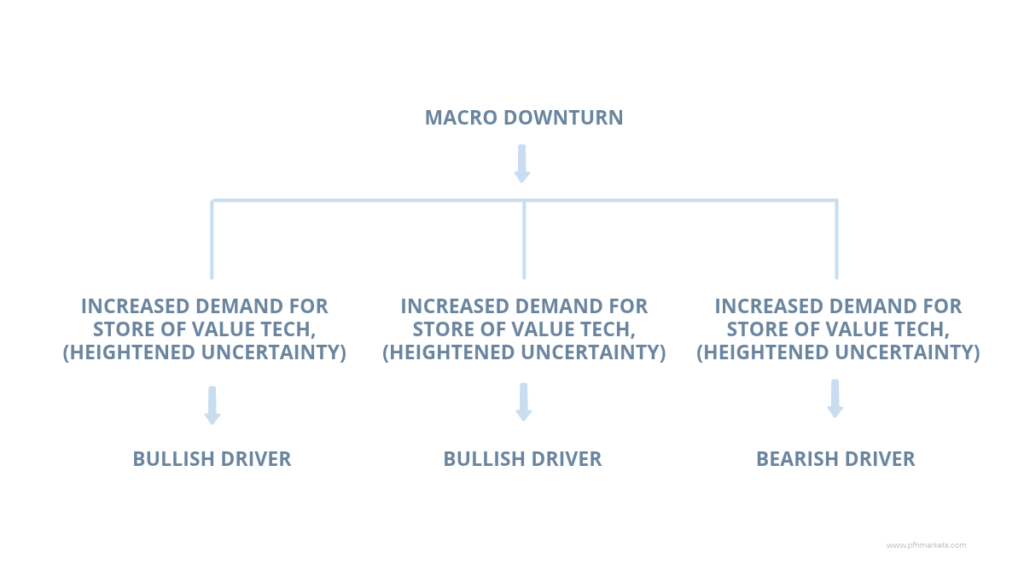
When examining recession and gold, investors frequently highlight its historical status as a store of value. During periods of bank stress, debt sustainability concerns, or extreme equity market volatility, gold often experiences investment demand from institutional and retail market participants seeking non-sovereign wealth protection.
How Interest Rates and the US Dollar Affect Gold
Gold produces no yield or dividend income. Consequently, its price path is inversely related to real interest rates (nominal yield minus inflation expectations):
- Falling Real Yields: When government bond yields fall faster than inflation expectations, the opportunity cost of holding non-yielding gold decreases, providing a bullish backdrop.
- US Dollar Strength: Since gold is primarily priced in US dollars, a sharp rally in the USD can make gold more expensive for foreign currency buyers, exerting downward price pressure.
Understanding these broader multi-asset dynamics is essential; analyzing how interest-rate decisions affect markets
clarifies the interplay between central bank policy rates, real bond yields, and precious metals.
Why Gold Can Still Fall During a Recession
Gold is not guaranteed to rise during every economic downturn. In the early stages of a liquidity crunch or financial crisis, institutional investors facing margin calls in equity or credit markets may liquidate gold holdings to raise immediate cash. If real yields rise sharply or the US dollar surges, gold prices can decline alongside traditional risk assets.
How Does a Recession Affect Commodities Such as Oil?
The relationship between recession and commodities hinges on physical supply and demand balances across energy, industrial metals, and agricultural products.
Why Weaker Demand Pressures Industrial Commodities
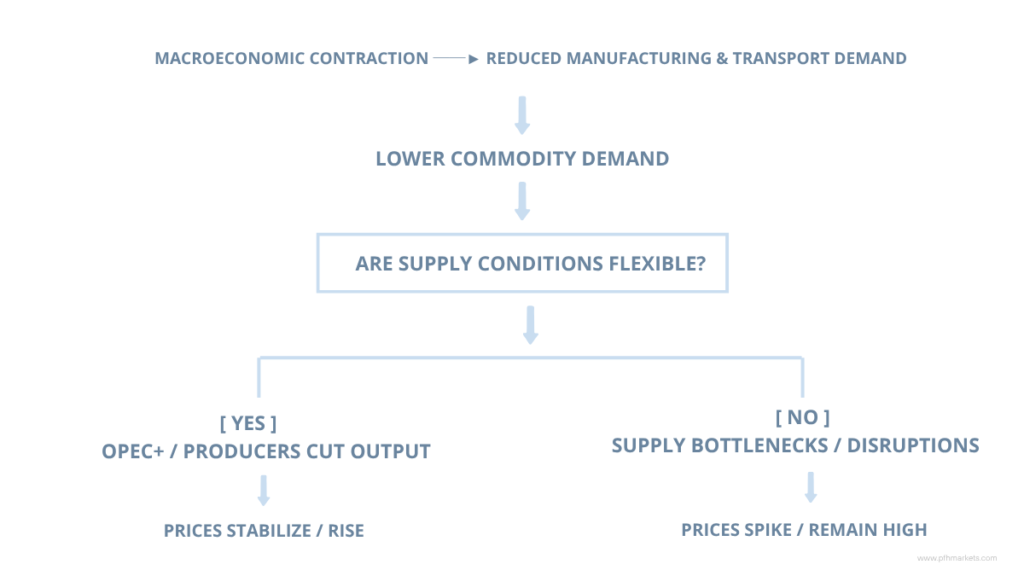
Industrial commodities—such as copper, aluminum, crude oil, and natural gas—are directly linked to industrial output, construction activity, freight transport, and consumer travel. As factory orders drop and global trade contracts during a recession, consumption of raw materials declines, leading to inventory buildups and falling market spot prices.
Why Oil Prices May Not Fall During Every Recession
While crude oil consumption typically contracts during an economic slowdown, prices are governed by the supply curve as well:
- Production Adjustments: Cartels like OPEC+ may restrict supply quotas to balance reduced demand and defend price floors.
- Geopolitical Disruption: Conflict or sanctions targeting major oil-producing regions can restrict physical oil supplies, causing prices to spike even within a weakening global economy.
Market participants following international energy benchmarks can access global energy trading tools to monitor supply forecasts, inventory reports, and economic demand indicators simultaneously.
Why Commodities Can React Before Economic Data
Commodity futures markets trade on forward-looking expectations. Speculative traders, commercial hedgers, and commodity trading advisors (CTAs) adjust positions based on revised macroeconomic growth forecasts long before quarterly GDP or industrial production figures are officially published.
What Happens to Interest Rates and Bonds During a Recession?
Fixed-income instruments and interest rate markets serve as core transmission belts for global capital during macroeconomic shifts.
Why Central Banks May Lower Interest Rates
To cushion an economy against severe job losses and business failures, central banks lower benchmark policy rates. Lower borrowing costs lower capital costs for firms and households, encouraging credit creation and investment. However, if structural inflation remains entrenched during a downturn, monetary authorities may be constrained from delivering rate cuts.
How Bond Yields React
When economic activity decelerates and central banks cut policy rates:
- Yields on benchmark government bonds (e.g., US Treasuries) generally decline across maturities.
- Investors bid up government bond prices for perceived safety and fixed yield income.
- Conversely, corporate bonds—especially high-yield or junk-grade bonds—may suffer price declines as investors demand higher credit risk premiums to compensate for elevated corporate default risks.
Why Bond Prices and Yields Move in Opposite Directions
A fundamental rule of fixed-income markets is that bond prices and yields move in opposite directions:
- When market interest rates fall, newly issued bonds offer lower coupon payments.
- Consequently, existing bonds with higher coupon rates become more valuable, driving up their market price.
To explore how these fixed-income dynamics influence other asset classes, review how how bond yields affect markets
across equities, currencies, and broader capital flows.
Why Markets Sometimes Move Before a Recession Is Confirmed
A common source of confusion for developing traders is why asset prices often rally during severe economic news, or drop during seemingly positive reports.
Markets React to Expectations, Not Published Data
Financial markets operate as discounting mechanisms. Price discovery is driven by the variance between actual data outcomes and prior market expectations:
- If an economic report shows a sharp decline in GDP, but analysts had anticipated an even worse outcome, markets may rally on relief.
- If a weak employment report increases the probability that a central bank will lower interest rates quickly, stock and bond markets may interpret the bad economic news as good monetary news.
Why Recession Headlines Do Not Predict Market Direction
Headline news reports are lagging indicators that describe past economic performance. By the time an official agency officially declares a recession, asset prices may have already discounted the downturn months prior. Understanding why markets move before news
is crucial for aligning trading strategies with forward-looking market pricing rather than backward-looking economic headlines.
Recession Trading: What Should Traders Monitor?
Navigating financial markets during periods of economic contraction requires structured analysis and risk discipline.
1. Track Economic Indicators in Context
Key macroeconomic releases should be evaluated relative to consensus forecasts:
- Labor Market Data: Non-farm payrolls, unemployment claims, and wage growth.
- Inflation Metrics: Consumer Price Index (CPI) and Personal Consumption Expenditures (PCE).
- Purchasing Managers’ Indexes (PMI): Leading indicators of manufacturing and services health.
- Consumer Confidence & Retail Sales: Measures of household sentiment and private spending power.
2. Watch Central Bank Communication and Expectations
Track central bank rate statements, meeting minutes, and yield curve shifts. Compare official policy guidance against rate-futures pricing to determine whether markets expect monetary policy to turn dovish or remain hawkish.
3. Manage Volatility and Position Risk
Recessions are characterized by heightened market volatility, expanding daily trading ranges, and frequent price gaps:
- Position Sizing: Consider scaling down trade sizes to accommodate wider stop-loss placements.
- Leverage Awareness: High leverage amplifies losses during volatile, fast-moving markets.
- Slippage Risk: Order execution prices may experience slippage during major news releases due to reduced order-book liquidity.
4. Avoid Assuming One Asset Will Always Outperform
Historical market correlations can break down during multi-asset liquidations. Rather than relying on simple assumptions such as assuming gold will always rise or stocks will always drop traders should employ scenario-based analysis that accounts for prevailing inflation, central bank flexibility, and dynamic shifts in market sentiment
Traders interested in navigating international currency trends can directly explore forex marketsusing multi-asset platform tools.
FAQ
Which markets are most affected by a recession?
Cyclical stocks, high-yield corporate bonds, and industrial commodities (such as crude oil and copper) typically experience the strongest direct demand shocks. However, foreign exchange, gold, and government bond markets also undergo significant shifts driven by monetary policy adjustments and risk-off liquidity flows.
What happens to forex during a recession?
Forex responses depend on relative growth rates, interest-rate differentials, and safe-haven flows between currency pairs. A currency may weaken if its domestic central bank cuts interest rates faster than peers, whereas liquid currencies like USD, JPY, or CHF may attract safe-haven demand during periods of global stress.
Does gold always rise during a recession?
No. Gold often benefits from economic uncertainty and falling real interest rates, but it can decline during liquidity crises if investors sell assets to meet margin calls, or if the US dollar and real yields appreciate sharply.
Why can stock markets recover before a recession ends?
Stock markets are forward-looking pricing mechanisms that discount expected future conditions 6 to 12 months in advance. As soon as market participants anticipate central bank rate cuts, lower inflation, or cyclical troughs in corporate profits, equity valuations can rise well before official GDP and employment data turn positive.
What should traders watch during an economic slowdown?
Traders should monitor economic releases relative to consensus expectations, central bank policy statements, real yield movements, corporate earnings revisions, and shifting risk sentiment, while maintaining strict risk controls and disciplined position sizing.
Conclusion: Read the Economic Conditions, Not Just the Recession Label
A recession is not a uniform event that dictates a single direction for every asset class. Instead, it represents a complex macroeconomic environment where equities, forex, gold, commodities, and bonds interact based on underlying inflation dynamics, central bank responses, supply conditions, and overall risk appetite.
Rather than relying on simplified market rules or attempting to time exact tops and bottoms based on lagging economic news, market participants benefit from assessing fresh economic data against forward-looking market expectations. Understanding the transmission channels across global asset classes provides a structured, objective framework for reading financial markets throughout every stage of the economic cycle.