

Currency markets operate continuously on a global scale, driven primarily by market forces of supply and demand, economic indicators, and monetary policy. However, exchange rates do not always move in predictable or stable patterns. When excessive currency volatility threatens economic stability, international trade, or domestic inflation, monetary authorities step in. Central banks regularly buy or sell currencies to influence exchange rate movements and ensure market stability.
Understanding currency intervention requires looking beyond basic economic definitions. Central bank actions directly connect macroeconomic decisions with real-world exchange rate movements, foreign exchange reserve management, interest rate policies, and forex trading conditions. This guide covers how foreign exchange intervention works, why central banks execute these transactions, the different intervention methods available, documented real-world examples, and key implications for participants in global currency markets
What Is Currency Intervention?
Currency intervention, also known as foreign exchange intervention, refers to the deliberate purchase or sale of domestic or foreign currencies by a central bank to influence the value of its exchange rate. By entering the foreign exchange market directly or indirectly, monetary authorities alter the supply and demand dynamics of specific currency pairs.
At its core, currency valuation depends on market supply and demand:
- Increased demand for a currency generally leads to its appreciation.
- Increased supply of a currency tends to push its value down.
When a central bank determines that market forces have driven a currency too far from its economic fundamentals or created destabilizing volatility, it intervenes to shift market equilibrium.
Exchange Rate Regimes and Intervention
The nature and frequency of currency intervention explained across different market structures vary significantly based on a country’s exchange rate system:
- Fixed (Pegged) Exchange Rate Systems: The central bank commits to maintaining a specific exchange rate relative to a anchor currency (such as the US Dollar) or a basket of currencies. Intervention is routine and mandatory to keep the rate within narrow policy bands.
- Managed Float Systems: The exchange rate fluctuates daily based on market forces, but the central bank actively intervenes to curb sharp movements or steer the currency within an undisclosed target range.
- Floating Exchange Rate Systems: Market forces primarily dictate exchange rates. Central banks intervene rarely, typically only during extreme market stress, liquidity shortages, or disorderly trading conditions.
Currency intervention does not necessarily mean fixing an exchange rate at a permanent, rigid target. In floating and managed regimes, central banks frequently intervene simply to smooth out extreme fluctuations rather than enforce a specific price level.
How Does Central Bank Currency Intervention Work?
Central bank currency intervention relies on large 0scale spot or derivative transactions to tilt currency supply and demand dynamics.
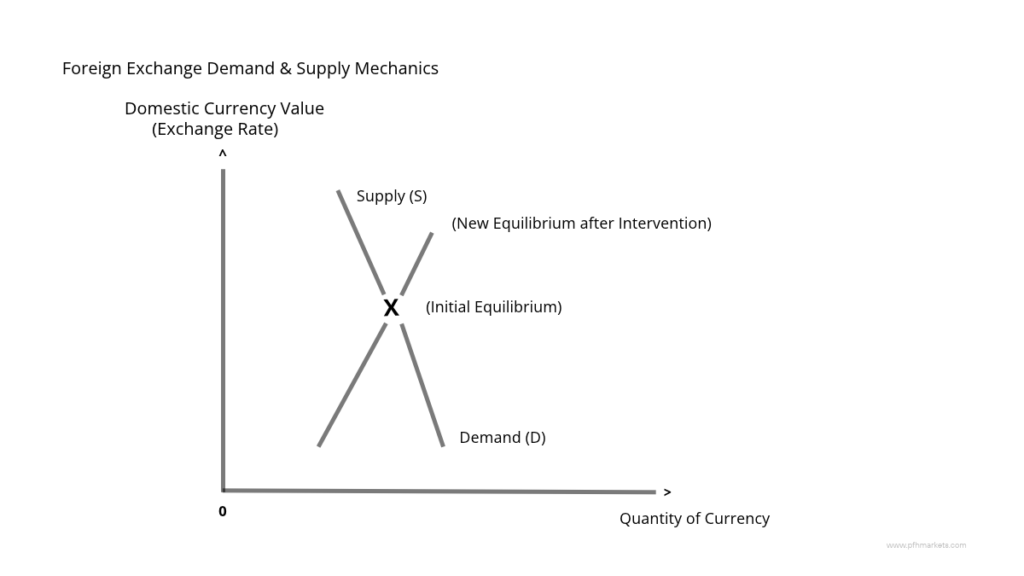
The Mechanism of Buying and Selling Currencies
- Supporting the Domestic Currency: If a central bank wants to stop its currency from depreciating, it enters the market as a buyer. It uses its holdings of foreign currency assets to purchase its own domestic currency, reducing market supply and creating upward price pressure.
- Limiting Domestic Currency Appreciation: If a currency appreciates too rapidly, threatening export competitiveness, the central bank sells its domestic currency and purchases foreign currencies. This increases the supply of the domestic currency in the forex market, placing downward pressure on its exchange rate.
The Role of Foreign Exchange Reserves
Executing direct market intervention requires access to substantial reserves. Foreign exchange reserves consist of foreign currencies (primarily US Dollars, Euros, Yen, and British Pounds), gold, Special Drawing Rights (SDRs), and foreign treasury securities held by a central bank.
A central bank’s capacity to support a weakening currency depends directly on the depth of its foreign currency reserves. Conversely, capping an appreciating currency involves creating domestic currency to buy foreign assets, which accumulates reserves but carries distinct domestic liquidity implications.
Why Is Currency Intervention Different from Regular Monetary Policy?
While both currency intervention and conventional monetary policy aim to manage macroeconomic stability, they rely on distinct mechanisms and primary transmission channels:
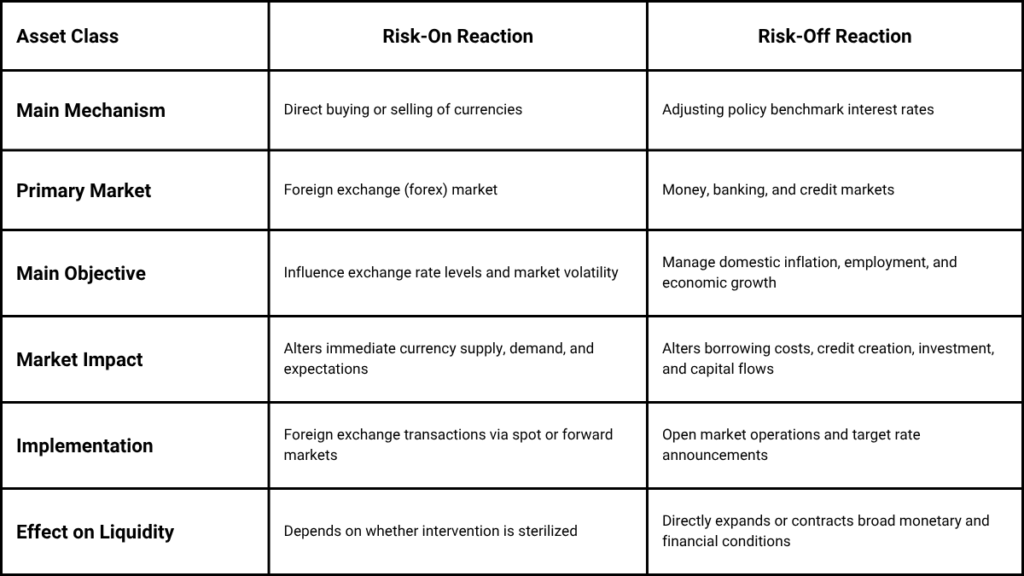
How Monetary Policy and Intervention Interact
Central bank policy interest rates influence exchange rates indirectly. Higher interest rates typically attract foreign capital seeking higher yields, driving up currency demand. Conversely, lower rates can encourage capital outflows, weakening the domestic currency.
Currency intervention and interest rate policy can be used independently or in tandem. For instance, if interest rate hikes alone fail to slow capital flight, a central bank may combine rate adjustments with direct market interventions to restore confidence. For a deeper look into these interactions, review how interest rate decisions and their market impact shape broad asset classes.
Why Do Central Banks Intervene in Foreign Exchange Markets?
Monetary authorities do not intervene in foreign exchange markets without clear economic drivers. The primary motivations behind central bank intervention fall into four distinct categories:
1. To Reduce Excessive Exchange Rate Volatility
Rapid, unpredictable exchange rate swings create uncertainty for international trade, long-term investments, and financial planning. Sudden currency moves can force domestic importers and exporters into severe short-term losses. Central banks step in during chaotic market conditions to restore liquidity, smooth out sharp price spikes, and maintain orderly order books.
2. To Support a Weakening Domestic Currency
A sharply depreciating currency raises the cost of imported goods, fuel, and raw materials, leading to imported inflation. For emerging market economies holding significant foreign-currency denominated debt, a weaker domestic currency exponentially increases debt-servicing burdens. In such scenarios, central banks sell foreign reserves to buy domestic currency and stabilize the exchange rate.
3. To Manage Excessive Currency Appreciation
While a strong currency reduces import costs, rapid appreciation makes domestic exports more expensive abroad and cheaper foreign imports more competitive domestically. Export-reliant economies (such as Japan or Switzerland) frequently monitor appreciation risks. By selling domestic currency and buying foreign assets, central banks attempt to preserve export competitiveness and domestic corporate earnings.
4. To Maintain Financial and Economic Stability
Large capital flows driven by international speculative sentiment can destabilize a country’s banking system. Sudden capital flight can deplete domestic bank liquidity and drive asset prices down. Foreign exchange intervention acts as a defensive buffer against external financial shocks, curbing speculative attacks and preserving broader systemic stability.
5. To Build or Preserve Foreign Exchange Reserves
Central banks build reserves during periods of capital inflows to construct a safety buffer for economic downturns. Maintaining adequate reserve levels ensures a sovereign entity can meet international balance-of-payment obligations and defend its financial system during severe global crises.
What Are the Different Types of Currency Intervention?
Central banks employ several strategies to conduct foreign exchange intervention, depending on their policy goals and liquidity requirements.
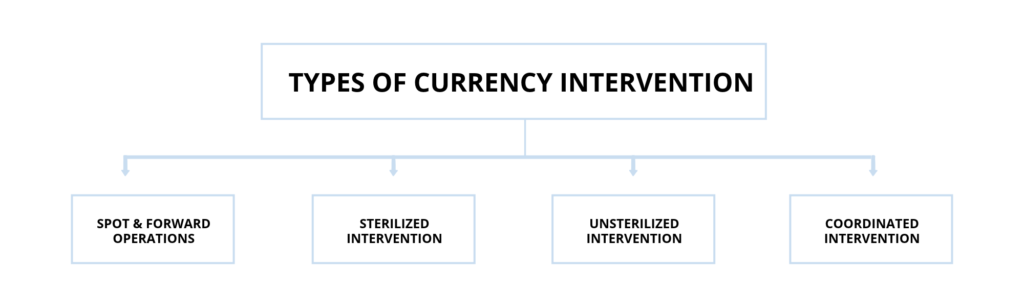
Direct (Spot Market) Intervention
In a spot market intervention, the central bank directly buys or sells foreign currency against its domestic currency for immediate settlement.
- Example: If a central bank buys $1 billion worth of its domestic currency in the spot market, it immediately absorbs that amount of domestic liquidity while adding to foreign exchange market demand.
Forward Market Intervention
Rather than trading spot contracts, central banks can use derivative instruments such as forward contracts, swaps, or options. Forward intervention allows a central bank to signal policy intent and influence future exchange rate expectations without instantly drawing down its current physical foreign exchange reserves.
Sterilized Currency Intervention
When a central bank buys or sells foreign assets, it alters the amount of domestic currency circulating in the commercial banking system. To prevent this transaction from changing domestic monetary conditions and short-term interest rates, the central bank conducts sterilized intervention:
- The central bank sells foreign currency to buy domestic currency (reducing domestic monetary bank reserves).
- Simultaneously, it conducts open market operations purchasing domestic government bonds to inject an equal amount of domestic liquidity back into the banking system.
Sterilization allows a central bank to influence the exchange rate without altering its domestic monetary policy stance.
Unsterilized Currency Intervention
In an unsterilized intervention, the central bank allows foreign exchange transactions to directly expand or contract the domestic money supply:
- Selling domestic currency to purchase foreign reserves increases domestic bank reserves, expanding overall money supply and lowering domestic short-term interest rates.
- Buying domestic currency reduces monetary reserves, tightening monetary conditions.
Unsterilized actions alter both exchange rates and underlying domestic monetary policy conditions simultaneously.
Coordinated Intervention
Coordinated intervention occurs when two or more central banks act together to move a specific currency pair. Joint interventions send a powerful unified signal to market participants, greatly enhancing the psychological impact and market effectiveness of the operation.
How Does Currency Intervention Affect Exchange Rates?
The impact of central bank actions on exchange rates extends beyond simple volume transactions; market expectations and credibility play central roles. Understanding what drives currency movements helps contextualize how intervention alters market dynamics.
When a Central Bank Buys Its Domestic Currency
- Demand Shift: The central bank enters the market as a major buyer, shifting the market demand curve outward.
- Reserve Consumption: The bank surrenders foreign assets (e.g., US Dollars) from its reserves.
- Price Effect: The increased buy-side pressure places upward pressure on the domestic currency’s exchange rate against the foreign currency.
When a Central Bank Sells Its Domestic Currency
- Supply Expansion: The central bank creates or releases domestic currency to purchase foreign assets.
- Reserve Accumulation: The central bank’s foreign reserves increase.
- Price Effect: The increased supply of domestic currency in international markets places downward pressure on its value.
The Role of Market Expectations
Market participants react to the announcement and signaling value of an intervention just as much as the actual transaction size.
- High Central Bank Credibility: If traders believe a central bank has the economic fundamentals and reserves to back up its target, speculative traders align their positions with the central bank, amplifying the intervention’s success.
- Low Central Bank Credibility: If the market perceives that the central bank is fighting fundamental macroeconomic realities (e.g., severe inflation or huge trade deficits), intervention can trigger speculative attacks, quickly consuming central bank reserves without altering the currency’s overall trajectory.
Real-World Examples of Central Bank Currency Intervention
Documented operations across global markets illustrate how intervention works under different economic conditions:
1. Japan’s Foreign Exchange Interventions (2022 and 2024)
- Economic Context: Rapid depreciation of the Japanese Yen (JPY) driven by wide interest rate differentials between the US Federal Reserve’s rate hikes and the Bank of Japan’s ultra-loose policy.
- Intervention Method: Direct spot market intervention. Japan’s Ministry of Finance directed the Bank of Japan to sell US Dollar holdings from its foreign reserves to purchase JPY.
- Outcome: Operations in late 2022 and mid-2024 produced immediate, sharp JPY rallies (moving USD/JPY down hundreds of pips in hours). While intervention successfully curbed chaotic volatility and speculative positioning, long-term exchange rate stabilization only fully materialized as broader interest rate expectations began to shift.
2. Switzerland’s Minimum Exchange Rate Floor (2011–2015)
- Economic Context: During the Eurozone sovereign debt crisis, massive safe-haven capital flowed into the Swiss Franc (CHF), causing intense appreciation that threatened Swiss exporters and introduced deflationary risks.
- Intervention Method: In September 2011, the Swiss National Bank (SNB) set an explicit minimum exchange rate floor of 1.20 CHF per Euro, pledging to purchase foreign currency in un-capped quantities to defend the floor.
- Outcome: The SNB successfully defended the target for over three years, expanding its foreign exchange reserves rapidly. However, when maintaining the floor became economically unsustainable due to ECB policy easing, the SNB abruptly discontinued the policy in January 2015, triggering record high volatility in CHF trading pairs.
What Factors Determine Whether Currency Intervention Is Successful?
Central bank intervention does not guarantee a target outcome. Four main factors dictate operational success:
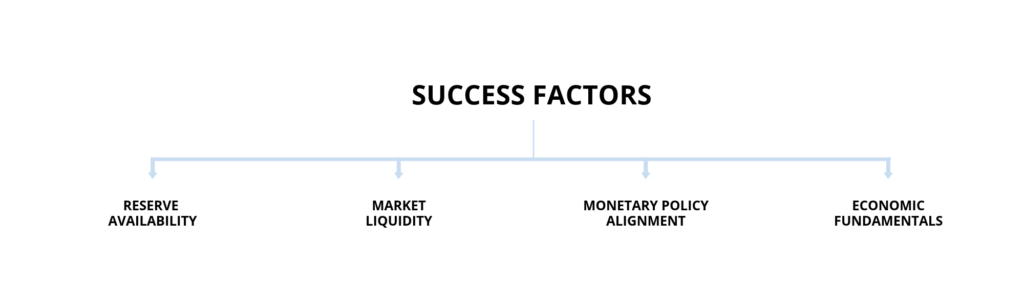
- Size and Availability of Foreign Exchange Reserves: Supporting a weak currency requires finite foreign reserves. If market participants realize a central bank’s reserves are running low, speculative pressure accelerates.
- Market Liquidity and Investor Sentiment: Forex markets trade trillions of dollars daily. If global institutional investors align against a currency due to broader market trends, central bank interventions can be overwhelmed by sheer market volume.
- Monetary Policy Alignment: Intervention works best when supported by domestic monetary policy. Attempting to support a currency while simultaneously cutting interest rates sends conflicting signals that diminish intervention effectiveness.
- Economic Fundamentals and Capital Flows: Interventions cannot permanently override structural trade deficits, high inflation differentials, or persistent fiscal imbalances.
What Are the Risks and Limitations of Currency Intervention?
While currency intervention can stabilize markets, it presents major policy risks and operational trade offs:
- Reserve Depletion: Defending a depreciating currency risks exhausting foreign currency reserves, leaving an economy vulnerable to balance-of-payments crises.
- Domestic Liquidity Distortions: Unsterilized market interventions can unintentionally distort domestic money supply, creating unwanted inflation or tightening credit conditions.
- Conflicting Market Signals: Frequent or unannounced interventions increase market confusion, making it difficult for businesses and investors to accurately price long-term currency risk.
- Speculative Backlash: Failed interventions weaken central bank credibility, inviting aggressive speculative short positions against the currency.
- International Policy Friction: Persistent one-sided currency interventions designed to keep domestic currencies artificially weak can lead to international trade disputes and accusations of currency manipulation.
Intervention is a temporary management tool to smooth out market friction; it cannot replace sustainable structural economic policy.
How Does Currency Intervention Affect Forex Traders?
For participants in forex trading, central bank interventions represent periods of heightened risk and elevated market opportunity.
1. Sudden Exchange Rate Movements and Volatility
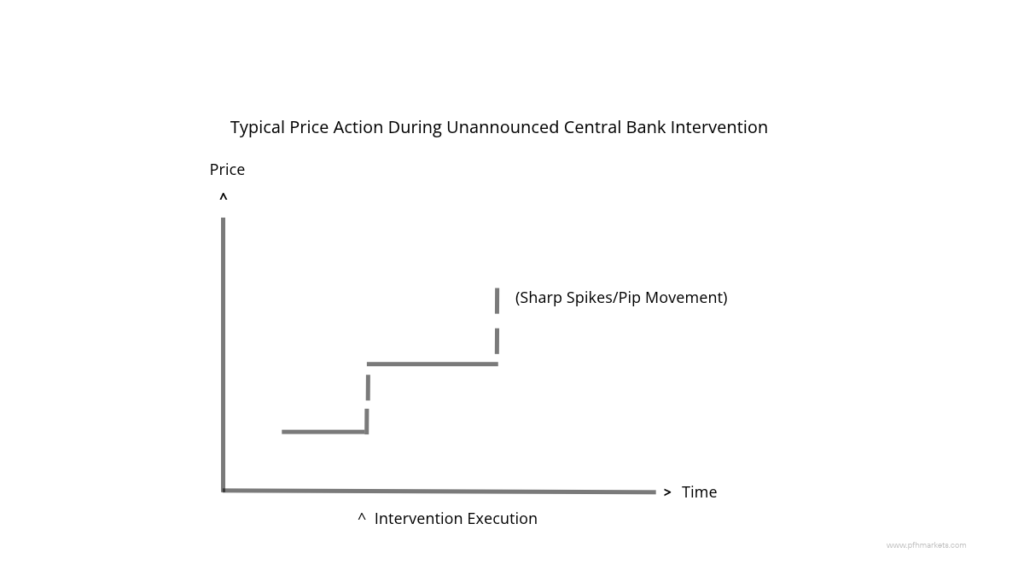
Central bank interventions often occur without warning. Unannounced spot market interventions trigger sudden spikes in volatility, shifting currency pairs hundreds of pips within seconds. Traders holding unhedged positions risk severe slippage or stop-out events.
2. Shifts in Currency Pair Trends
Major intervention programs can temporarily alter short-term market momentum or break key technical support and resistance levels. However, if macroeconomic drivers point in the opposite direction, the currency pair often resumes its underlying trend once the intervention volume subsides.
3. Impact on Trading Spreads and Execution Liquidity
During active central bank intervention:
- Spreads Widen: Institutional liquidity providers broaden bid-ask spreads to offset rapid price movement risks.
- Slippage Risks Increase: Market orders may execute at prices significantly different from the rate displayed at order entry.
What Forex Traders Should Monitor
To navigate intervention-driven volatility, traders should track key economic indicators:
- Official central bank policy statements and intervention commentary.
- Monthly foreign exchange reserve data releases.
- Foreign exchange rate deviations from long-term moving averages.
- Country-specific inflation data, interest rate differentials, and trade balances.
Practical Risk Management Strategies
- Avoid Trading Pure Rumors: Refrain from placing high-leverage trades purely on unconfirmed intervention rumors.
- Adjust Position Sizes: Reduce trade sizes during periods of expected central bank activity to account for elevated volatility and wider spreads.
- Use Guaranteed Stop-Losses Where Applicable: Protect positions against extreme price slippage caused by sudden market interventions.
- Follow Broad Economic Fundamentals: Evaluate whether central bank actions align with broader macroeconomic trends before anticipating sustained currency reversals.
FAQ
Why do central banks intervene in the forex market?
Central banks intervene to reduce excessive exchange rate volatility, curb rapid currency depreciation or appreciation, protect foreign trade competitiveness, and preserve financial stability.
How does central bank intervention affect exchange rates?
Intervention alters the supply and demand balance of currency pairs in the market. Buying domestic currency increases its demand and can push its value up, while selling domestic currency increases supply and can lower its value.
Can central banks completely control exchange rates?
No. Central banks can influence exchange rates, but they cannot maintain complete control over them in open capital markets when broader economic fundamentals point in the opposite direction.
What is the difference between sterilized and unsterilized intervention?
Sterilized intervention offsets the liquidity impact of foreign exchange trades through domestic bond transactions, leaving the domestic money supply unchanged. Unsterilized intervention allows foreign exchange trades to directly expand or contract domestic bank reserves and money supply.
Does currency intervention always strengthen a currency?
No. Depending on economic goals, a central bank may sell domestic currency to weaken an appreciating exchange rate or buy domestic currency to strengthen a weakening rate.
What happens when a central bank sells foreign exchange reserves?
Selling foreign reserves allows a central bank to buy back its domestic currency. This reduces domestic currency supply in foreign exchange markets, helping support or stabilize its exchange rate.
How can forex traders identify possible currency intervention?
Traders monitor sudden high-volume price candles near key historical support/resistance levels, official central bank press conferences, shifts in foreign reserve balances, and unexpected widening of market bid-ask spreads.
Conclusion: Why Currency Intervention Matters in Global Forex Markets
Central bank currency intervention serves as an essential policy bridge connecting macroeconomic management with active financial markets. By deploying foreign exchange reserves across spot, forward, and derivative markets, monetary authorities work to curb destabilizing volatility, maintain balance-of-payments equilibrium, and protect domestic economic goals.
For investors, international businesses, and market participants, recognizing the mechanisms, boundaries, and historical impacts of central bank interventions is vital for effective risk management. While central bank actions can create sudden price shifts and temporary trend dislocations, long-term exchange rate trajectories remain governed by underlying economic fundamentals. Explore how key macroeconomic factors shape global trade and pricing dynamics by reviewing foreign exchange trends across global currency markets.