

Navigate the currency markets in 2027 by understanding core economic drivers rather than relying on unreliable price predictions. The global Forex landscape continues to evolve based on shifting interest rates, persistent or cooling inflation, global economic growth, and geopolitical developments.
Because currency markets move on expectations rather than past economic data alone, no single forecast can guarantee future market direction. Instead, evaluating potential macroeconomic scenarios equips traders to analyze shifting market conditions and adapt their risk management strategies effectively.
What Is the Forex Market Outlook for 2027?
The 2027 Forex market outlook is shaped by global inflation trends, central bank monetary policy shifts, interest rate differentials, economic growth trajectories, geopolitical risks, and evolving market sentiment.
What Is the Forex Market Outlook for 2027?
A Forex market outlook provides a structured evaluation of macro forces, monetary policies, and global events expected to impact currency values. Understanding different currency pairs is an important starting point before evaluating a currency market outlook, as major, minor, and exotic pairs react uniquely to global economic pressures.
Crucially, an outlook is not a guaranteed price prediction. Financial markets are inherently dynamic; unexpected economic releases, political shifts, or black swan events frequently disrupt long-term forecasts.
While a prediction attempts to pinpoint where a currency pair will trade at a given time, an economic outlook establishes logical scenarios. Traders use these insights to assess market conditions, evaluate risk exposure, and build flexible trading plans.
Forex Outlook vs. Forex Forecast: What’s the Difference?
| Feature | Forex Market Outlook | Forex Forecast |
| Core Definition | A broad view of macro conditions and fundamental drivers. | A specific prediction regarding short- or long-term price targets. |
| Primary Focus | Fundamental trends, central bank biases, and market scenarios. | Expected price levels, direction, and technical targets. |
| Trading Application | Used for strategic preparation and scenario analysis. | Used for setting speculative short- or medium-term expectations. |
| Adaptability | High; adjusts as broad macroeconomic conditions evolve. | Low; easily invalidated by unexpected news or market volatility. |
The Biggest Global Economic Trends Shaping Forex Markets in 2027
To understand currency movements, traders must analyze the primary economic forces driving international capital flows.
Inflation Outlook and Changing Price Pressures
Inflation directly impacts consumer purchasing power and monetary policy. When inflation rises above central bank targets, policymakers typically raise interest rates to cool economic activity, which can strengthen a domestic currency by attracting capital yield.
Conversely, disinflation or deflation may prompt rate cuts, reducing yield appeal. Because economies recover and experience price pressures at different speeds, diverging national inflation rates create major currency trends. Traders can also explore how inflation indicators such as CPI and PPI influence currency markets to track these shifts.
Central Bank Policy and Interest Rate Expectations
Central banks dictate national monetary policy through interest rate adjustments, asset purchases, and liquidity management. When central banks signal rate increases (hawkish bias), foreign capital often flows in, pushing the currency higher.
Rate cuts (dovish bias) generally reduce currency demand. However, markets trade on forward guidance the verbal and written signals given by central banks about future policy meaning exchange rates often adjust long before official rate changes occur. Interest rate decisions remain one of the most important drivers of currency market movements.
Global Economic Growth and Recession Risks
Economic expansions boost corporate earnings, trade balances, and investment, supporting domestic currency valuations. When economic growth slows or enters recessionary territory, central banks typically lower rates to stimulate activity, which can weaken the national currency. Understanding how Forex behaves during economic slowdowns can help traders evaluate defensive market scenarios and spot potential capital shifts toward safer assets.
Geopolitical Events and Currency Market Volatility
Elections, trade conflicts, international disputes, and energy supply shocks rapidly alter market dynamics. Unexpected geopolitical events can quickly change currency market sentiment and volatility, prompting sudden capital flows out of riskier assets and into traditional safe-haven currencies like the US Dollar (USD), Swiss Franc (CHF), or Japanese Yen (JPY).
Key Central Bank Trends Traders Should Monitor in 2027
Central banks remain the primary architects of currency market volatility. Tracking their policy shifts is essential for any macroeconomic analysis.
Macroeconomic Data → Inflation & Growth Signals → Central Bank Policy Response → Interest Rate Differentials → Currency Valuation Shifts
Why Interest Rate Decisions Matter for Forex
Capital naturally flows toward higher yield. When a country’s central bank raises interest rates relative to another, holding assets in that currency yields a higher return. This creates an interest rate differential, driving international capital flows and altering the exchange rate between the two currencies.
Monetary Policy Divergence Between Major Economies
Monetary policy divergence occurs when major central banks pursue opposing strategies such as the Federal Reserve cutting rates while the European Central Bank holds rates steady. This divergence creates multi-month trending opportunities across major currency pairs as capital shifts toward the higher-yielding or more economically stable currency.
Forward Guidance and Central Bank Communication
Official policy statements, meeting minutes, and speeches by central bank leaders provide crucial clues about upcoming decisions. Because financial markets price in expected policy changes well in advance, central bank communication often creates immediate market volatility even when official rates remain unchanged.
Currency Market Outlook: Major Themes to Watch in 2027
Instead of making speculative price predictions, traders should monitor specific fundamental drivers across major currency regions.
US Dollar Outlook and Global Reserve Currency Demand
As the dominant global reserve currency, the US Dollar is influenced by both domestic interest rate expectations and global risk sentiment. During periods of worldwide economic uncertainty, the USD often strengthens due to safe-haven demand, regardless of domestic US economic challenges.
Euro Currency Outlook and European Economic Conditions
The Euro performance depends heavily on structural energy costs, trade dynamics, and economic growth across the Eurozone. Monetary policy decisions by the European Central Bank (ECB) must balance differing economic conditions across member states, making European growth trends and inflation data key factors to watch.
Japanese Yen and Safe-Haven Currency Dynamics
The Japanese Yen (JPY) has historically functioned as a key carry trade and safe-haven currency. Shifts in the Bank of Japan’s (BOJ) monetary framework, alongside changes in global bond yields, heavily impact JPY capital flows. When global equity markets face steep declines, JPY often experiences rapid safe-haven inflows.
Emerging Market Currencies and Global Capital Flows
Emerging market currencies (such as the South African Rand, Mexican Peso, or Brazilian Real) generally offer higher yields but carry elevated risk profiles. Their performance relies on global commodity prices, international trade appetite, domestic political stability, and overall global risk sentiment.
What Economic Indicators Should Traders Watch?
Economic indicators provide raw data on national economic health, directly influencing central bank decisions and currency valuations.
Key Economic Indicators Checklist
Consumer Price Index (CPI)
Producer Price Index (PPI)
Non-Farm Payrolls (NFP) & Unemployment Rate
Gross Domestic Product (GDP) Growth
Purchasing Managers’ Index (PMI)
Central Bank Rate Decisions & Statements
Inflation Data (CPI & PPI)
- Consumer Price Index (CPI): Measures the average change over time in prices paid by consumers for a basket of goods and services. High CPI pushes central banks toward hawkish policy.
- Producer Price Index (PPI): Tracks wholesale price changes before they hit consumers, serving as an early indicator of future CPI trends.
- Core Inflation: Excludes volatile food and energy prices to reveal underlying, persistent price trends.
Employment Reports
Labor market health directly dictates consumer spending and economic growth:
- Non-Farm Payrolls (NFP): A critical monthly indicator measuring US job creation.
- Unemployment Rate: High unemployment suggests economic distress, often delaying interest rate increases.
- Wage Growth: Accelerating wages can trigger cost-push inflation, prompting monetary tightening.
GDP and Economic Growth Reports
Gross Domestic Product (GDP) reports reveal overall economic contraction or expansion. Consistently strong GDP growth boosts investor confidence and increases demand for a nation’s currency.
PMI and Business Activity Data
The Purchasing Managers’ Index (PMI) tracks monthly activity in manufacturing and services sectors. A reading above 50 signals expansion, while a reading below 50 indicates contraction, making PMI a valuable leading economic indicator.
Retail Sales and Consumer Spending
Consumer activity makes up a significant portion of total GDP in developed economies. Robust retail sales show strong economic momentum, supporting central bank confidence to maintain or raise borrowing rates.
Tracking Events via Economic Calendars
An economic calendar can help traders identify scheduled events that may influence currency volatility, allowing them to adjust risk parameters prior to high-impact releases.
Forex Market Sentiment and Risk Appetite
Market sentiment represents the overall tone or attitude of investors toward financial markets, often driving price movements independently of underlying economic data.
What Is Forex Market Sentiment?
Market sentiment reflects collective trader psychology. While fundamental analysis focuses on economic reports and technical analysis focuses on price charts, sentiment analysis tracks whether market participants are predominantly optimistic (bullish) or pessimistic (bearish).
Risk-On vs. Risk-Off Market Conditions
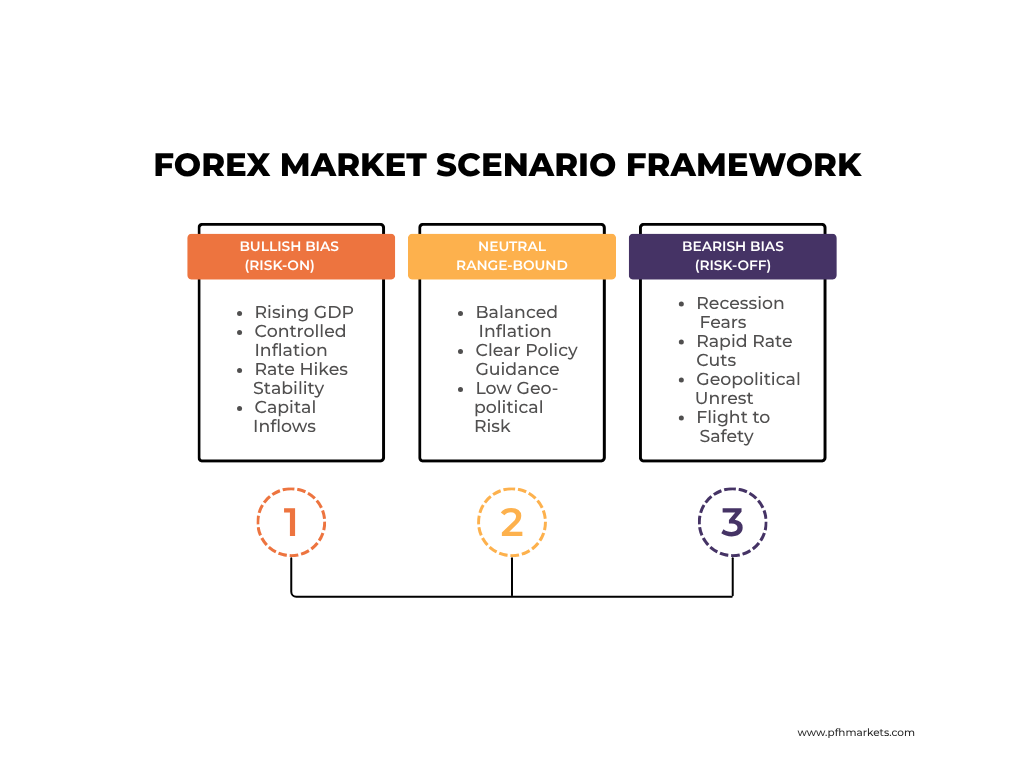
- Risk-On Sentiment: Occurs when economic outlooks are positive. Investors seek higher yields by buying growth-linked assets, equities, commodities, and high-beta currencies (e.g., AUD, NZD, CAD).
- Risk-Off Sentiment: Triggered by economic distress, geopolitical crises, or market shocks. Capital quickly flees high-risk assets, moving into safe-haven instruments such as USD, JPY, CHF, and Gold.
How Market Expectations Move Prices Before Data Releases
Forex markets run on anticipation. If market consensus expects a central bank to raise rates by 25 basis points, that expectation is usually priced into the exchange rate prior to the announcement. If the central bank delivers the expected rate hike, the currency may barely move or even fall in a “buy the rumor, sell the news” reaction.
Prices shift dramatically when actual data deviates significantly from market expectations.
Forex Volatility Outlook: Preparing for Market Shifts
Volatility measures the rate and magnitude of price changes over a given period. Rather than fearing volatility, prepared traders structure their risk management to handle price expansion.
Why Forex Volatility Changes
Market volatility fluctuates based on liquidity conditions and economic clarity:
Low Volatility Phase → Unexpected News / Data Release → Volatility Spike → Market Re-Pricing → Liquidity Returns → Stabilization
- High-Impact News: Unscheduled events or economic releases that deviate from forecasts spike volatility.
- Policy Shifts: Sudden central bank pivots create multi-day volatility expansions.
- Liquidity Shifts: During market holiday transitions or session overlaps, reduced liquidity can lead to sharp, sudden price swings.
What Is High Volatility in Forex?
High volatility occurs when price ranges expand rapidly, marked by large candlestick ranges, slippage, and sudden direction changes. While this expands short-term profit opportunities, it increases financial risk if trades are improperly managed.
How Traders Prepare for Volatile Markets
- Review Position Sizing: Reduce lot sizes during volatile market conditions to keep monetary risk consistent.
- Account for Spread Widening: Spreads often widen significantly during news announcements and session roll-overs. Understanding what spread widening is and why it happens during high volatility helps prevent unexpected trade entry costs.
- Utilize Guaranteed Stop Losses: Relying on basic stop-loss orders during extreme volatility can expose accounts to slippage.
- Avoid Emotional Decision-Making: Stick to predetermined rules rather than reacting impulsively to sudden market swings.
Forex Trading Strategies for Changing Market Conditions
Different macroeconomic environments require distinct strategic approaches. Adapting your methodology to match prevailing market conditions is essential for long-term consistency.
Trend-Following During Strong Economic Cycles
When monetary policy divergence or sustained economic expansion creates long-term direction, trend-following strategies perform effectively. Traders use moving averages, trendlines, and market structure analysis to enter trades in the direction of the macro trend.
Range Trading During Stable Market Conditions
When economic data is mixed and central bank policy is balanced, currency pairs often trade within horizontal support and resistance channels. Range-bound strategies focus on buying near established support and selling near resistance levels until a clear catalyst drives a breakout.
News-Based Trading Around Major Economic Events
News trading involves executing trades around high-impact economic releases (such as NFP or CPI). Due to rapid slippage and volatile price action, news traders often wait for initial volatility to settle before trading market structure breakouts.
Market Structure Analysis for Changing Trends
Identifying structural shifts helps traders recognize trend transitions early. Studying key price action concepts like Break of Structure (BOS) and Change of Character (CHoCH) provides clear signs of momentum shifts before lagging indicators catch up.
Why Risk Management Matters More Than Forecast Accuracy
Even the most thorough macroeconomic forecast can fail if unexpected events alter market conditions. Consistent performance depends far more on effective risk parameters than on forecasting accuracy.
- Position Sizing: Calculating trade size based on account size and stop-loss distance prevents excessive capital drawdown.
- Risk Per Trade: Professional traders typically limit risk to 1–2% of total account balance per trade.
- Stop-Loss Execution: Placing technical stop losses based on market structure rather than arbitrary monetary amounts protects trading accounts from severe drawdowns.
How AI and Technology Influence Forex Trading
Artificial intelligence and modern automated systems continue to reshape market analysis, order execution, and news tracking.
Can AI Improve Forex Market Analysis?
AI tools can rapidly process macro datasets, analyze central bank statements using natural language processing (NLP), and backtest strategy parameters. Exploring how AI agents improve market analysis for smarter trading decisions highlights how technology streamlines quantitative analysis.
However, AI models operate on historical patterns and input parameters; they cannot predict black swan events, geopolitical crises, or sudden human sentiment shifts with absolute certainty. Human oversight and strict risk management remain essential.
AI Trading Tools vs. Traditional Market Analysis
| Feature | AI & Automated Trading Tools | Traditional Market Analysis |
| Data Processing | Analyzes massive datasets and historical patterns in seconds. | Relies on manual interpretation of charts and news reports. |
| Execution Speed | Executes trades instantly based on coded parameters. | Involves manual order entry, introducing human latency. |
| Emotion Control | Operates strictly on algorithms without fear or greed. | Vulnerable to emotional biases, hesitation, and overtrading. |
| Context Adaptation | Can struggle during unprecedented structural market shocks. | Allows human discretion and qualitative context evaluation. |
How Traders Can Use the Forex Market Outlook
To translate a macroeconomic outlook into practical routines, traders should build a structured operational workflow.
1. Build a Personal Economic Calendar Routine
Check weekly economic calendars every Sunday to identify upcoming interest rate decisions, CPI reports, and labor data. Map out major news release times to avoid taking unnecessary speculative exposure right before market-moving events.
2. Monitor Central Bank Policy Signals
Track central bank rate statements, vote splits, and forward guidance. Note whether key central banks are adopting hawkish, dovish, or neutral stances to evaluate potential currency pair divergence.
3. Evaluate Multiple Economic Scenarios
Construct clear bullish, bearish, and neutral trading plans for your primary currency pairs. Knowing how to adjust your bias when economic data strays from consensus expectations prevents emotional decision-making.
4. Adjust Risk Rules to Market Conditions
When trading high-impact news cycles or geopolitical events, reduce position sizes, widen stop-loss parameters, or move to the sidelines until price action stabilizes.
What Are the Biggest Risks Traders Should Watch?
Major Forex Trading Risks
1. Central Bank Policy Surprises
2. Sudden Geopolitical Escalations
3. Unexpected Inflation Re-Accelerations
4. Illiquidity & Slippage Spikes
5. Account Overleveraging
Managing trading risks requires awareness of market hazards that can cause capital losses:
- Policy Surprises: Unexpected rate moves or unannounced central bank intervention can trigger sharp market moves.
- Slippage & Gapping: Major news events can cause prices to jump past stop-loss orders, resulting in execution at less favorable rates.
- Overleveraging: Using high leverage amplifies both gains and losses. Overleveraging remains one of the primary reasons retail traders blow trading accounts.
- Emotional Trading: Deviating from structured risk rules out of FOMO (fear of missing out) or revenge trading damages long-term capital preservation.
FAQ
What factors will influence Forex markets in 2027?
Forex markets will primarily respond to central bank interest rate decisions, inflation reports (CPI/PPI), GDP growth data, employment figures, global geopolitical developments, and broad market risk appetite.
Is it possible to predict Forex prices accurately?
No. Forex markets are influenced by unpredictable global events, shifting expectations, and complex economic variables. Traders rely on scenario analysis and risk management rather than fixed predictions.
How do interest rate decisions affect Forex markets?
Higher interest rates attract foreign investment capital seeking better yield returns, boosting demand for that domestic currency. Lower interest rates generally decrease currency demand, lowering its value relative to higher-yielding currencies.
Why is inflation important for currency trading?
Inflation dictates central bank policy. Persistent inflation pushes central banks to raise interest rates to cool the economy, impacting currency valuation.
What economic indicators should Forex traders follow?
Key indicators include the Consumer Price Index (CPI), Non-Farm Payrolls (NFP), Gross Domestic Product (GDP), Purchasing Managers' Index (PMI), and official central bank rate announcements.
How can beginners prepare for changing Forex market conditions?
Beginners should focus on risk management, learn to read economic calendars, avoid trading with excessive leverage, use stop-loss orders, and analyze fundamental economic drivers rather than relying on price predictions.
Can AI predict Forex market trends?
AI processes historical data and identifies statistical patterns faster than humans, but it cannot accurately predict unexpected geopolitical shocks or sudden economic black swan events. Human oversight remains critical.
Final Thoughts: Navigating Currency Markets in 2027
Navigating the Forex market requires a disciplined focus on underlying economic drivers rather than speculative price forecasts. Monitoring inflation trends, central bank policy divergence, employment data, and market sentiment provides the macro context needed to navigate changing market conditions.
Focus on developing flexible trading plans, adapting to market volatility, and using strict risk management controls to preserve capital across all economic cycles. Forex trading with PFH Markets
gives traders access to global currency and CFD markets via MT5, allowing them to test strategies and apply macroeconomic analysis within live financial markets.