

Navigating global financial markets requires sifting through thousands of data points every second. From breaking economic announcements and central bank press conferences to earnings reports, commodity supply updates, and social discussions, the sheer volume of information can easily overwhelm human analysis. Market participants are no longer just asking what the data says they are trying to understand how the broader market feels about it.
This challenge has brought AI market analysis to the forefront of modern financial research. By applying artificial intelligence to vast streams of financial information, analytical systems can organize unstructured data, highlight changing narratives, and identify broad sentiment patterns across global asset classes.
However, a fundamental question remains: Can machines truly understand market sentiment?
While artificial intelligence excels at classifying language, recognizing subtle linguistic patterns, and tracking shifting tone across millions of documents, it does not experience human emotion or possess real-world intuition. This comprehensive guide explores what AI market analysis is, how machines process sentiment data, where these systems provide genuine utility, and why recognizing their inherent limitations remains essential for every trader and analyst.
What Is AI Market Analysis?
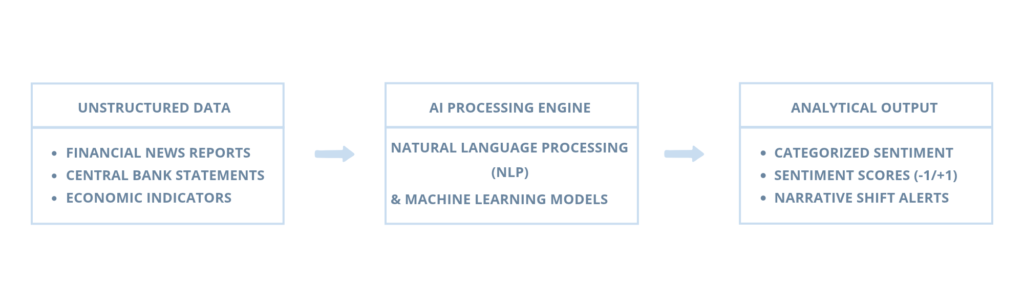
AI market analysis refers to the application of artificial intelligence, machine learning, and natural language processing to evaluate financial data, recognize structural patterns, summarize complex developments, and support market research. Rather than replacing human critical thinking, AI serves as an advanced analytical engine capable of processing structured numbers and unstructured text at a speed and scale that far exceeds human capacity.
How AI Market Analysis Differs from Traditional Market Analysis
Traditional financial analysis generally falls into two core disciplines: technical analysis (evaluating historical price charts, indicators, and volume) and fundamental analysis (examining economic indicators, corporate balance sheets, and macroeconomic conditions).
AI market analysis enhances both disciplines by bridging the gap between quantitative numbers and qualitative narrative. Traditional analysis often relies on scheduled data releases or manual evaluation of news reports. AI-driven systems continuously monitor textual data alongside market metrics, identifying correlations between shifting news coverage and market movements in real time.
The Role of AI Sentiment Analysis in Financial Research
A significant portion of global market movement is driven by expectations, perception, and collective psychology. AI sentiment analysis focuses specifically on evaluating textual and conversational data to quantify the prevailing mood of market participants. By converting qualitative commentary into standardized numerical scores, analysts can measure whether public and professional narrative leans optimistic, pessimistic, or uncertain. To explore how machine learning translates into currency evaluation, see our detailed guide on AI in forex trading.
AI Market Analysis vs. AI Trading Analysis
It is critical to distinguish between analytical evaluation and trading execution:
- AI Market Analysis: Focuses on information processing, narrative tracking, data summarization, and context evaluation. It answers the question: What is happening, and how is the market describing it?
- AI Trading Analysis: Focuses on trade execution models, systematic entry/exit rules, and automated risk management. It answers the question: What action should be taken based on specific parameters?
Key Distinction: Analytical assistance does not automatically mean a system can generate reliable price forecasts or make trade decisions. Information processing is only one component of navigating financial markets.
What Is Market Sentiment, and Why Does It Matter?
At its core, market sentiment represents the aggregate tone, attitude, and expectations of traders, investors, and institutions toward a specific asset, financial sector, or the broader global economy. Markets are not driven solely by static mathematical facts; they are actively driven by how human participants interpret those facts.
Bullish, Bearish, and Neutral Market Sentiment
Market sentiment is commonly categorized into three primary states:
- Bullish Sentiment: Prevailing optimism where participants expect prices to rise, often characterized by strong demand, risk-on behavior, and positive interpretation of news.
- Bearish Sentiment: Prevailing pessimism where participants expect prices to decline, leading to heightened selling pressure, risk-off positioning, and defensive capital allocation.
- Neutral or Uncertain Sentiment: A state of indecision where market participants lack strong conviction, often occurring prior to major economic releases or amidst conflicting macroeconomic signals.
How Expectations and Uncertainty Influence Market Behaviour
Prices in financial markets constantly reflect discounted future expectations. If participants anticipate that a central bank will lower interest rates or that a commodity supply will tighten, prices often adjust before the actual event takes place.
Uncertainty acts as a key catalyst for market volatility. When incoming data conflicts with established consensus, sentiment can shift abruptly, resulting in sharp market re-evaluations even if the underlying asset fundamentals remain unchanged.
Why Positive News Can Coincide with Falling Prices
One of the most counterintuitive aspects of financial markets is that an asset can drop in value immediately following a seemingly positive news release.
Consider an economic growth report showing steady expansion. If analysts had already priced in exceptionally strong growth, a “good” report that falls short of those elevated expectations is viewed as a disappointment. The headline text reads positive, but the market context is negative. Understanding this difference between surface-level language tone and market expectation is crucial when evaluating sentiment analysis outputs.
How Does AI Sentiment Analysis Work?
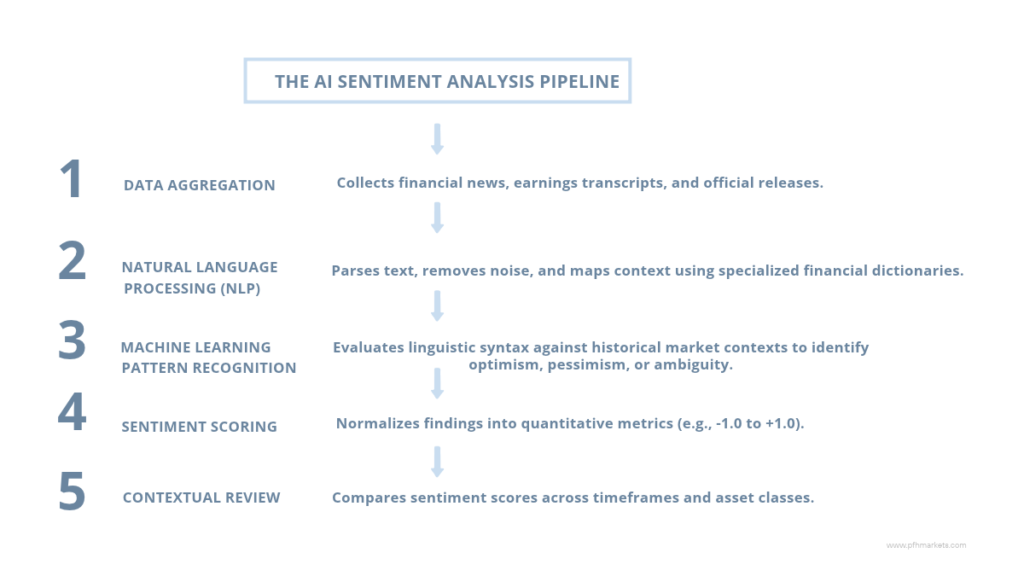
To understand how machines process tone, it helps to examine the underlying technical workflow. AI sentiment analysis translates unstructured language into structured data through a multi-step pipeline.
Collecting Financial News and Sentiment Data
The process begins with automated data collection (ingestion). AI systems ingest text across hundreds of thousands of online sources, including breaking news feeds, central bank policy statements, corporate filings, regulatory disclosures, and public financial forums.
Using Natural Language Processing to Interpret Financial Language
Standard natural language processing (NLP) models trained on everyday conversational language often fail in financial contexts. In general English, words like “liability,” “risk,” or “outperform” carry neutral or non-financial meanings.
Specialized financial NLP models utilize domain-specific dictionaries and language transformers trained on market terminology. For example, an NLP model must understand that “hawkish policy stance” implies a preference for tighter monetary policy, whereas “dovish tone” suggests leaning toward monetary easing.
Applying Machine Learning to Identify Sentiment Patterns
Once the text is parsed, machine learning algorithms evaluate syntactic structure and phrase relationships. Advanced transformer models analyze word sequences rather than isolated vocabulary. This allows the system to evaluate how modifiers alter sentiment distinguishing between “growth exceeded expectations” and “growth barely met revised lower expectations.”
Turning Individual Observations into Sentiment Scores
After parsing an article or statement, the model converts qualitative language into a standardized quantitative metric:
Sentiment Score = (Positive Tokens – Negative Tokens) / Total Contextual Tokens
- Scores near +1.0 indicate extreme positive alignment/optimism.
- Scores near 0.0 indicate neutral or balanced commentary.
- Scores near -1.0 indicate strong negative alignment/pessimism.
Comparing Sentiment Across Assets and Time Periods
A single isolated score provides minimal utility. AI systems establish baselines by tracking sentiment scores over daily, weekly, and monthly timeframes. A sudden shift in a currency’s sentiment score from +0.6 to +0.1 might still represent a positive reading in absolute terms, but the directional change signals a significant cooling of market optimism.
What Data Can AI Use to Understand Market Sentiment?
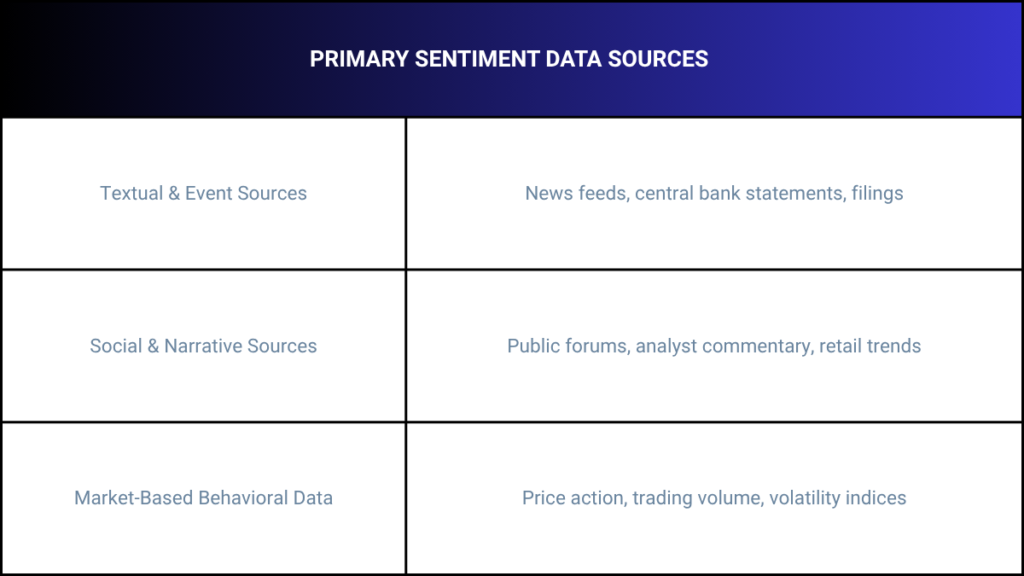
AI systems rely on diverse data streams to build a comprehensive picture of sentiment. Combining distinct data types helps mitigate the blind spots inherent in any single source.
Financial News, Economic Reports, and Official Announcements
Major global publications, central bank policy releases, and government economic updates provide high-authority text. These sources directly reflect official policy direction and institutional reporting, forming the baseline for macro sentiment analysis.
Company Statements and Earnings Commentary
During corporate earnings seasons, AI systems analyze formal financial statements along with executive commentary during earnings calls. The tone used by executives when answering unexpected questions can reveal underlying confidence or concern regarding future operations.
Public Discussions and Social Sentiment
Retail participation and public discussion threads offer insight into broader market enthusiasm or panic. Tracking discussion volume, keyword density, and narrative changes on public message boards provides a view into retail sentiment trends.
Price Movements, Trading Volume, and Volatility
Market sentiment is not established by words alone; observable market behavior reflects capital commitment. AI models combine textual metrics with order flow, trading volume, and volatility metrics (such as historical and implied volatility) to confirm whether language shifts match actual capital positioning.
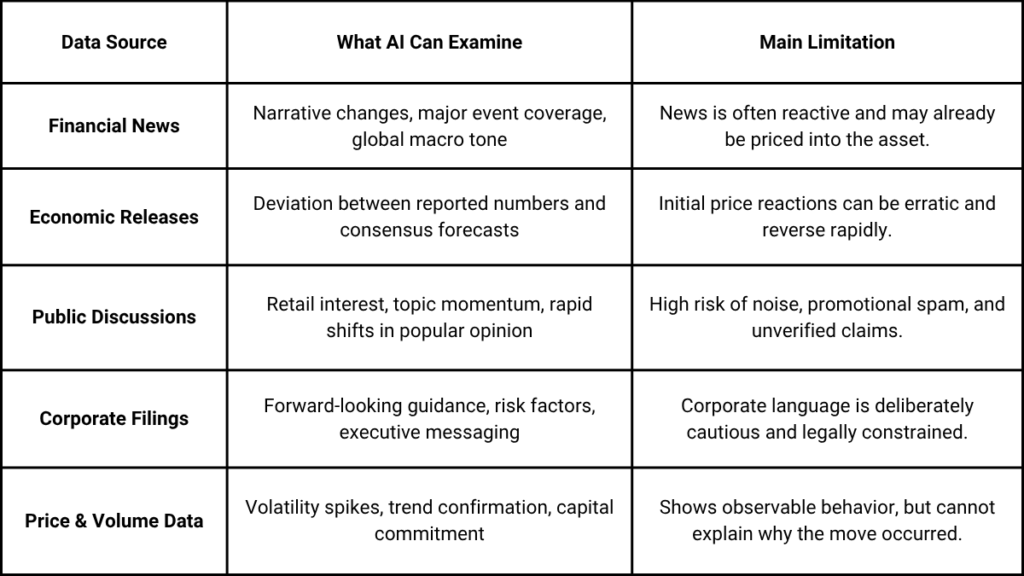
Data Source Comparison
To evaluate sentiment effectively, analysts must recognize what each data source can and cannot establish on its own:
Can Machines Really Understand Market Sentiment?
Addressing this question requires drawing a clear line between pattern recognition and true comprehension.
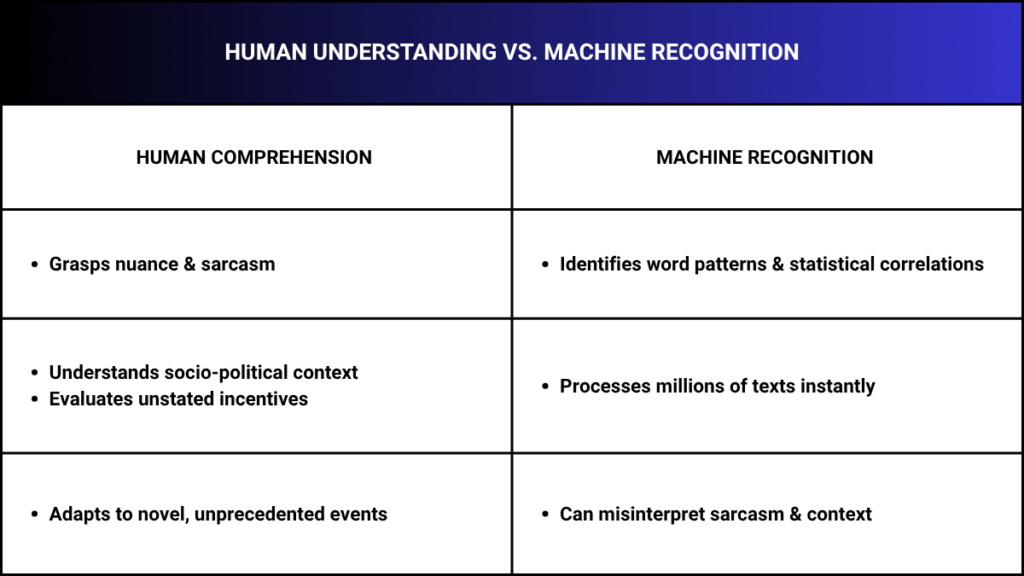
What AI Can Recognise in Financial Language
AI excels at detecting statistical correlations, frequency changes, tone variations, and narrative clusters. It can categorize thousands of news headlines per second into standardized sentiment brackets, identifying subtle shifts in central bank language across multiple years far faster than human researchers.
How Context Changes the Meaning of Market News
Where machines encounter challenges is in contextual evaluation. Consider the phrase: “The central bank raised interest rates to combat persistent inflation.”
- An AI model reading this headline might tag “raised interest rates” and “persistent inflation” as tightening or restrictive language.
- However, if the market was expecting a 50-basis-point increase and the central bank only raised rates by 25 basis points, the human market context is dovish/optimistic for risk assets. The machine risks misinterpreting the market effect if it relies solely on the raw textual tone.
Why Sarcasm, Rumours, and Conflicting Opinions Are Difficult to Interpret
Financial commentary especially on public forums is filled with irony, sarcasm, exaggerated claims, and speculative rumors. A post stating “Great job on those earnings!” published alongside a massive stock decline is clearly sarcastic to a human reader, but an NLP system may register it as positive sentiment unless complex contextual filters are applied.
Detecting Sentiment vs. Predicting Price Movements
A critical error in modern market research is assuming that identifying market sentiment is equivalent to predicting future price movement.
Core Principle: AI can detect signals associated with prevailing optimism or pessimism. It cannot predict market movements with absolute certainty, nor can it reproduce human reasoning. Sentiment is merely one variable among liquidity constraints, macroeconomic forces, and unexpected geopolitical developments.
How AI Market Analysis Can Be Applied Across Financial Markets
A key strength of AI market analysis is its versatility across global asset classes. Because textual data and sentiment drive different dynamics in different sectors, AI systems adapt their focus based on the market being analyzed.
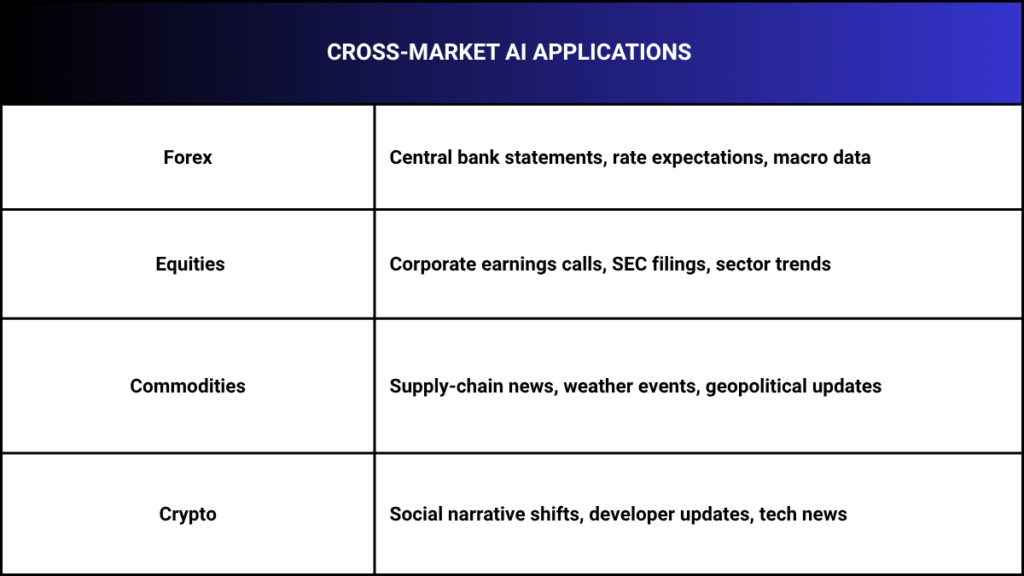
Forex — Central Bank Communications and Economic Expectations
In global currency markets, exchange rates move primarily on macroeconomic interest rate differentials and economic health metrics. AI models parse central bank press releases, policy meeting minutes, and economic speech transcripts to detect subtle hawkish or dovish language shifts before rate decisions occur.
Stocks and Indices — Corporate Earnings and Risk Sentiment
For equity markets, sentiment tools monitor earnings call transcripts, regulatory disclosures, and sector-wide news. An AI system can cross-evaluate executive language across an entire industry sector to gauge whether management teams share systemic concerns regarding input costs or supply chain delays.
Commodities — Supply News, Demand Expectations, and Geopolitics
Commodity markets (such as crude oil, metals, and agricultural products) are sensitive to supply disruptions and geopolitical risks. AI sentiment analysis tracks global news streams for disruptions, shipping bottlenecks, weather anomalies, and trade policy updates to highlight localized supply concerns.
Crypto Assets — Narrative Dynamics and Rapid Sentiment Changes
Digital asset markets operate continuously and are influenced heavily by online narrative velocity, community discussions, and technological updates. AI systems assist analysts by filtering out automated network noise to identify genuine shifts in developer engagement and public sentiment momentum.
A Practical Example of AI Market Sentiment Analysis
To see how an AI-assisted analytical workflow functions in practice, consider a fictional scenario involving an international economic release.
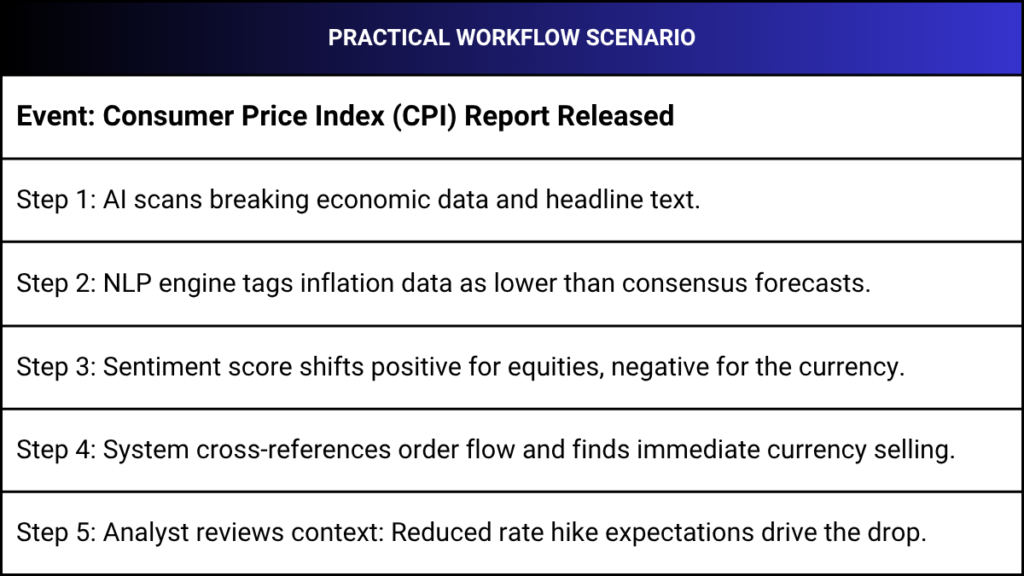
Step 1: Identify an Important Economic Announcement
An international economic agency releases its monthly Consumer Price Index (CPI) report. Analysts want to evaluate how the data compares with baseline market expectations.
Step 2: Analyze Language and Media Coverage
As news wire services publish the report, an AI analytics engine ingests hundreds of articles within seconds. The NLP model parses phrases such as “inflation cools faster than anticipated” and “price pressures ease.”
Step 3: Compare Sentiment with Prior Expectations
The machine calculates a positive sentiment shift score (+0.65) regarding economic relief, but registers a negative sentiment score (-0.40) regarding central bank interest rate expectations.
Step 4: Check Price Behaviour and Volatility
The analyst looks at real-time market behavior: the domestic currency declines sharply against foreign counterparts immediately following the release.
Step 5: Review Findings in Context Before Drawing Conclusions
By combining the AI sentiment output with market context, the analyst understands the movement: while lower inflation is positive for consumers, the market interprets the data as reducing the probability of future interest rate hikes. This rate expectation shift weakens currency demand.
The AI system efficiently classified the text and highlighted the narrative shift, but human interpretation was required to connect the sentiment output with the macroeconomic mechanism.
Benefits and Limitations of AI Financial Analysis
An objective evaluation of AI market analysis requires weighing its capabilities against its structural limitations.
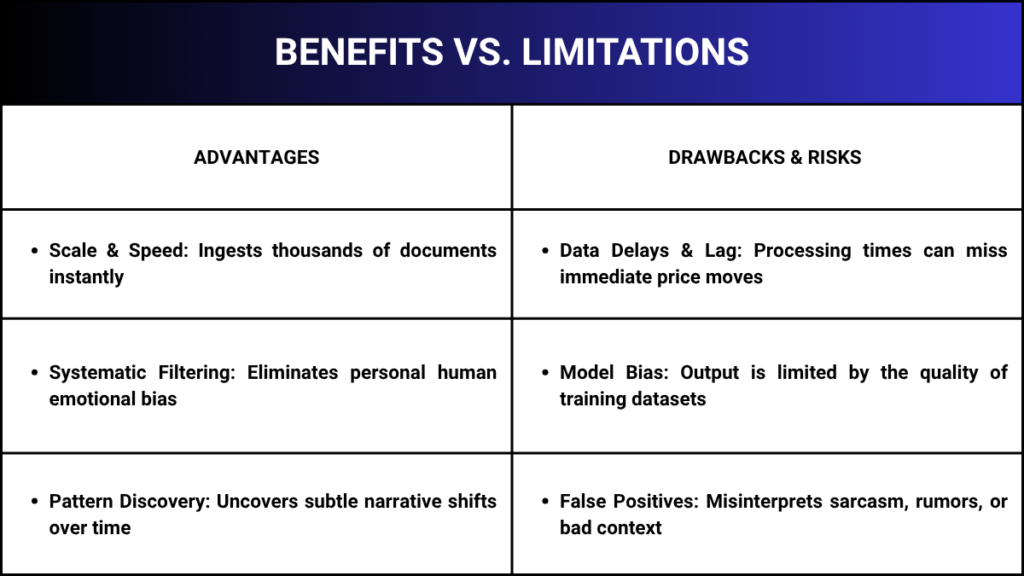
Benefits of AI Market Analysis
- Scale and Speed: AI systems can monitor global news streams, financial reporting, and social commentary across multiple languages concurrently.
- Consistency: Automated models apply identical evaluation rules to every text file, eliminating human fatigue and personal confirmation bias.
- Pattern Discovery: Machine learning can identify complex linguistic patterns across historical datasets that human analysts might miss.
Limitations of AI Market Analysis
- Data Delays and Latency: Text aggregation and NLP processing take time. By the time an AI sentiment score registers a news shift, high-frequency institutional trading algorithms may have already priced the event into the market.
- False Positives and Hallucinations: AI models can misinterpret complex double negatives, sarcasm, or sensationalist media headlines, resulting in skewed sentiment scores.
- Changing Market Relationships: Market dynamics evolve. Historical relationships between news sentiment and asset movements can break down completely during economic regime shifts or unprecedented geopolitical crises.
How Traders Can Use AI Market Analysis Responsibly
To incorporate AI-derived sentiment data effectively into market research, participants should follow a structured, disciplined methodology:
- Define the Analytical Purpose: Determine clearly what you are evaluating—such as short-term news sentiment vs. multi-month macroeconomic trends—before consulting sentiment metrics.
- Verify Against Original Sources: Never rely exclusively on an AI-generated text summary. Always review the original press release, earnings transcript, or official statement to confirm the context.
- Cross-Reference Sentiment with Market Behavior: Compare sentiment output directly with price structure, volume, and support/resistance levels. If sentiment metrics are strongly bullish but price action is breaking lower, re-evaluate your thesis.
- Explore Available Analytical Features: Sentiment scoring is just one component of quantitative technology. You can examine broader market software features in our breakdown of AI trading tools.
- Search for Contradictory Evidence: Actively look for data points that challenge the dominant AI narrative. Identify whether the consensus view is overly crowded.
- Maintain Independent Risk Controls: Treat AI sentiment readings as secondary informational inputs rather than trade signals. Position sizing and risk parameters must remain independent of analytical sentiment scores.
How AI Market Analysis Is Evolving: From Tools to AI Agents
Trading technology continues to advance rapidly. The landscape is shifting from standalone informational tools toward integrated, multi-step analytical workflows.
Early AI applications functioned purely as specialized tools—summarizing single documents or evaluating localized sentiment scores. Modern developments focus on autonomous analytical agents capable of executing multi-step research workflows. An advanced research workflow can now automatically pull breaking news, query historical database metrics, run cross-asset correlations, and synthesize a contextual briefing report for human review.
To understand how research workflows are transitioning from simple analytical assistants to fully autonomous workflows, see our guide on AI agents in trading.
FAQ
How does AI sentiment analysis work?
AI sentiment analysis collects unstructured text from news releases, corporate filings, and media sources. Using natural language processing models, it parses the language, evaluates the context, and converts qualitative tone into standardized numerical sentiment scores.
Can AI predict market movements from sentiment?
No. AI sentiment analysis identifies language patterns and measures prevailing market tone, but it cannot predict future price movements with certainty. Market prices are influenced by multiple variables beyond textual sentiment, including order flow and macroeconomic conditions.
What data does AI use to analyze market sentiment?
AI models ingest diverse data types, including financial news feeds, central bank policy statements, corporate earnings transcripts, public message board discussions, and observable price and volume metrics.
Is AI market analysis suitable for beginners?
Yes, provided it is used as an educational and research assistance tool. Beginners can use AI summaries to parse complex financial reports quickly, but should not rely on sentiment outputs as direct financial advice or trade triggers.
Can AI sentiment analysis be used across different financial markets?
Yes. AI sentiment analysis is applied globally across foreign exchange (forex), equities, stock indices, physical commodities, and digital assets, with models customized to reflect the unique language and drivers of each market.
Conclusion: AI Can Read Signals, but Context Still Matters
Artificial intelligence has transformed how market participants process financial information. By turning vast volumes of unstructured text into quantifiable sentiment metrics, AI market analysis enables researchers to evaluate global narrative shifts with unprecedented speed and scale.
However, machines do not possess human context, emotional intuition, or an understanding of unstated market dynamics. A positive headline does not guarantee rising prices, and a sentiment score cannot substitute for comprehensive risk management.
Ultimately, AI market analysis is most effective when used as a complementary tool—combining automated data processing with rigorous human interpretation, sound fundamental analysis, and disciplined risk management.
Risk Disclaimer
This article is provided for educational and informational purposes only and does not constitute financial, investment, or trading advice. Financial trading involves substantial risk of loss and is not suitable for every investor. Past performance of analytical models or market sentiment metrics is not indicative of future results. Always conduct independent research and consult with a qualified financial advisor before making market decisions.