

Interest rates differ between countries, and these differences can influence how traders position themselves in the foreign exchange market. When one country offers a significantly higher interest rate than another, capital often moves toward the higher-yielding asset. In foreign exchange, traders use higher-yielding and lower-yielding currencies to attempt to capture this yield gap a concept central to the carry trade.
A carry trade in forex attempts to achieve returns by taking advantage of the interest rate differential between two currencies while holding a position over time. However, this strategy is not simply about collecting yield; exchange rate movements, central bank policies, and overnight financing costs can substantially affect the overall outcome.
This guide breaks down how a carry trade strategy works, the role of interest rate differentials, how central banks influence market sentiment, and the critical risks traders must manage.
What Is a Carry Trade in Forex?
A carry trade in forex is an investment strategy where a trader sells or borrows a currency with a lower interest rate to purchase a currency with a higher interest rate. The primary goal is to capture the difference between the two interest rates while holding the trading position.
Understanding the Two Currencies in a Carry Trade
Every currency carry trade involves two specific types of currencies:
- Funding Currency: The currency with the relatively lower interest rate. Borrowing or selling this currency incurs a lower interest cost.
- Target (Investment) Currency: The currency with the relatively higher interest rate. Holding this currency offers the potential for higher yield returns.
By selling the funding currency to buy the target currency, a trader establishes a net long position in the higher-yielding asset.
[ Funding Currency ] —> Sells / Borrows (Lower Yield)
[ Target Currency ] —> Buys / Holds (Higher Yield)
Why Interest Rate Differences Matter
Yield differences act as a fundamental driver of international capital flows. Institutional investors, hedge funds, and retail traders actively seek environments where capital can work more productively. When a central bank maintains higher interest rates, it can attract global capital seeking better yields, increasing demand for that national currency. Conversely, economies with near-zero or negative interest rates often serve as capital sources for international investments.
How Does a Carry Trade Strategy Work?
Executing a forex carry trade follows a structured macroeconomic and technical process:
- Identify Interest Rate Differentials: Locate two economies with a noticeable gap in their benchmark interest rates.
- Select the Funding Currency: Choose a currency backed by a central bank with a low, stable interest rate policy.
- Identify the Target Currency: Choose a currency backed by a central bank with higher interest rates and stable economic fundamentals.
- Establish the Exposure: Open a long position in the target currency paired against the funding currency.
- Account for Rollover Adjustments: Receive or pay overnight financing adjustments (swap rates) for each day the position remains open.
- Monitor Macroeconomic Shifts: Track central bank forward guidance, economic data, and exchange rate fluctuations to protect the position.
What Is an Interest Rate Differential?
The interest rate differential is the absolute difference between the central bank benchmark interest rates of two different countries.
Interest Rate Differential = Higher Interest Rate – Lower Interest Rate
While a wider differential creates a larger yield gap, a larger differential does not automatically guarantee higher trading profitability. Unforeseen exchange rate movements can easily overshadow short-term yield gains.
How Do Traders Earn From a Carry Trade?
The final return on a carry trade strategy relies on two primary contributors:
- Interest Income (Positive Rollover): The net positive financing credit credited to the trading account for holding the higher-yielding currency overnight.
- Capital Appreciation: An increase in the value of the target currency relative to the funding currency over the holding period.
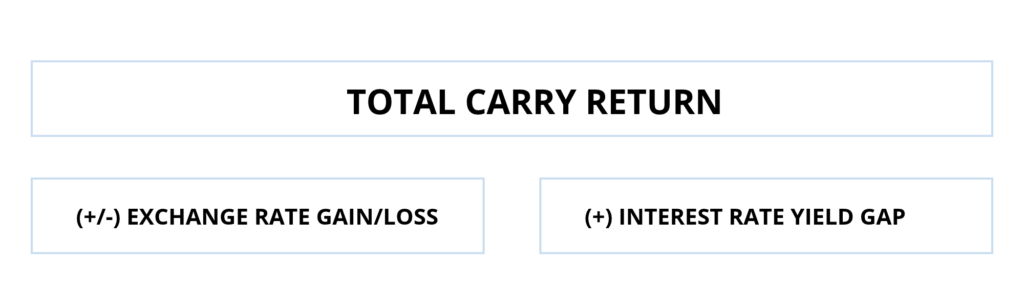
If the target currency depreciates against the funding currency, the exchange rate loss can exceed the total interest income earned, resulting in a net loss.
Carry Trade Example: Understanding Interest Rate Differences
To illustrate how a carry trade operates in practice, consider the following hypothetical scenario between two economic regions:
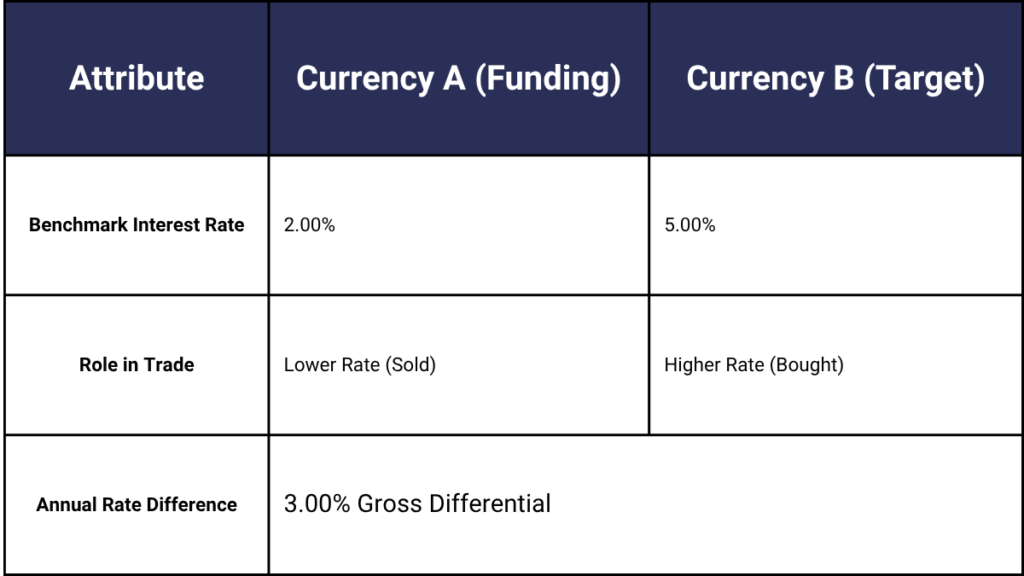
Note: This 3% represents an illustrative annual rate difference before transaction fees, rollover adjustments, leverage, and currency price movements.
Step-by-Step Carry Trade Calculation
- Position Setup: The trader opens a buy position on Currency B against Currency A (Pair B/A).
- Gross Yield Gap: The base interest rate gap is calculated as:
5.00% – 2.00% = 3.00% per annum - Daily Rollover Impact: The annual 3.00% yield is converted to a daily credit applied to the position while open overnight.
- Exchange Rate Realization: The final outcome depends on the currency pair’s exchange rate when the trade is closed.
What Happens If the Target Currency Appreciates or Depreciates?
- Scenario 1: Target Currency Appreciates (+2%)
- Interest yield (+3%) + Capital appreciation (+2%) = +5% Gross Return
- Scenario 2: Target Currency Remains Flat (0%)
- Interest yield (+3%) + Capital appreciation (0%) = +3% Gross Return
- Scenario 3: Target Currency Depreciates (-5%)
- Interest yield (+3%) – Capital depreciation (-5%) = -2% Gross Loss
What Is the Role of Central Banks in Carry Trades?
Central banks set benchmark interest rates to manage domestic inflation, employment, and economic growth. Because monetary policy dictates national borrowing costs, decisions made by institutions like the Federal Reserve, the European Central Bank, or the Bank of Japan directly shape carry trade environments.
How Interest Rate Hikes Affect Carry Trades
When a central bank raises its policy rate, it widens the yield gap relative to low-interest economies. This often increases the target currency’s appeal, driving capital inflows as market participants adjust positions to capture higher yields. Furthermore, financial markets frequently price in anticipated rate hikes well before official policy announcements occur.
How Interest Rate Cuts Affect Carry Trades
When a central bank reduces policy rates, the interest rate differential narrows. Lower yields reduce the economic incentive to maintain long carry positions. As the yield benefit diminishes, market participants may unwind existing positions, leading to capital outflows and potential downward pressure on the target currency.
Why Interest Rate Expectations Matter
Currency markets operate on forward-looking expectations. Traders closely monitor economic indicators including Consumer Price Index (CPI) releases, Gross Domestic Product (GDP) growth, and employment statistics alongside central bank forward guidance. If markets anticipate an upcoming rate shift, exchange rates adjust dynamically prior to the formal rate decision.
How Carry Trades Influence Currency Markets
Individual carry trades aggregate into substantial institutional capital flows that can influence broad forex market dynamics.
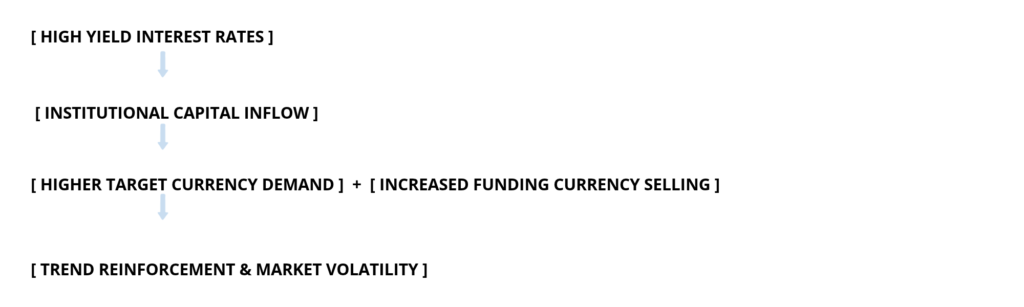
The Relationship Between Carry Trades and Currency Demand
Persistent demand for target currencies can reinforce medium- and long-term currency trends. As capital moves into higher-yielding assets, sustained buying pressure can strengthen the target currency while sustained selling pressure weighs on the funding currency.
What Happens When Carry Trades Are Unwound?
During periods of global economic uncertainty, market volatility, or rapid shifts in central bank policy, investors often exit carry trade positions simultaneously a process known as carry trade unwinding.
To unwind a carry trade, market participants must:
- Sell their holdings in the higher-yielding target currency.
- Repurchase the lower-yielding funding currency to settle underlying obligations.
This sudden reallocation can trigger rapid price movements, sharply appreciating the funding currency while causing the target currency to decline rapidly.
Which Currency Pairs Are Commonly Associated With Carry Trades?
When selecting pairs for carry trades, traders evaluate national economic conditions, liquidity, and policy trajectories rather than focusing on yield alone.
Characteristics of Potential Carry Trade Currency Pairs
- Pronounced Interest Rate Gap: A clear, stable gap between the two underlying benchmark rates.
- Macroeconomic Stability: Low inflation risk and sound fiscal fundamentals in the target economy.
- High Market Liquidity: Sufficient trading volume to ensure efficient order execution and manageable spreads.
- Predictable Central Bank Trajectories: Transparent forward guidance regarding future policy direction.
Currency pair suitability is dynamic. Historically low-yielding currencies can enter rate-hiking cycles, while high-yielding economies may cut rates sharply. Funding and target roles adjust alongside changing global economic cycles. For a detailed guide on structural pair classifications, refer to our overview of understanding different forex currency pairs
How Does Rollover Interest Affect a Forex Carry Trade?
While economic interest rate differentials provide the macroeconomic foundation, practical carry trade execution relies on rollover interest (also known as swap rates).
Positive vs. Negative Rollover
- Positive Rollover (Swap Credit): Applied when you hold a net long position in a currency with a higher interest rate relative to the currency sold. Your trading account receives an overnight financing credit.
- Negative Rollover (Swap Charge): Applied when you hold a position where the currency bought pays a lower rate than the currency sold. Your account incurs an overnight financing debit.
Interest Rate Differentials vs. Swap Rates
It is essential to distinguish between central bank benchmark rates and retail trading swap rates:
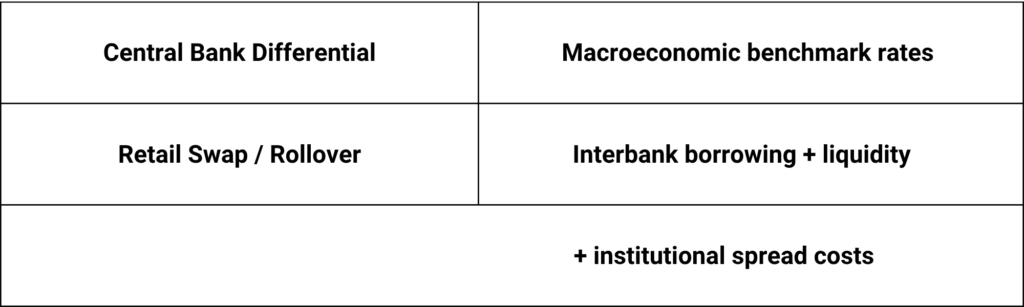
Swap rates reflect interbank borrowing costs, market liquidity conditions, broker administrative fees, and market volatility. Consequently, daily rollover adjustments may not match theoretical benchmark calculations exactly. Furthermore, rollover rates typically follow a triple-swap schedule on Wednesdays to account for weekend settlement cycles.
What Are the Major Risks of a Carry Trade Strategy?
Understanding carry trade risks is critical for maintaining balanced capital management.
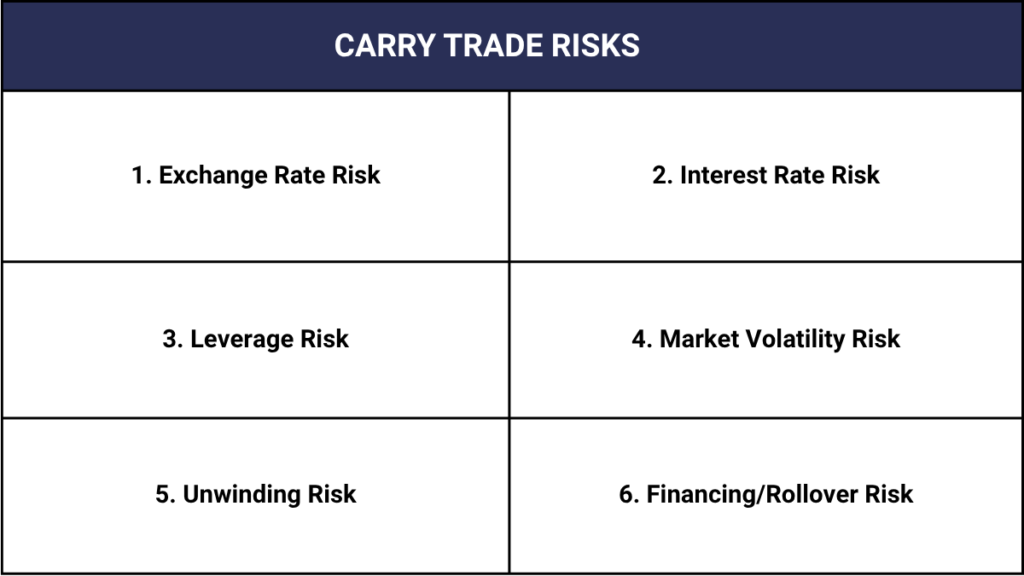
1. Exchange Rate Risk
Exchange rate volatility is the primary risk in carry trading. An adverse movement in price can easily offset accumulated yield gains.
2. Interest Rate Risk
Central bank policy shifts can narrow rate differentials, reducing expected returns and altering market positioning.
3. Leverage Risk
Leverage amplifies both gains and losses. While leverage increases net yield relative to deposited margin, it equally accelerates capital losses if exchange rates move unfavorably.
4. Market Volatility Risk
Global risk-averse environments often prompt investors to retreat from yield-seeking strategies toward safe-haven assets, increasing price volatility across target currencies.
5. Carry Trade Unwinding Risk
Simultaneous position unwinding by major market participants can cause rapid exchange rate swings, increasing slippage and drawdown risk.
6. Financing and Rollover Risk
Variable swap rates and changing interbank liquidity can alter daily holding costs over extended periods.
How Can Traders Evaluate a Carry Trade Opportunity?
A structured analytical framework helps traders evaluate carry opportunities objectively:
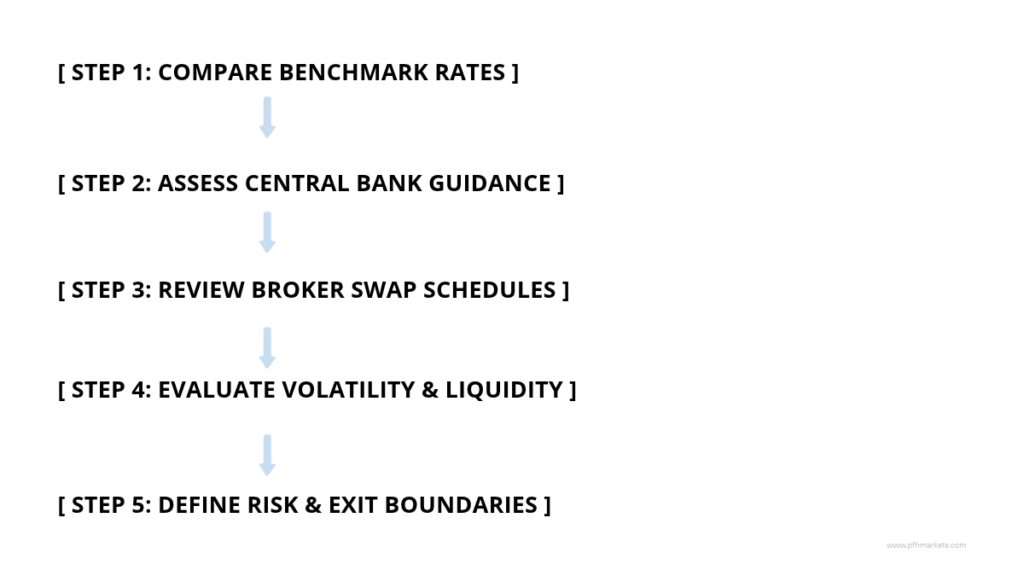
- Analyze Policy Direction: Ensure central bank policies favor a stable or widening interest rate differential. Read more on how interest rate decisions affect forex markets to understand broader central bank mechanics.
- Check Effective Swap Rates: Review current rollover tables rather than relying solely on central bank benchmark numbers.
- Assess Volatility: Check historical price stability to confirm potential price swings remain within acceptable risk parameters.
- Manage Leverage Exposure: Maintain lower leverage ratios to withstand standard market pullbacks without risking margin stress.
- Establish Clear Risk Parameters: Set defined stop-loss levels and exit conditions to manage downside risk during periods of sudden market stress.
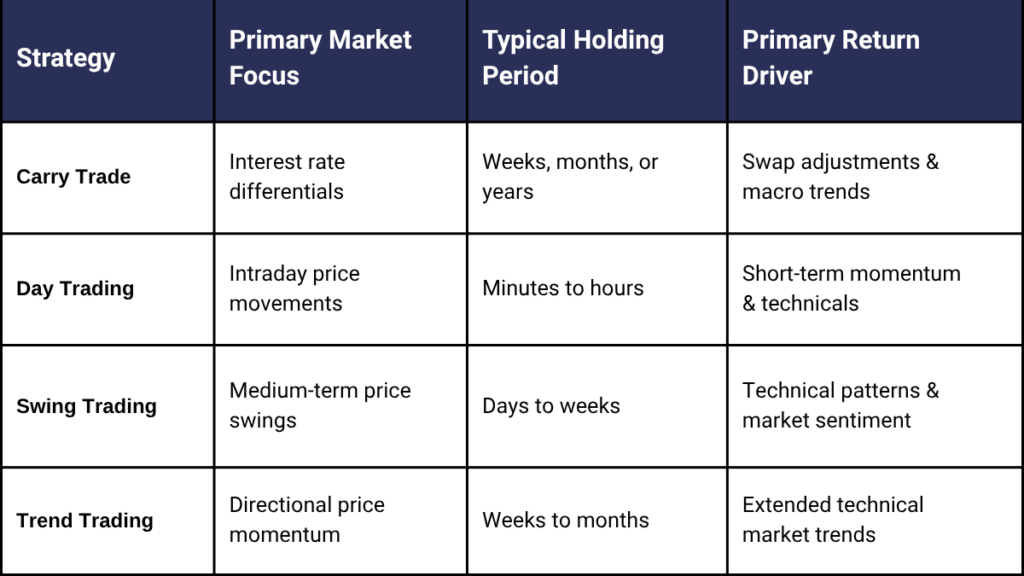
Carry Trade vs. Other Forex Trading Strategies
Carry trading differs fundamentally from technical or short-term trading methods in its approach, duration, and underlying drivers:
Is a Carry Trade Strategy Suitable for Every Forex Trader?
Carry trading requires patience, an understanding of global macroeconomic trends, and careful risk management. Because positions are typically held over long horizons, accounts are exposed to extended market fluctuations and overnight financing adjustments. Positive carry does not guarantee overall trading profits; sustainable performance depends on managing exchange rate risk alongside yield accumulation.
FAQ
How does a carry trade work in forex?
Traders take a long position in a currency paying a higher yield paired against a currency paying a lower yield, receiving daily rollover adjustments while managing price fluctuation risks.
What is an interest rate differential in carry trading?
It is the percentage gap between the policy interest rates of two central banks in a currency pair.
How do traders make money from carry trades?
Returns come from positive overnight rollover adjustments (swap credits) and capital gains if the target currency appreciates against the funding currency.
What is a funding currency in a carry trade?
The funding currency is the currency with lower benchmark interest rates that is sold or borrowed to finance the trade.
What is rollover interest in forex?
Rollover interest (or swap) is the credit or debit applied to a trader’s account for holding a leveraged position past the market daily close.
Can a carry trade result in losses?
Yes. If the higher-yielding target currency depreciates significantly against the funding currency, exchange rate losses can exceed any earned interest.
How do central bank decisions affect carry trades?
Rate hikes widen interest rate differentials and can attract carry positions, whereas rate cuts narrow the yield gap and may reduce trade appeal.
What happens when a carry trade is unwound?
Traders exit positions simultaneously by selling the target currency and repurchasing the funding currency, often causing rapid shifts in market exchange rates.
Is carry trading suitable for beginners?
While the core concept is straightforward, managing leverage, central bank shifts, and exchange rate volatility requires thorough risk planning.
Understanding Carry Trades Beyond Interest Rate Differences
Carry trading links central bank monetary policies directly with practical currency trading. While capturing yield gaps is a central feature of the strategy, long-term outcomes depend on managing macroeconomic trends, overnight financing terms, and exchange rate movements.
By pairing clear risk limits with an understanding of economic fundamentals, traders can evaluate yield opportunities while protecting capital. To continue building your market knowledge, explore the PFH Markets Forex Hub for deeper insights into global currency dynamics.