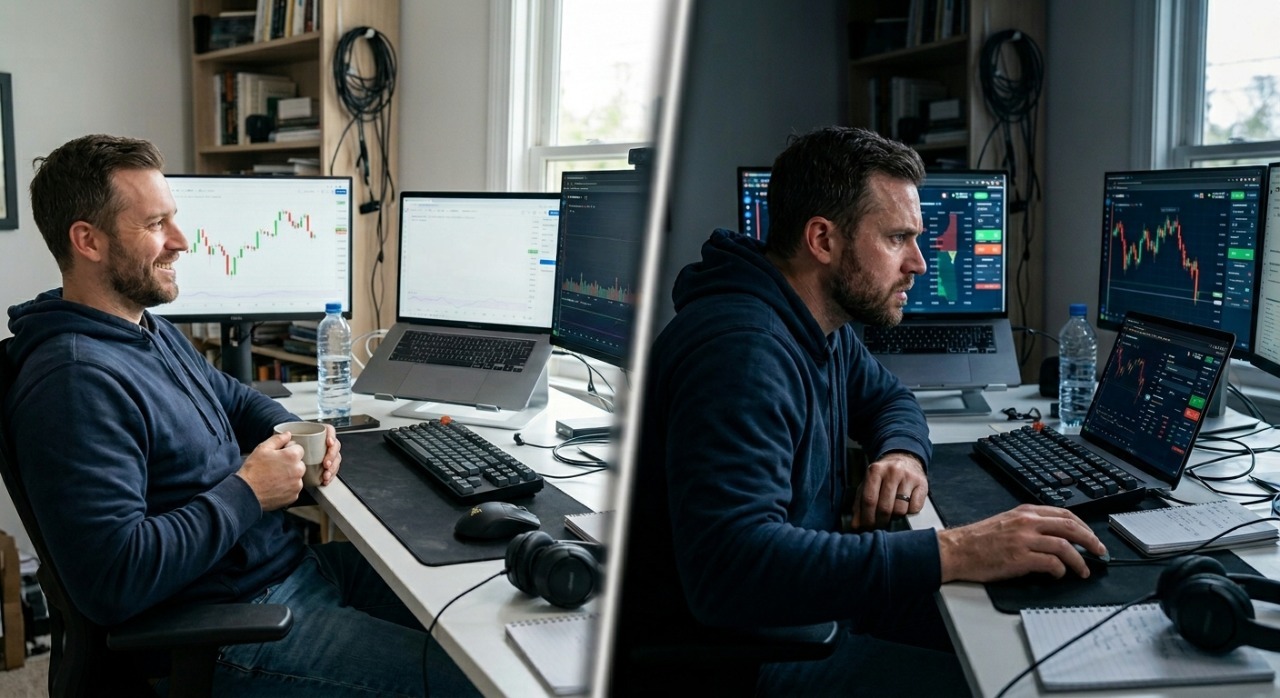
Many traders become consistently profitable on demo accounts only to struggle significantly when they move to live markets. The strategy is identical. The setups are the same. The rules have not changed. Yet somehow, the results are completely different. If this experience sounds familiar, you are not alone. The reasons behind this shift are both well understood and entirely addressable.
The gap between demo vs live trading performance is one of the most common and consequential challenges traders face globally. It is not a strategy problem, nor is it a market knowledge problem. In the vast majority of cases, it is a psychological problem. Real execution differences, risk management breakdowns, and decision-making pressures compound this issue because they simply do not exist when virtual capital is at stake.
In this comprehensive guide, we will explore every dimension of the demo vs live trading divide. We will examine the psychological forces that alter behavior when real money is on the line. Additionally, we will look at the execution differences that change results in live account trading and the risk management breakdowns that undermine sound strategies. Most importantly, you will find practical steps to transition from demo success to live consistency.
By the end of this guide, you will understand not just why demo vs live trading performance diverges, but exactly what to do about it.
What Is Demo Trading?
Demo trading is a simulated environment provided by brokers and trading platforms. It allows traders to practice executing trades, test strategies, and learn platform functionality without risking real capital. The platform grants virtual money for all positions typically a preset balance of $10,000 to $100,000 so all profits and losses exist only within the simulation.
Demo trading serves several genuinely valuable purposes in a trader’s development journey:
- Risk-Free Testing: It provides a safe environment for strategy testing. Traders can evaluate whether a particular approach produces consistent results before committing real capital.
- Platform Familiarity: It ensures users understand order types, chart tools, and execution mechanics. This prevents pressure-driven, costly operational mistakes later on.
- Pattern Recognition: It allows systematic market observation, helping traders understand how different instruments behave across sessions.
For new traders, this structured practice represents an essential developmental stage that no one should rush or skip.
The Critical Limitation: The psychological conditions of demo trading differ so fundamentally from live account trading that demo performance is a limited predictor of live success. Most educators fail to address this honestly.
What Is Live Account Trading?
Live account trading means deploying real capital in actual market conditions. Every position taken involves genuine financial risk. Every profit represents real money gained, and every loss represents real money surrendered. This presence of real financial consequences transforms the entire psychological landscape of trading in ways that no simulation can replicate.
In live account trading, execution occurs in the real market environment. This space is subject to actual spreads, real liquidity conditions, genuine slippage, and complex order routing through live broker infrastructure. Unlike the idealized execution environment of most demo platforms, live account trading exposes every trade to real-world friction.
Most importantly, live trading creates a completely different decision-making environment. When a trade moves against a position and real capital is at risk, the psychological pressure generates fear, greed, hesitation, and revenge trading. These emotions become neurologically real in a way that virtual losses never produce. This is the central reality that every trader must understand before making the transition.
Demo vs Live Trading — Key Differences
The following comparison captures the most significant dimensions of the demo vs live trading divide across the variables that matter most:
| Factor | Demo Trading | Live Trading |
| Capital Risk | Virtual money only | Real capital at stake |
| Emotional Pressure | Minimal | High and immediate |
| Execution Quality | Simulated — often idealized | Market-based — subject to slippage |
| Spread Conditions | Often fixed and narrow | Variable — widens during volatility |
| Discipline | Easier to maintain | Harder under financial pressure |
| Decision Speed | Relaxed — no financial urgency | Pressure-driven — fear and greed activated |
| Risk Management | Followed more consistently | Frequently broken under emotional stress |
| Performance Anxiety | Absent | Present and often performance-impairing |
| Revenge Trading | Rare — no real loss pain | Common after real capital losses |
This table illustrates why moving to a live account is not simply a matter of shifting the same activity to a new environment. It is a fundamentally different experience that demands specific preparation and adaptation.
The Psychology Difference That Changes Performance
The psychological gap is the primary reason that consistent demo performance does not automatically translate to live results. Traders must understand each psychological mechanism individually to manage them systematically.
Fear of Losing Real Money
In demo trading, losses are abstract. A $500 loss on a demo account produces mild disappointment at most because no real financial consequence follows. In live account trading, that same $500 loss represents a loss of actual purchasing power. For most beginners, this reality triggers a fear response that directly impacts execution quality.
Fear manifests most commonly as hesitation at the entry point. Traders wait for additional confirmation even when the strategy criteria are met. It also produces early exits from winning trades because the fear of watching a profitable trade reverse becomes overwhelming. Finally, it causes traders to avoid valid setups entirely when recent losses create an association between trading and pain.
Greed and Overconfidence
Greed operates with equal destructive force. When a series of winning trades creates confidence, temptation takes over. Traders quickly increase position sizes beyond planned parameters, take sub-optimal setups, and hold winning trades past logical exit levels.
Overconfidence after demo success is a particularly common pitfall. Many traders enter live account trading implicitly believing their results will transfer directly. When early live trades produce normal, statistical losses, the gap between expectation and reality triggers a dangerous “doubling-down” response.
Revenge Trading
Revenge trading is the impulse to recover losses immediately through larger, faster, less considered trades. This is one of the most destructive psychological patterns in live trading. Because demo losses carry no real financial consequences, the emotional urgency that drives revenge trading simply does not arise in a simulation.
In live trading, a significant loss creates genuine financial pain. The mind urgently wants to resolve this discomfort. The path of least psychological resistance is to take another trade—often larger and less selective than the first. This pattern systematically compounds drawdowns and destroys accounts.
Performance Anxiety
When real capital is at stake, many traders experience intense self-consciousness. This performance anxiety manifests as second-guessing valid setups, seeking excessive validation, and abandoning system rules. It creates a paradoxical situation where the desperate desire to perform well actively prevents the disciplined execution required to do so.
Execution Differences Between Demo and Live Markets
Beyond psychology, genuine technical differences between demo and live execution contribute meaningfully to the performance gap.
Slippage in Live Trading
Slippage is the difference between the price at which you submit an order and the price at which the broker actually executes it. Most demo platforms fill orders at the exact price displayed on the screen, creating an idealized environment.
In live account trading, orders are frequently filled at less favorable prices during volatile market conditions, high-impact news releases, or periods of reduced liquidity. This slippage accumulates across multiple trades, creating a performance drag that demo testing never captured.
Read our comprehensive guide on slippage in trading to understand exactly how order execution differences affect real-world profitability.
Spread Changes in Live Conditions
Demo trading platforms typically display fixed, narrow spreads that represent perfect market conditions. In live markets, spreads are variable. They widen significantly during news events, session transitions, and periods of reduced liquidity. This variability creates a much higher cost structure.
If you calibrate your strategy on demo spreads, wider live spreads can easily erode your profit margins. Scalping strategies suffer the most here; a spread widening from 2 pips to 5 pips can eliminate the entire planned profit of a trade.
Learn more about spread widening and how variable spread conditions in live account trading differ from simulated environments.
Order Execution Speed
Latency is another hidden factor. Demo platforms typically simulate instantaneous execution. Live account trading, however, involves real network latency, broker processing time, and exchange routing delays. For time-sensitive strategies like scalping or news trading, this delay can have a measurable, negative impact on your fill quality.
Why Risk Management Often Breaks Down in Live Trading
The most technically sound risk management framework can quickly fall apart under the psychological pressure of live trading.
- Position Sizing Mistakes: In demo trading, following a strict 1–2% risk rule is straightforward. In live trading, the temptation to increase size after a “perfect” setup—or to drastically reduce size after a losing streak—creates volatile consistency.
- Moving Stop Losses: Moving stop losses further away to avoid taking a loss is an incredibly damaging habit. This behavior is rare in demo trading where loss acceptance is easy, but common in live trading where accepting a loss means surrendering real cash.
- Closing Winners Too Early: The fear of watching a green trade turn red causes traders to exit profitable positions prematurely. This cuts their average win size short, destroying the system’s mathematical edge.
- Holding Losing Trades Too Long: An emotional attachment to losing positions causes traders to hold losses far past their planned exit. The desire to “be right” transforms a small, controlled loss into an account-threatening disaster.
How Order Types Affect Demo vs Live Trading Results
Your choice of order type has massive implications for execution quality in live markets:
- Market Orders: These execute at the best available price at that exact microsecond. They are highly susceptible to slippage during volatile conditions, an issue demo platforms usually mask.
- Limit Orders: These execute only at your specified price or better. This eliminates slippage risk entirely, but introduces the risk that the market leaves you behind without a fill.
- Stop Orders: These trigger a market order when the price hits a specific level. They combine guaranteed execution with full exposure to slippage.
- Stop-Limit Orders: These trigger a limit order at a specified price. They provide excellent slippage protection, but you risk non-execution if the market moves too quickly.
Explore our comprehensive guide on order types in trading to understand how execution methods affect your fill quality across different market conditions.
Does Strategy Performance Change Between Demo and Live?
The honest answer is yes, often significantly. However, the degree of change depends heavily on your trading style:
Scalping Strategies
Scalpers suffer the most during the transition. The razor-thin profit margins of scalping are incredibly vulnerable to real-world execution costs like slippage, spread widening, and latency. A strategy that looks like a money-printer on demo may turn net-negative in live conditions.
Swing Trading Strategies
Swing traders are generally less affected by technical execution differences because their larger profit targets easily absorb minor execution costs. Instead, the psychological dimension—such as fear and premature exits—poses the greatest threat to swing trading success.
News Trading
News trading is often completely unviable when moving from demo to live. The extreme slippage, massive spread widening, and execution delays that characterize high-impact news releases are almost never simulated accurately on demo accounts.
Algorithmic Systems
Algorithmic systems face unique challenges. The execution assumptions built into backtesting frequently fail in live markets. Real-world latency and variable spreads combine to create an environment where the algorithm performs far differently than it did in testing.
Social and Copy Trading — Demo vs Live Behaviour
The performance gap creates a specific dynamic in social and copy trading environments. In demo copy trading, following another trader’s signals feels low-stakes. The follower has nothing to lose, so they apply very little critical evaluation.
When real capital is on the line, the psychological relationship changes completely. Abstract losses suddenly become real, painful financial hits. This pain often triggers emotional responses, leading followers to manually close trades early, override stop losses, or abandon strategies mid-drawdown. This behavior breaks the long-term math of the strategy they are copying.
Read our complete guide on copy trading explained to understand the full risk, performance implications, and psychological dynamics of social trading.
Signs You Are Ready to Move From Demo to Live Trading
Moving to live trading should be a deliberate, data-driven decision rather than a choice born out of impatience. Review this checklist before making the switch:
| Readiness Indicator | Status |
| Following your trading plan consistently for 2–3 months | Yes / No |
| Managing demo losses calmly without revenge trading | Yes / No |
| Maintaining a detailed trading journal for every session | Yes / No |
| Respecting stop-loss rules without moving them | Yes / No |
| Producing consistent positive results across changing market conditions | Yes / No |
| Understanding your strategy’s win rate and trade expectancy | Yes / No |
| Completing trades without emotional interference on entries and exits | Yes / No |
If you cannot honestly answer “Yes” to the majority of these indicators, continue demo trading. Focus heavily on your unresolved areas. Moving to live trading prematurely is one of the costliest mistakes a trader can make.
How to Transition From Demo to Live Without Losing Confidence
To protect your capital and your mindset, treat the transition as a gradual, structured process.
1. Start With Small Position Sizes
Begin live trading with position sizes that are only 10% to 25% of your planned full allocation. This strategy limits financial exposure while you adjust psychologically. It keeps the real money at risk small enough that your emotional responses remain manageable rather than overwhelming.
2. Focus on Process Over Profit
The transition period is not about making millions; it is about proving your processes work under real pressure. Evaluate each session based on execution criteria. Ask yourself: Did I follow the checklist? Did I respect the stop loss? Did I maintain position sizing discipline? ### 3. Use Realistic Risk Limits
Apply the exact same risk management parameters that worked on your demo account. Keep a 1–2% maximum risk per trade, a strict daily loss limit, and a maximum trade cap per session to protect your account during early emotional hurdles.
4. Track Emotional Triggers
Keep a detailed log of your emotional states before rule breaks. Identifying these psychological patterns through tracking allows you to implement structural rules to fix them before they become permanent, bad habits.
5. Review Execution Quality
Compare your intended entry prices with your actual fill prices. Collecting this empirical data allows you to adjust your strategy parameters, stop distances, and profit targets to account for real market friction.
Common Mistakes Traders Make When Going Live
Recognizing these classic pitfalls in advance will significantly reduce your chances of falling into them:
- Trading Too Large: Increasing position size too quickly because early trades feel familiar. This completely removes your risk buffer.
- Overtrading: Taking trades outside your system’s criteria due to an urgent desire to make real money. This introduces negative expectancy trades that dilute your edge.
- Ignoring Market Conditions: Applying demo strategies to live environments without adjusting for different volatility regimes, sessions, and liquidity drops.
- Changing Strategies Too Quickly: Abandoning a validated approach after a completely normal losing streak before your sample size is large enough to yield meaningful conclusions.
- Comparing Results: Measuring your progress against the curated, reported results of others. This creates toxic psychological pressure.
Demo vs Live Trading — Which One Builds Better Traders?
An honest assessment acknowledges that both environments provide essential, complementary value to a developing trader.
Demo trading teaches strategy. It builds your technical foundation, platform mastery, pattern recognition, and basic mechanical skills. It gives you a safe space to make inevitable beginner mistakes without costing you a dime.
Live trading tests character. It builds emotional discipline under financial pressure, real execution experience amidst slippage, and the psychological resilience required to survive true capital drawdowns.
The most successful long-term traders use demo environments to build a flawless technical foundation, then approach live markets with humility, patience, and the structural discipline that real capital demands. The demo vs live trading gap can absolutely be bridged—but only by those who face it honestly.
FAQ
Why do traders perform worse in live markets than in the demo?
The primary reasons in the demo vs live trading performance gap are psychological fear, greed, and emotional decision-making activated by real financial consequences. Secondary factors include real execution differences such as slippage, variable spreads, and order execution latency that demo platforms typically do not accurately simulate.
How long should I practice on a demo account before going live?
There is no fixed duration; the readiness criteria matter more than the time elapsed. Two to three months of consistent demo performance, combined with demonstrated ability to follow the trading plan, respect stop losses, and manage losses calmly, provides a more meaningful readiness indicator than any specific time period.
Can demo trading make you genuinely profitable?
Demo trading can validate that a strategy has positive expectancy and develop the technical skills required for live account trading. However, profitability in the demo environment does not guarantee profitability in live account trading because the psychological conditions that most commonly cause live trading losses are absent from the demo environment.
Does slippage happen in demo trading?
Most demo platforms do not accurately replicate the slippage that occurs in live account trading conditions. Demo fills are typically shown at the displayed price regardless of market conditions concealing the real execution costs that accumulate in live account trading through volatile conditions, news events, and liquidity gaps.
When should I switch from demo to live trading?
When you can consistently follow your trading plan, respect stop-loss rules, manage losses without revenge trading, and produce positive results across at least two to three months of varied market conditions in demo trading and when you have a clearly defined risk management framework with realistic position sizing for the live account trading transition.