

The global movement of money is undergoing a rapid transformation. As digital payments expand, stablecoins often called digital dollars have become a core pillar of modern finance.
While conventional finance relies on banks and central clearinghouses, stablecoins leverage blockchain networks. Consequently, they offer continuous 24/7 transfers and fast global settlement. However, a dollar-pegged token operates under completely different rules, mechanics, and risks than cash held in a commercial bank account.
Therefore, understanding Stablecoins vs Traditional Money is essential for businesses, traders, and everyday users. This guide breaks down how both systems work, where digital dollars excel, and where traditional money remains superior.
What Are Stablecoins and Traditional Money?
Before comparing their practical uses, we must establish the core foundations of both asset types.
Stablecoins Explained: How Digital Dollars Work
A stablecoin is a digital token on a blockchain. Issuers peg its value directly to a reference asset, such as the US dollar (USD).
To maintain price parity, issuers rely on three primary mechanisms:
- Fiat-Backed Stablecoins: Private companies hold cash, bank deposits, or short-term Treasury bills in reserve. Users can redeem these tokens directly for fiat currency.
- Crypto-Backed Stablecoins: Automated smart contracts hold an over-collateralized pool of cryptocurrencies to support token value.
- Algorithmic Stablecoins: Computer algorithms adjust token supply dynamically to manage the price peg.
Crucially, holding a stablecoin in a private wallet is not legally identical to holding dollars in a bank account. A stablecoin represents a private digital claim backed by an issuer’s reserves, market arbitrage, or automated code.
What Is Traditional Money?
Traditional money (fiat currency) is government-issued legal tender. It forms the backbone of global commerce across three distinct formats:
- Physical Cash: Banknotes and coins issued directly by a central bank.
- Central Bank Reserves: Digital funds held by commercial banks at a central bank for interbank clearing.
- Commercial Bank Deposits: Digital balances held by consumers and businesses in checking or savings accounts.
When you send a traditional bank transfer, you move claims between financial institutions via centralized networks like ACH or SWIFT. Furthermore, statutory deposit insurance (such as FDIC insurance in the US) protects commercial bank deposits up to specific limits.
Are Stablecoins the Same as Digital Fiat Currency?
No. Commercial banks already store most traditional fiat money as electronic digital balances.
Furthermore, stablecoins differ significantly from Central Bank Digital Currencies (CBDCs):
- Stablecoins are private digital assets created by private companies or decentralized protocols on public blockchains.
- CBDCs are official digital currencies issued directly by a government central bank.
Stablecoins vs Traditional Money: Key Differences Explained
The comparison table below highlights the core structural differences between both systems:
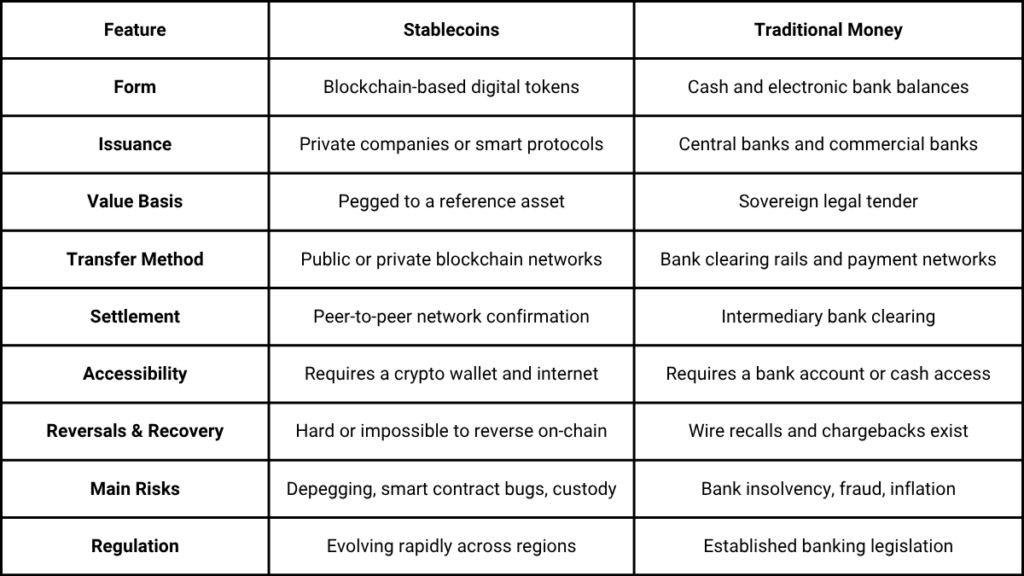
How Do Stablecoins Compare With Bank Transfers?
When comparing stablecoins to bank transfers, speed, operating hours, and settlement finality stand out:
- Operating Hours: Traditional banks observe business hours and weekend cut-off times. In contrast, public blockchain networks operate continuously around the clock.
- Settlement Mechanics: Standard bank wires can take days to settle fully across borders. Conversely, blockchain networks confirm transactions within minutes.
- Redemption Realities: However, converting stablecoins back into fiat cash still requires traditional banking rails and standard operating hours.
Which Offers More Stability and Protection?
Commercial bank deposits offer clear regulatory protections, strict capital rules, and government-backed deposit guarantees. As a result, depositors enjoy strong protection if a bank fails.
In contrast, stablecoins depend entirely on the issuer’s solvency, reserve quality, and risk management. Consequently, if an issuer loses banking access or mismanages reserves, token holders face potential depegging losses.
How Stablecoin Payments Are Changing Global Transactions
Digital dollar infrastructure creates efficient global payment channels alongside legacy banking rails.
Cross-Border Payments and International Transfers
Traditional international transfers pass through multiple correspondent banks. Therefore, users face high currency conversion fees and slow settlement times.
In contrast, stablecoins move value directly between peer-to-peer wallets:
- Freelancers and Remote Workers: Global workers receive cross-border earnings instantly without paying high international wire fees.
- International B2B Commerce: Businesses pay foreign suppliers without waiting multiple business days for clearing.
- Total Transaction Costs: Nevertheless, total costs must factor in network gas fees, exchange spreads, and local cash-out fees.
Payments Beyond Traditional Banking Hours
Because blockchains operate without central maintenance windows, businesses execute and verify stablecoin transfers anytime. Thus, continuous payment availability benefits global e-commerce and automated treasury operations.
However, heavy network congestion can occasionally cause temporary surges in blockchain gas fees.
The Role of Stablecoins in Digital Commerce
Many modern payment processors now allow merchants to accept stablecoins at checkout. This eliminates credit card interchange fees and chargeback fraud risks. However, merchants must still navigate local tax accounting and regulatory reporting requirements.
How Stablecoin Liquidity Influences Crypto Markets
Beyond payments, stablecoins provide crucial market depth and stability across digital asset exchanges.
What Is Stablecoin Liquidity?
Liquidity measures how easily traders can buy or sell an asset without impacting its market price. In crypto markets, digital dollars serve as the primary trading pair for almost all digital assets.
Stablecoin availability can influence trading activity, market depth, and the ease of moving between digital assets. Understanding crypto market liquidity
helps explain how these mechanisms affect trading conditions.
How Stablecoin Supply and Demand Affect Crypto Trading
When stablecoin supply expands, capital flows directly into the digital asset ecosystem. Key market dynamics include:
- Dominant Trading Pairs: Exchanges settle most spot and futures trading volume in stablecoins rather than fiat money.
- Tighter Spreads: Higher stablecoin liquidity reduces bid-ask spreads, helping institutional traders execute larger orders smoothly.
- Capital Preservation: Traders swap volatile assets for stablecoins during market pullbacks to preserve capital without exiting to cash.
What Happens When a Stablecoin Loses Its Peg?
A depegging event happens when market panic or liquidity shortages push a stablecoin’s price away from its $1 target.
Common causes include:
- Sudden runs on issuer reserves by token holders.
- Operational delays during fiat redemption processing.
- Illiquid or opaque reserve holdings.
- Smart contract vulnerabilities in algorithmic stability loops.
Consequently, when a prominent stablecoin depegs, it triggers liquidations across decentralized protocols and spreads panic across broader markets.
Blockchain, On-Chain Activity, and the Future of Digital Money
Public blockchain ledgers record every transaction transparently, creating verifiable financial data tracks.
How Blockchain Changes Transaction Visibility
Unlike closed bank databases, public blockchains allow anyone to audit transaction flows independently.
Examining on-chain activity can help readers understand how stablecoins move between wallets, applications, and trading venues, although these data points require context before they can support conclusions about market sentiment.
Key on-chain factors include:
- Public Transparency: Anyone can analyze real-time wallet flows and institutional capital transfers.
- Pseudonymity: Wallet addresses remain public alphanumeric strings. However, centralized exchanges enforce strict Identity Verification (KYC) when users convert tokens to bank cash.
Stablecoins and the Evolution of Financial Infrastructure
Stablecoins form a fundamental building block for automated finance. Developers embed digital dollars directly into automated lending protocols, smart contracts, and global payment rails.
Stablecoins are one part of a wider shift towards blockchain-based financial services, including tokenized assets
that represent claims on or interests in real-world and financial assets.
As commercial banks adopt distributed ledger technology, stablecoins and tokenized deposits will co-exist, connecting legacy finance with digital asset markets.
Risks and Limitations of Stablecoins Compared With Traditional Money
A complete evaluation requires examining the distinct risks inherent in stablecoins.
Reserve, Issuer, and Redemption Risks
Unlike central banks, stablecoin creators operate as private businesses. As a result, users face specific operational risks:
- Reserve Quality: Reserves must consist of cash and short-term Treasuries rather than riskier corporate debt.
- Custody Risk: Commercial banks holding reserve cash could experience distress.
- Redemption Friction: Issuers often set high minimum redemption thresholds or charge withdrawal fees.
Regulatory and Legal Differences Across Countries
Global regulations vary significantly:
- European Union: The MiCA framework enforces strict capital rules, reserve mandates, and licensing for token issuers.
- Global Regulators: Other countries continue developing targeted rules around reserve transparency, consumer rights, and anti-money laundering controls.
Therefore, users must review local regulations to understand their legal protections.
Technology, Wallet, and Security Risks
Using digital tokens introduces unique technical challenges:
- Irreversible Transfers: Sending tokens to a wrong address causes permanent loss.
- Self-Custody Risks: Losing private wallet keys forfeits assets completely without recovery options.
- Smart Contract Exploits: Code vulnerabilities in decentralized protocols can lead to lost funds.
Inflation, Purchasing Power, and Currency Exposure
A dollar-pegged stablecoin targets the nominal value of $1 USD. However, it does not hedge against inflation. When inflation reduces purchasing power for cash, digital dollars lose purchasing power at the exact same rate. Furthermore, international holders face ongoing foreign exchange rate risks against their home currency.
How Stablecoins and Traditional Money May Coexist in Global Markets
Rather than replacing traditional money, stablecoins complement modern banking systems.
Traditional banks will continue to manage legal tender, monetary policy, and consumer lending. Meanwhile, stablecoins excel at fast 24/7 cross-border transfers, micro-payments, and automated digital asset trading.
What Should Individuals and Businesses Consider?
Before choosing between traditional bank transfers and stablecoins, evaluate these key factors:
- Transaction Purpose: Use traditional banking for local bills and salary payouts. Choose stablecoins for rapid international settlements.
- Net Fees: Compare total cost by factoring in network gas fees, exchange conversion spreads, and off-ramp bank charges.
- Recipient Capabilities: Verify that your recipient maintains a compliant digital wallet and a reliable local off-ramp.
- Protection Needs: Choose traditional channels when you require chargeback protections and deposit insurance guarantees.
FAQ
Are stablecoins real money?
Stablecoins act as a digital medium of exchange and unit of account. However, most countries classify them as digital financial assets rather than legal tender.
Are stablecoins safer than keeping money in a bank?
No. Traditional bank accounts feature statutory deposit insurance and regulatory backing. Stablecoins carry unique technological, issuer, and smart contract risks.
Can stablecoins lose their dollar peg?
Yes. Poor reserve management, sudden market panics, or smart contract bugs can cause a stablecoin to drop below $1.
Are stablecoin payments faster than bank transfers?
Yes, blockchain networks settle transactions within minutes peer-to-peer. However, cashing out to a local bank account still depends on traditional banking hours.
How do stablecoins affect crypto market liquidity?
They act as the primary trading currency across exchanges, providing deep market liquidity and reducing price volatility during trades.
Are stablecoins regulated in every country?
No. Some regions like the EU enforce strict frameworks, while other countries are still developing formal rules.
What is the difference between stablecoins and central bank digital currencies (CBDCs)?
Private companies issue stablecoins on open blockchains. In contrast, sovereign central banks issue CBDCs directly as official liabilities.
Can stablecoins replace traditional money?
Unlikely. Instead, stablecoins serve as a complementary payment layer for global transfers, web3 applications, and modern digital asset markets.
Conclusion: Stablecoins vs Traditional Money What Comes Next?
The ongoing evolution of Stablecoins vs Traditional Money highlights a changing financial landscape. While traditional fiat money remains the bedrock of modern economies, stablecoins demonstrate how public blockchains enable fast, continuous, and automated transfers worldwide.
Ultimately, choosing between the two depends on speed requirements, fee structures, and necessary legal protections.
Understanding how digital assets operate within evolving financial markets can help readers explore the wider crypto landscape, including the role of blockchain-based assets and changing market structures at crypto markets