The foreign exchange market operates 24 hours a day, processing trillions of dollars in daily volume across global currencies. For individual and institutional traders alike, the primary challenge in Forex trading has rarely been a lack of information it is an excess of it. From real-time price feeds and central bank announcements to macroeconomic indicator releases and geopolitical developments, the sheer volume of data can easily lead to analytical fatigue and delayed execution.
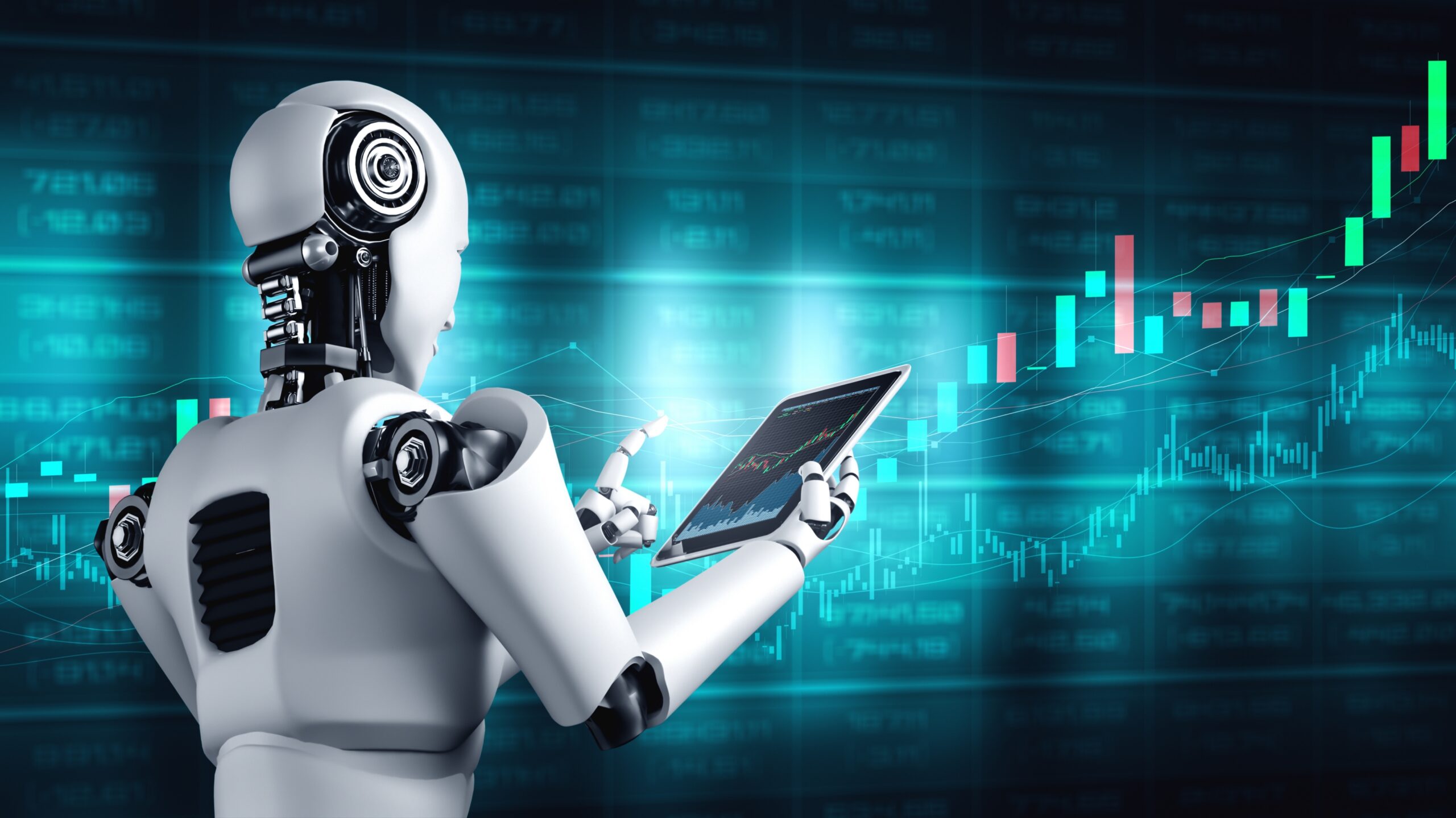
In recent years, artificial intelligence has emerged as a key technology for handling this massive data flow. Once reserved for institutional quantitative desks, AI-driven analysis, machine learning models, and automated data processing tools are increasingly accessible to retail traders.
However, a fundamental question remains: Can AI genuinely improve Forex trading decisions, or is it simply another overhyped technological tool?
Artificial intelligence is a decision-support technology rather than an automated route to guaranteed returns. While AI excels at processing vast amounts of historical data, detecting subtle market patterns, and streamlining repetitive research, it cannot eliminate financial risk or predict the future with absolute certainty. It must always be combined with core risk management principles.
Below is a detailed examination of how AI works within global Forex trading, its practical applications, its critical limitations, and how modern traders combine machine intelligence with disciplined risk management and human oversight.
What Is AI in Forex Trading?
At its core, AI in Forex trading refers to the use of advanced computational algorithms, machine learning models, and data-processing systems to analyze currency markets, evaluate trading setups, and support decision-making.
Unlike traditional technical analysis which relies heavily on manual chart drawing and static indicators like Simple Moving Averages (SMA) or the Relative Strength Index (RSI) AI systems adapt dynamically to incoming data. They evaluate hundreds of variables simultaneously to identify correlations that may be invisible to the human eye.
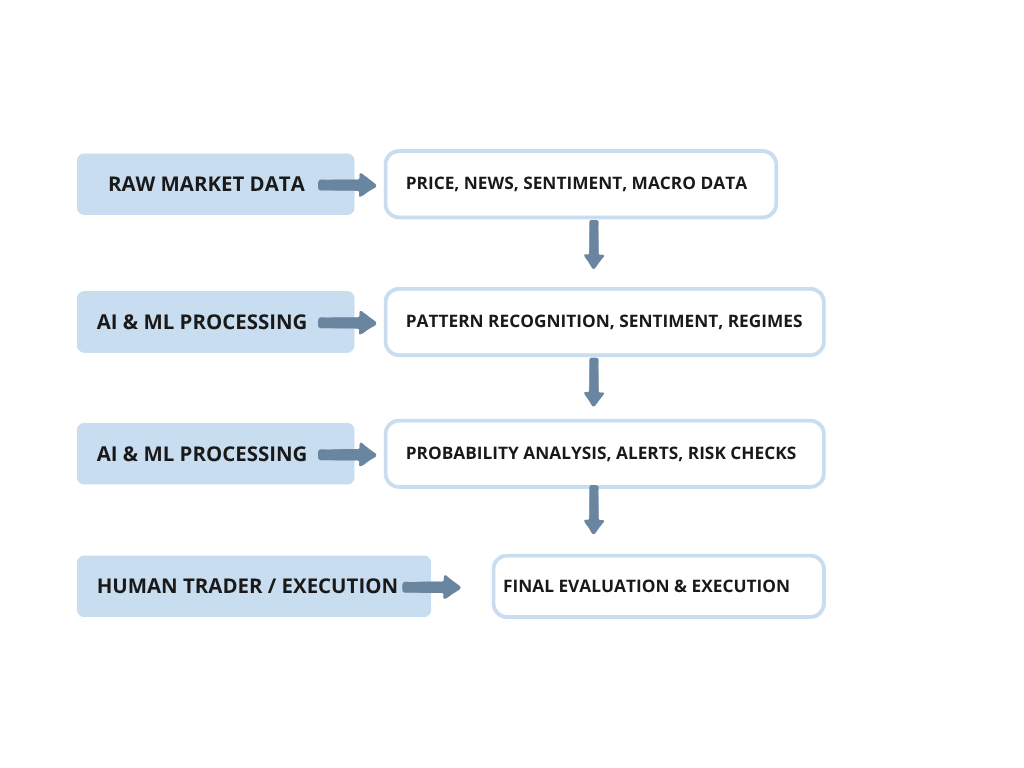
Core Technologies Powering AI Trading Systems
To understand how AI functions in the Forex market, it helps to break down its core underlying technologies:
- Artificial Intelligence (AI): The overarching field focused on creating systems capable of performing tasks that typically require human intelligence, such as pattern recognition, reasoning, and problem-solving.
- Machine Learning (ML): A subfield of AI where algorithms learn from historical data over time. Instead of following rigid, pre-programmed rules, ML models update their mathematical parameters as new market data is introduced.
- Natural Language Processing (NLP): A technology that allows computers to read, interpret, and analyze human language. In Forex, NLP is used to scan financial news, central bank speeches, and economic reports to gauge market sentiment.
- Predictive Models: Statistical frameworks trained on historical price action, economic releases, and volatility patterns to estimate the probability of potential future price movements.
- Algorithmic Systems: Automated rule-based software that executes specific trading actions (such as generating an alert or opening an order) when defined analytical conditions are met.
How AI Differs From Traditional Trading Analysis
| Feature | Traditional Technical Analysis | AI-Assisted Trading Analysis |
| Data Processing | Limited to single charts, manual indicators, and basic timeframes. | Processes multi-timeframe price action, news, economic data, and sentiment simultaneously. |
| Adaptability | Uses fixed rules (e.g., “buy when RSI drops below 30”). | Adapts parameters dynamically based on changing market regimes and historical behavior. |
| Speed & Scope | Manual scanning across currency pairs is time-consuming and prone to human oversight. | Instantly screens dozens of currency pairs for specific statistical conditions. |
| Bias | Subject to emotional biases, confirmation bias, and cognitive fatigue. | Evaluates data objectively based on underlying mathematical models. |
How Does AI Help Forex Traders Make Decisions?
The primary value of AI in Forex trading lies in its ability to augment human analysis. By taking over repetitive research and complex data filtering, AI allows traders to focus on strategy, risk control, and execution.
1. Identifying Patterns in Complex Market Data
Forex markets generate continuous streams of tick-level price data. Machine learning algorithms excel at evaluating historical price behavior, recurring market structures (such as consolidation breakouts or liquidity sweeps), and complex multi-variable relationships.
For instance, an AI model can evaluate how EUR/USD typically responds to interest rate differentials when simultaneous volatility spikes occur in the commodities market. However, recognizing a historical pattern does not mean the price will inevitably move in the same direction again; it simply provides a statistical backdrop for the trade.
2. Processing Multidimensional Information Simultaneously
A manual trader can usually monitor only a few charts and news feeds at a time. AI systems can continuously ingest and synthesize:
- Real-time and historical price tick data across multiple timeframes.
- Scheduled macroeconomic releases (e.g., Non-Farm Payrolls, CPI, GDP).
- Central bank rate decisions and policy statements.
- Market volatility metrics and cross-currency correlations.
- Global market sentiment indicators derived from news media and social channels.
3. Detecting Potential Trading Setups
Rather than executing orders blindly, AI tools act as automated screeners. A trader can set criteria to monitor multiple currency pairs
for specific structural setups such as a momentum divergence combined with an expanding volatility regime. When those criteria are met, the system alerts the trader for further manual review.
4. Supporting Faster, Objective Decision-Making
Market noise often leads to overtrading or emotional hesitation. AI models help filter out minor, irrelevant price fluctuations by highlighting setups that meet specific statistical criteria. By organizing complex data into actionable summaries, AI reduces research time and helps traders respond to genuine market opportunities without falling victim to emotional panic.
AI Forex Tools Traders Can Use
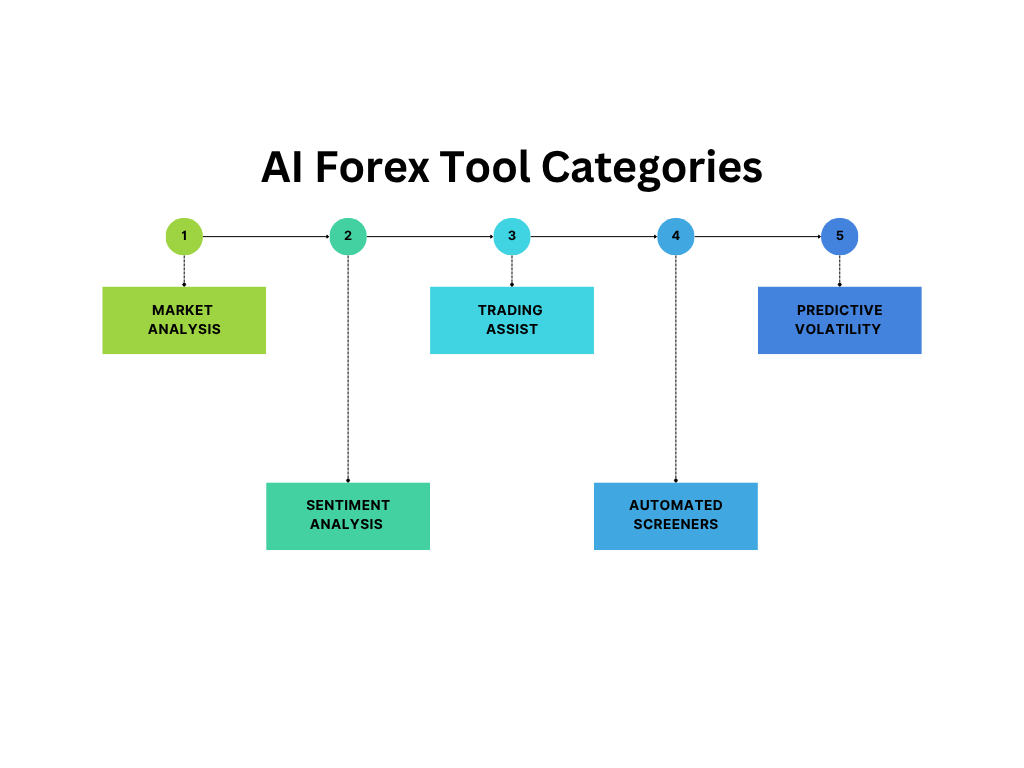
Rather than searching for a single “all-in-one” solution, traders utilize specialized AI Forex tools
designed to solve specific analytical challenges.
AI-Powered Market Analysis
These applications focus on evaluating structural market health. They analyze price trends, identify key support and resistance levels, measure market momentum, and detect shifts in market regimes (e.g., transitioning from a low-volatility range into a strong breakout trend).
AI-Based Sentiment Analysis
Currencies are heavily driven by market perception and broader market sentiment. Natural Language Processing (NLP) tools monitor global financial news, economic commentaries, and social channels to classify market tone as bullish, bearish, or neutral.
Note: Sentiment analysis should always be treated as supporting evidence alongside technical and fundamental factors, rather than as an isolated trade signal.
AI Trading Assistants
Generative AI and specialized AI trading assistants
act as virtual research partners. Traders use them to:
- Summarize dense economic policy documents or central bank transcripts.
- Formulate and refine complex trading hypotheses.
- Compare hypothetical market scenarios based on past economic events.
- Structure daily trade journals and performance logs.
Automated Screening and Alerts
AI-driven screeners operate continuously in the background. Instead of forcing a trader to sit in front of screens for hours, these systems scan multiple pairs and timeframes, triggering targeted notifications only when conditions align with predefined trading rules.
AI Trading Strategies: How Can Traders Apply AI?
Applying AI to Forex trading does not require building an autonomous supercomputer. Instead, traders incorporate machine learning concepts into established trading methodologies to enhance precision.
AI-Assisted Trend Analysis
Machine learning classifiers can evaluate whether a currency pair is in a clear trend, a noisy consolidation, or a structural reversal. By combining model outputs with traditional price action analysis, traders can align their positions with the dominant market regime and avoid trading counter-trend setups during strong momentum moves.
Machine Learning in Trading
Machine learning in trading generally falls into two categories:
- Supervised Learning: The algorithm is trained on labeled historical data (e.g., identifying historical chart patterns that resulted in a minimum 2:1 risk-to-reward outcome) to recognize similar configurations in live markets.
- Unsupervised Learning: The algorithm analyzes raw market data without predefined labels to uncover hidden groupings, correlations, or anomalies that human analysts might miss.
While machine learning identifies statistical relationships within historical data, traders must remember a core principle: historical performance does not guarantee future results.
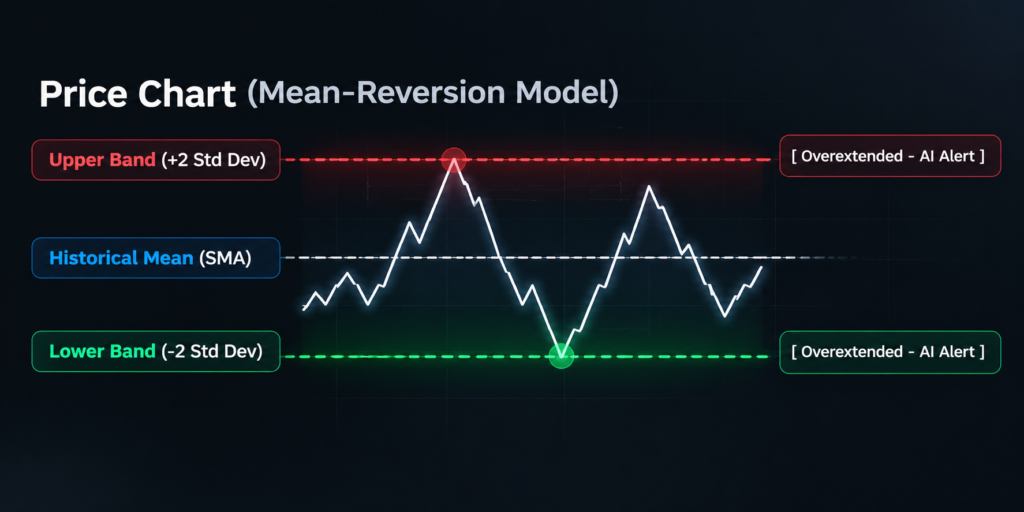
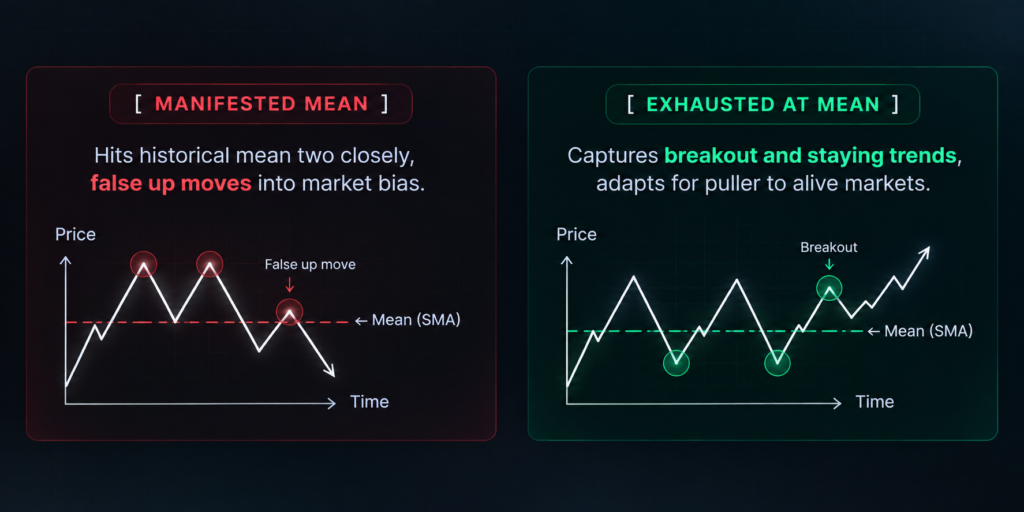
AI-Assisted Mean-Reversion Analysis
Mean-reversion strategies rely on the idea that prices eventually return to their historical average after extreme moves. AI tools evaluate statistical standard deviations and historical volatility to flag when a currency pair is stretched relative to its historical baseline.
AI-Based Volatility Analysis
Volatility is rarely constant in the FX market. AI models can track implied and historical volatility to anticipate periods of expansion (often occurring before major economic news) or contraction. This helps traders adjust their position sizing and widen or narrow stop-loss levels ahead of market movements.
AI and Algorithmic Trading
It is critical to distinguish between AI-assisted analysis and traditional algorithmic trading:
- Algorithmic Trading: Executes hardcoded rules automatically (e.g., “If Line A crosses Line B, execute a Buy order”).
- AI Systems: Evaluate unstructured data, learn from underlying patterns, and estimate probabilities to inform decisions.
Modern quantitative trading increasingly blends both approaches: machine learning models analyze complex data inputs to select high-probability setups, while algorithmic execution modules handle precise order placement and trade management.
AI Market Analysis vs. Human Decision-Making
AI is superior at rapid calculations and data processing, but human traders retain crucial capabilities that machines lack, such as contextual reasoning, risk accountability, and adaptability during unexpected global events.
| Task / Domain | What AI Can Do Best | What the Human Trader Must Provide |
| Data Processing | Ingests and processes millions of data points across global markets in seconds. | Evaluates whether the processed data is relevant to the current trading strategy. |
| Pattern Detection | Identifies complex, multi-variable price structures instantly without emotional bias. | Interprets market context, structural integrity, and economic background. |
| Sentiment Analysis | Classifies thousands of news headlines into numeric sentiment scores. | Assesses the credibility, nuance, and true market impact of news releases. |
| Market Monitoring | Monitors 30+ currency pairs simultaneously around the clock. | Aligns trading opportunities with individual risk tolerance and trading objectives. |
| Scenario Generation | Computes statistical probabilities for multiple hypothetical trade outcomes. | Makes the final discretionary execution decision and manages trade drawdown emotionally. |
Why Human Judgment Still Matters
- Rapidly Changing Context: Global events such as unexpected policy shifts or geopolitical conflicts—can instantly render historical data obsolete.
- Model Limitations: An AI model is only as reliable as the data used to train it. If market regimes shift, the model’s accuracy can decline rapidly.
- Breakdown of Correlations: Long-standing correlations between asset classes can temporarily or permanently break down during market crises.
- Final Accountability: An algorithm cannot manage personal financial exposure or take accountability for drawdown; the responsibility rests entirely with the trader. Understanding key market dynamics like institutional liquidity shifts remains essential.
Can AI Predict Forex Prices Reliably?
One of the most common misconceptions among retail traders is that AI can function as a “crystal ball” that predicts exact future price levels. The reality is that AI cannot predict Forex market prices with absolute certainty.
Why Forex Prediction Is Exceptionally Difficult
- Extreme Market Noise: The Forex market is influenced by macroeconomics, institutional order flow, central bank interventions, and retail behavior, creating high levels of statistical noise.
- Unscheduled Events: Unexpected economic announcements, elections, or geopolitical tensions cannot be predicted purely through historical price charts.
- Regime Shifts: Economic dynamics evolve over time. A machine learning model trained during a high-interest-rate environment may fail when central banks transition to quantitative easing.
The Problem of Overfitting
When developing trading models, it is easy to over-optimize a system on historical data—a flaw known as overfitting. An overfitted model memorizes past price movements perfectly, producing flawless backtest results. However, when deployed in live markets, it often fails because live price action never replicates historical data exactly.
Probabilities vs. Predictions
Successful institutional traders do not view AI as a prediction engine. Instead, they use AI to calculate statistical probabilities. Rather than stating “EUR/USD will reach 1.1000 tomorrow,” an effective AI model might indicate “Under current volatility and sentiment conditions, similar historical structures moved in the direction of the dominant trend 62% of the time.”
Traders then use these probabilities to structure trades with favorable risk-to-reward ratios.
Risks and Limitations of AI in Forex Trading
To use AI safely in Forex trading, you must understand its potential pitfalls. Relying blindly on automated systems can lead to severe capital losses.
- Overfitting & Curve Fitting: As noted above, models that perform exceptionally well in backtests often fail in live market conditions due to excessive reliance on past noise.
- Data Quality Issues: If an AI model is fed corrupted, delayed, or incomplete tick data, its outputs will be inherently flawed (“garbage in, garbage out”).
- Regime Blindness: A model trained during an extended multi-year bull market will struggle during sudden, violent market sell-offs or range-bound conditions.
- False Signals: Machine learning algorithms can easily interpret random price anomalies as meaningful structural patterns, generating false signals.
- Automation Risk: Fully automated trading bots operating without safeguards can execute flawed strategies at scale, compounding drawdown rapidly during high-volatility events.
- Overdependence & Skill Atrophy: Relying completely on technology can prevent traders from developing core skills in market analysis, fundamental reasoning, and trade management.
AI and Forex Risk Management
Rather than focusing solely on trade entry signals, some of the most effective applications involve deploying AI for risk management. AI can serve as a risk controller, protecting capital from excessive drawdowns and emotional mistakes.
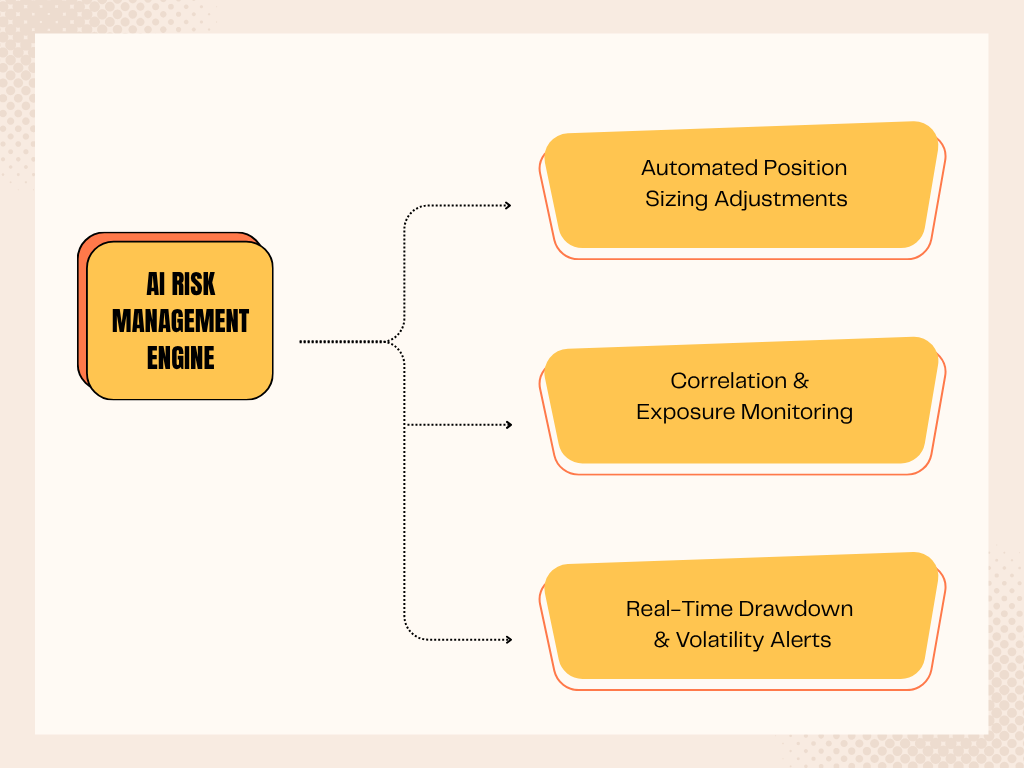
Key Applications of AI in Risk Management
- Dynamic Position Sizing: AI models can analyze current Average True Range (ATR) and account capital to recommend optimal position sizing based on specific volatility conditions.
- Correlation Tracking: If a trader opens long positions on both EUR/USD and GBP/USD, an AI risk tool can warn them of high portfolio correlation, preventing unintended exposure to the USD.
- Automated Stop-Loss Planning: AI tools evaluate structural support/resistance levels and market volatility to help establish logical, objective invalidation levels rather than arbitrary stop-loss distances.
- Drawdown Monitoring: Advanced risk algorithms can track real-time account drawdowns, automatically alerting the trader or scaling down trade sizes if equity falls below defined risk parameters.
Practical Framework: How to Use AI Without Giving Up Control
To integrate AI into your trading effectively, follow a structured workflow that keeps you firmly in control of final decisions.
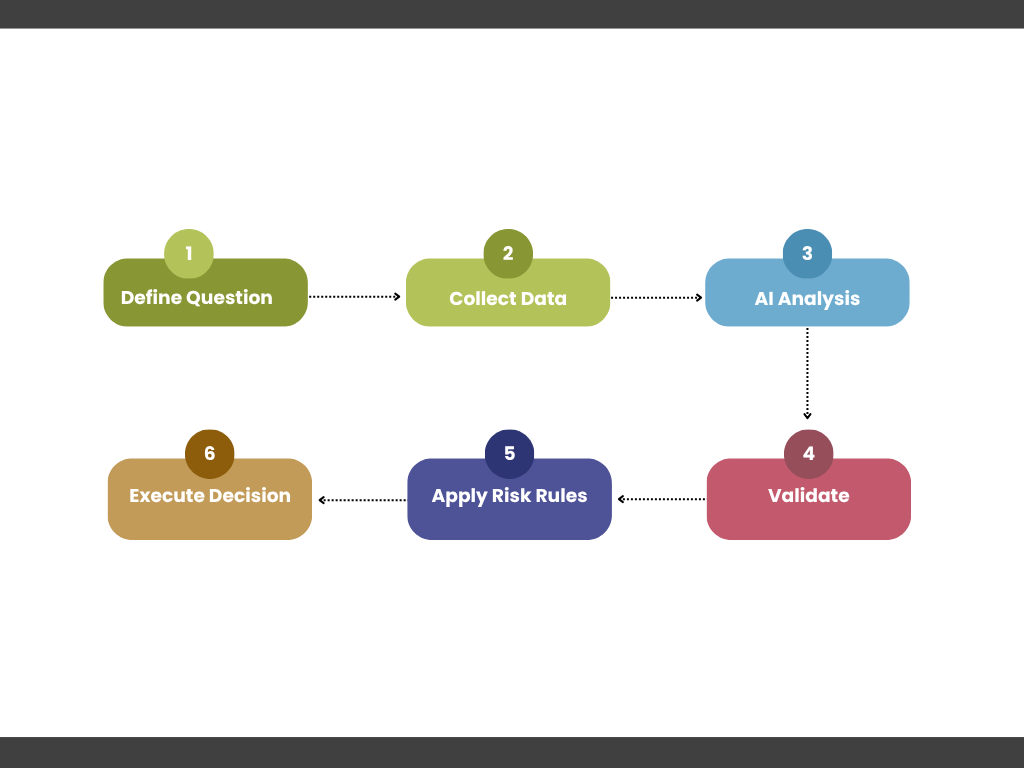
Step 1 — Define the Trading Question
Start with a clear hypothesis. Ask specific questions such as:
- Is GBP/JPY entering an expanding volatility regime?
- Has market sentiment on the US Dollar shifted following the latest CPI release?
Step 2 — Collect Relevant Data
Gather the necessary inputs for evaluation, including multi-timeframe price history, upcoming news releases, and current volatility metrics.
Step 3 — Let AI Assist With Analysis
Use AI tools to screen charts, process headlines, calculate relative strength, and detect structural patterns across multiple currency pairs.
Step 4 — Validate the Output
Crucially, never take AI outputs at face value. Cross-reference the model’s findings against independent price action, key fundamental drivers, and overall market structure.
Step 5 — Apply Strict Risk Rules
Before placing a trade, calculate your exact position size, identify invalidation (stop-loss) points, evaluate currency correlations, and ensure the risk-to-reward ratio meets your trading plan parameters.
Step 6 — Make the Final Execution Decision
The AI tool provides the analysis, but you make the final execution decision. This keeps you accountable for your trading strategy and risk management.
Real-World Example: A Decision-Making Workflow
Here is how an AI-assisted trading workflow operates in practice:
- Initial Alert: An AI screening tool detects a potential bullish consolidation pattern forming on EUR/USD on the 4-hour chart, accompanied by contracting volatility.
- Sentiment Evaluation: An NLP sentiment analysis tool flags that recent financial commentary surrounding the Euro has shifted from neutral to moderately bullish following positive European economic data.
- Fundamental Context Check: The human trader reviews the economic calendar and notes that no high-impact central bank announcements are scheduled for the next 24 hours, meaning the technical setup is unlikely to be invalidated by sudden news spikes.
- Risk Calculation: An AI risk manager calculates appropriate position sizing based on a strict 1% account risk limit and recommends a logical stop-loss placement below the recent consolidation swing low.
- Final Evaluation & Execution: The trader reviews the technical structure, confirms the trade aligns with their rules, and manually places the order.
Key Takeaway: AI streamlined the market research and filtering process, but human judgment validated the context and executed the final decision.
AI vs. Algorithmic Trading vs. Trading Bots
The terms AI, algorithmic trading, and trading bots are often used interchangeably, but they represent distinct technologies. Understanding how AI assistants differ from automated trading bots
is essential for developing a sound strategy:
| Concept | Primary Role | How It Operates | Flexibility |
| AI / Machine Learning | Advanced Analysis & Pattern Recognition | Learns and adapts based on incoming market data and statistical relationships. | High adaptability; continuously updates models based on new data. |
| Algorithmic Trading | Automated Execution | Follows strict, hardcoded conditional rules (IF/THEN statements). | Low flexibility; does not adapt unless programmed parameters are updated manually. |
| Trading Bots | Automated Execution Utility | Simple scripts designed to execute standard orders or manage repetitive trades automatically. | None; executes predefined instructions blindly regardless of changing market conditions. |
| AI Trading Assistant | Decision Support | Ingests data, synthesizes complex information, and provides research insights for human evaluation. | High flexibility; acts as an analytical research partner. |
What to Look for in an AI Forex Solution
If you are evaluating AI-powered trading software or tools, look for options that prioritize transparency and risk management over unrealistic performance claims:
- Transparent Methodology: Avoid “black box” algorithms that offer zero insight into how signals are generated. You should understand what inputs, data sources, and analytical logic the system uses.
- Rigorous Testing & Validation: Reliable tools demonstrate clear testing methodologies, including historical backtesting, out-of-sample testing, and forward testing across diverse market regimes.
- Integrated Risk Safeguards: Look for built-in risk controls, such as customizable position limits, maximum drawdown thresholds, and emergency exit alerts.
- Human-in-the-Loop Control: Ensure the software allows for easy manual overrides, customizable screening parameters, and flexible alert settings.
- Realistic Expectations: Steer clear of any platform that promises guaranteed profits, “100% win rates,” or automated wealth generation. Legitimate AI trading platforms emphasize analytical efficiency, probability calculation, and risk control.
The Future of AI in Forex Trading
As financial technology evolves, artificial intelligence will continue to reshape how market participants interact with global currency markets:
- Advanced Data Processing: AI tools will increasingly process unstructured real-time data, including live speeches, institutional order flow shifts, and global supply chain data.
- Enhanced Risk Customization: Future risk management tools will offer highly personalized portfolio protection, dynamically adjusting trade parameters based on a trader’s personal performance history and behavioral habits.
- Institutional-Grade Screening for Retail Traders: Complex quantitative models once exclusive to major banks and hedge funds will become increasingly accessible to individual retail traders.
- Shift Toward Hybrid Trading: The focus of trading education will shift away from basic manual chart scanning toward higher-level data validation, strategy management, model oversight, and capital allocation.
FAQ
Can AI predict Forex market movements with 100% accuracy?
No. Forex markets are inherently volatile and subject to unpredictable macroeconomic and geopolitical developments. AI cannot predict price movements with certainty; it evaluates statistical probabilities based on historical data patterns.
Is AI trading better than manual human trading?
Neither is inherently "better" they excel at different tasks. AI is significantly faster at processing large datasets and running objective calculations, while human traders provide essential context, reasoning, adaptivity, and emotional accountability. Combining both approaches generally yields the best results.
What is the main difference between AI and traditional Forex trading bots?
Traditional trading bots execute hardcoded, static rules (IF x happens, DO y). AI trading systems use machine learning to adapt to changing data inputs, evaluate unstructured information (such as news headlines), and analyze complex market patterns over time.
How does machine learning work in currency analysis?
Machine learning algorithms evaluate vast historical datasets to find relationships between variables like price action, volatility, news sentiment, and economic releases. Over time, the algorithm refines its mathematical parameters to flag similar setups in live market conditions.
Can beginners use AI tools for Forex trading?
Yes. Beginners can use AI tools as research assistants to summarize economic releases, screen currency pairs, and build disciplined risk management routines. However, beginners should avoid relying blindly on automated signal generators without understanding market fundamentals first.
What are the biggest risks of using AI in Forex trading?
The primary risks include model overfitting (where a strategy works in backtests but fails in live markets), relying on poor-quality data, failing to adjust for changing market regimes, and becoming overly dependent on technology without applying personal risk control.
How can AI help with Forex risk management?
AI can monitor account drawdown in real time, track position correlation across currency pairs, recommend dynamic position sizing based on market volatility, and alert traders when market conditions violate their risk parameters.
Final Verdict: Can Artificial Intelligence Improve Forex Trading Decisions?
Yes, artificial intelligence can significantly improve Forex trading decisions provided it is used correctly.
AI’s primary strength lies in its ability to process vast amounts of financial data, detect subtle structural patterns, analyze market sentiment, and screen dozens of currency pairs in real time. It removes analytical guesswork, speeds up research, and brings greater objectivity to market analysis.
However, AI is not a substitute for market understanding, emotional discipline, or strict risk management. It cannot eliminate financial uncertainty, predict black-swan events, or guarantee profitable trades.
The most effective modern trading approach is a hybrid framework: letting artificial intelligence handle data processing, screening, and probability modeling, while the human trader retains full control over strategy validation, risk allocation, and final decision-making.