
Introduction
Automation has fundamentally transformed how modern traders interact with financial markets. Tasks that once required hours of manual work monitoring price levels, executing orders, managing risk can now be handled by software running around the clock without human intervention. However, as trading technology has evolved, so has the confusion around the tools available.
Many traders use the terms AI agents and trading bots interchangeably, assuming they describe the same type of technology. In reality, the difference between AI agents vs trading bots is significant and understanding it is essential for making the right choice for your trading style.
In this guide, you will learn exactly how each system works, where each one performs best, what their genuine advantages and limitations are, and which technology may suit your specific trading goals. Rather than declaring a single winner, this comparison gives you the knowledge to evaluate both objectively. For broader context on how AI is reshaping trading technology overall, our AI Agents in Trading pillar guide provides the essential foundation.
What Are Trading Bots?
Definition of Trading Bots
A trading bot is an automated software program that executes trades based on a set of predefined rules. Developers or traders write these rules in advance, and the rules do not change unless someone manually updates them. In essence, trading bots operate on rule-based trading principles if a specific condition is met, a specific action is taken, without exception and without interpretation.
This approach makes trading bots highly consistent within their defined parameters. However, it also means they are entirely dependent on the quality and relevance of the rules they were given at the time of setup.
How Trading Bots Work
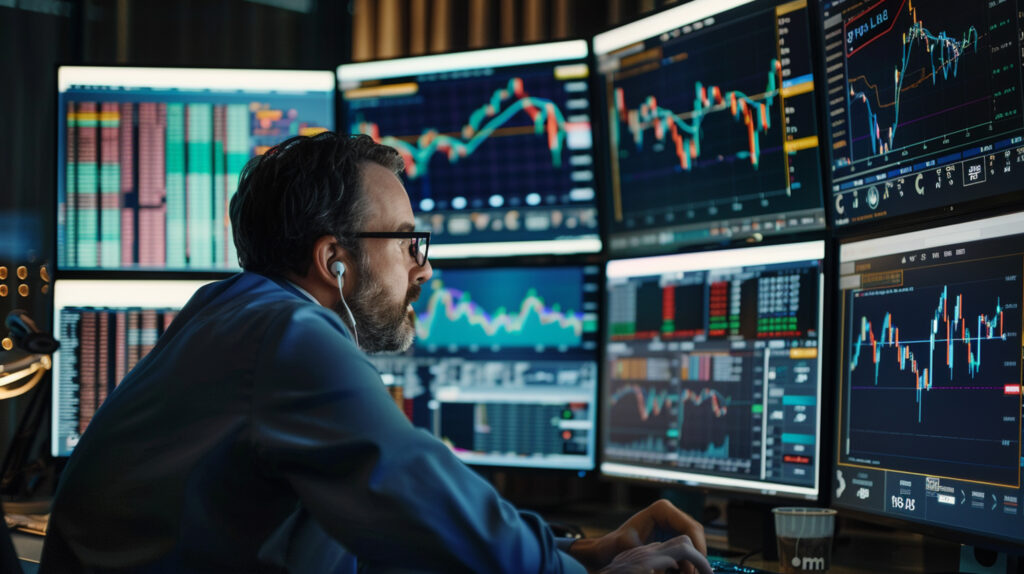
Trading bots work by continuously monitoring market data typically price feeds and technical indicators and comparing current conditions against their programmed entry and exit criteria. When conditions are met, the bot executes an order automatically based on the risk parameters defined by the trader.
For example, a simple trading bot might be programmed to buy when a short-term moving average crosses above a long-term moving average, and sell when the opposite crossover occurs. The bot executes this rule consistently, regardless of broader market context, news events, or changing volatility conditions.
Advantages of Trading Bots
Trading bots offer several meaningful advantages, particularly for traders with straightforward, repeatable strategies. Fast execution removes the delay between signal and order that human traders inevitably experience. Consistency ensures the same rules are applied on every trade without deviation. Emotion-free trading eliminates impulsive decisions driven by fear or greed. Additionally, 24/7 automation allows bots to monitor and trade markets around the clock, even when the trader is away from the screen.
Limitations of Trading Bots
Despite their advantages, trading bots carry significant limitations. They cannot adapt automatically when market conditions change. If the market shifts from trending to ranging behavior, a trend-following bot will continue executing its original rules — often with poor results. Furthermore, trading bots depend entirely on predefined rules that traders must manually update when conditions evolve. Consequently, they struggle during periods of high uncertainty, news-driven volatility, or structural market changes that fall outside their original programming.
What Are AI Agents?
Definition of AI Agents
An AI agent is an intelligent software system capable of perceiving information from its environment, reasoning about that information, and taking actions or providing decision support based on dynamic analysis rather than fixed rules. Unlike trading bots, AI agents are built around AI automation principles they learn, adapt, and improve over time as they process more data and receive feedback.
In a trading context, AI agents can monitor markets, analyze economic data, identify patterns, assess sentiment, and support trader decisions across a wide range of tasks simultaneously. Their intelligence comes not from predefined rules but from their ability to reason within context and adjust their behavior accordingly.
How AI Agents Work
AI agents work through a continuous cycle of data collection, interpretation, and decision support. They gather information from multiple sources simultaneously including price data, economic releases, news events, and sentiment indicators and apply machine learning trading techniques to identify relevant patterns and relationships within that data.
Rather than simply flagging a technical crossover, an AI agent can assess the broader context including current volatility, recent news, and historical behavior under similar conditions before generating an insight or recommendation. This multi-layered analytical process is what fundamentally separates AI agents from rule-based systems.
Capabilities Beyond Traditional Bots

AI agents offer capabilities that traditional trading bots simply cannot replicate. They serve as the backbone for building true adaptive trading strategies, allowing systems to respond dynamically to shifting market conditions. Context awareness enables AI agents to interpret market developments within their broader significance rather than in isolation. Adaptive learning enables the system to improve its outputs over time as market conditions evolve. Strategy optimization allows AI agents to identify which approaches are working and which are not, adjusting their analytical focus accordingly. Multi-source analysis means AI agents can simultaneously process structured data like price feeds and unstructured data like news articles, delivering a far more comprehensive market picture than any bot could achieve.
AI Agents vs Trading Bots The Core Differences
Understanding the comparison between AI agents vs trading bots becomes clearest when examined feature by feature.
| Feature | Trading Bots | AI Agents |
|---|---|---|
| Decision Making | Rule-based | Adaptive |
| Learning Ability | None | Continuous |
| Flexibility | Low | High |
| Market Analysis | Limited | Advanced |
| Strategy Updates | Manual | Automatic/Adaptive |
| Data Sources | Technical indicators | Multiple structured and unstructured sources |
| Human Supervision | Moderate | Moderate to High |
| Best For | Repetitive strategies | Complex market environments |
This AI trading bots comparison reveals that the two technologies are not simply different versions of the same tool they are fundamentally different approaches to market automation, each suited to different types of traders and strategies. For a deeper exploration of automation in trading more broadly, our What Is Algorithmic Trading? guide covers the foundational concepts behind rule-based systems.
AI Trading Bots Comparison: Similarities You Should Know
Despite their differences, AI agents and trading bots share several important characteristics that traders should understand before choosing between them.
Both technologies automate trading tasks, reducing the need for constant manual intervention. Emotional decision-making is also minimized, as neither system reacts impulsively to short-term price movements the way a human trader might. Execution speed improves significantly compared to manual trading, particularly during fast-moving market conditions where timing matters most. Proper risk management remains essential for both — stop losses, position sizing, and daily loss limits apply regardless of which system a trader uses. Furthermore, neither technology guarantees profits, no matter how sophisticated its underlying design. Finally, quality inputs and ongoing monitoring determine the performance of any automated system — poor data and neglected oversight undermine results equally across both technologies.
When Trading Bots May Be the Better Choice
Trading bots are not obsolete in the right context, they remain a highly effective tool. There are several situations where a trading bot may actually be the better choice.
Beginners who are learning to automate simple strategies often find bots easier to understand and implement. Simple strategies with clear, consistent rules translate naturally into bot logic without requiring complex AI infrastructure. Scalping strategies that rely on rapid, repetitive execution benefit from a bot’s speed and consistency. Grid trading, which involves placing orders at fixed intervals above and below a price level, is ideally suited to rule-based automation. Fixed rule systems that do not need to adapt to changing conditions perform reliably within the parameters bots are designed for. Additionally, bots generally carry lower computational requirements, making them more accessible and cost-effective for traders with limited technical resources. Our Can Trading Bots Really Beat the Market? guide explores this question in depth with practical context.
When AI Agents Offer Greater Advantages
AI agents become significantly more valuable in situations that demand flexibility, context awareness, and multi-dimensional analysis.
Multi-asset trading across currencies, commodities, and indices simultaneously benefits from AI agents’ ability to process diverse data streams and identify cross-market relationships. Fast-changing markets where volatility, sentiment, and fundamental conditions shift rapidly require the adaptability that bots simply cannot provide. Portfolio optimization balancing risk exposure across multiple positions demands the kind of nuanced, context-aware reasoning that AI agents are built for. Market sentiment analysis, which requires processing news, economic commentary, and social signals alongside price data, falls entirely outside a trading bot’s capabilities. Large datasets that contain too much information for manual review can be efficiently processed and summarized by AI agents. Finally, personalized strategy adaptation where the system learns an individual trader’s preferences and priorities over time is a uniquely AI-driven capability.
Common Myths About AI Agents and Trading Bots
Several persistent misconceptions cloud traders’ understanding of both technologies.
“AI never loses.” This is false. AI agents provide research, analysis, and decision support — they do not guarantee profitable outcomes. Every trading decision still carries risk.
“Bots guarantee profits.” Trading bots execute rules consistently, but profitability depends on whether those rules have a genuine edge in current market conditions. No bot can create an edge that does not exist in the underlying strategy.
“AI replaces traders.” AI agents are tools that enhance human capabilities, not replacements for human judgment, experience, or responsibility. The most effective use of AI combines machine efficiency with human oversight.
“More automation means better results.” The quality of automation matters far more than the quantity. A well-designed simple bot often outperforms a poorly implemented AI system.
“AI works without human oversight.” Both AI agents and trading bots require ongoing human monitoring to perform reliably. Market conditions change, systems develop errors, and outputs must be verified regularly.
Risks and Challenges of Both Technologies
Both AI agents and trading bots carry risks that traders must manage carefully. Understanding these challenges before deploying any automated system is essential for protecting capital and maintaining consistent performance over time.
Overfitting and Data Quality
Overfitting occurs when a system is optimized so specifically for historical data that it performs poorly in live markets. This risk affects both bots and AI systems, though it is particularly common in machine learning models. Furthermore, poor data quality undermines the accuracy of any automated system garbage in, garbage out applies to both technologies equally. Traders must therefore ensure that the data feeding their systems is clean, current, and sourced from reliable providers.
Technical Failures and Volatility
Technical failures, including connectivity issues, server outages, and software errors, can cause both systems to behave unpredictably during critical market moments. Additionally, market volatility that falls outside a system’s training or programming parameters can produce unexpected and costly results. Consequently, traders should always maintain a manual override plan and monitor system performance closely during high-impact news events and periods of unusual price action.
Cybersecurity and Human Oversight
Cybersecurity considerations grow increasingly important as automated systems connect to live trading accounts and handle sensitive financial data. Traders must protect their systems against unauthorized access, data breaches, and malicious interference at all times. Finally, human oversight remains essential regardless of which technology a trader uses — automation reduces workload but never eliminates the need for informed human supervision at every stage of the trading process.
Choosing the Right Solution for Your Trading Style
The best choice between AI agents vs trading bots depends on several personal factors rather than a universal answer.
Experience Level
Beginners typically benefit from starting with simple bots that are easier to understand, monitor, and adjust. More experienced traders who already understand market dynamics are better positioned to leverage the additional capabilities that AI agents provide.
Trading Frequency
High-frequency traders who rely on rapid, repetitive execution often find trading bots more practical. Lower-frequency traders who prioritize research quality and contextual analysis tend to benefit more from AI agents.
Strategy Complexity
Simple, rule-based strategies translate directly into bot logic. Complex strategies that depend on multiple variables, sentiment, and adaptive decision-making are better suited to AI agents.
Budget
Trading bots are generally more accessible and affordable. AI agents typically require greater technical infrastructure and investment, though the gap is narrowing as the technology becomes more widely available.
Risk Tolerance
Both technologies require disciplined risk management. However, AI agents introduce additional complexity, so traders with lower risk tolerance may prefer the predictability of a well-tested bot strategy.
Long-Term Goals
Traders focused on long-term skill development and adaptability should invest time in understanding AI capabilities. Those seeking straightforward automation of a proven strategy may find bots entirely sufficient.
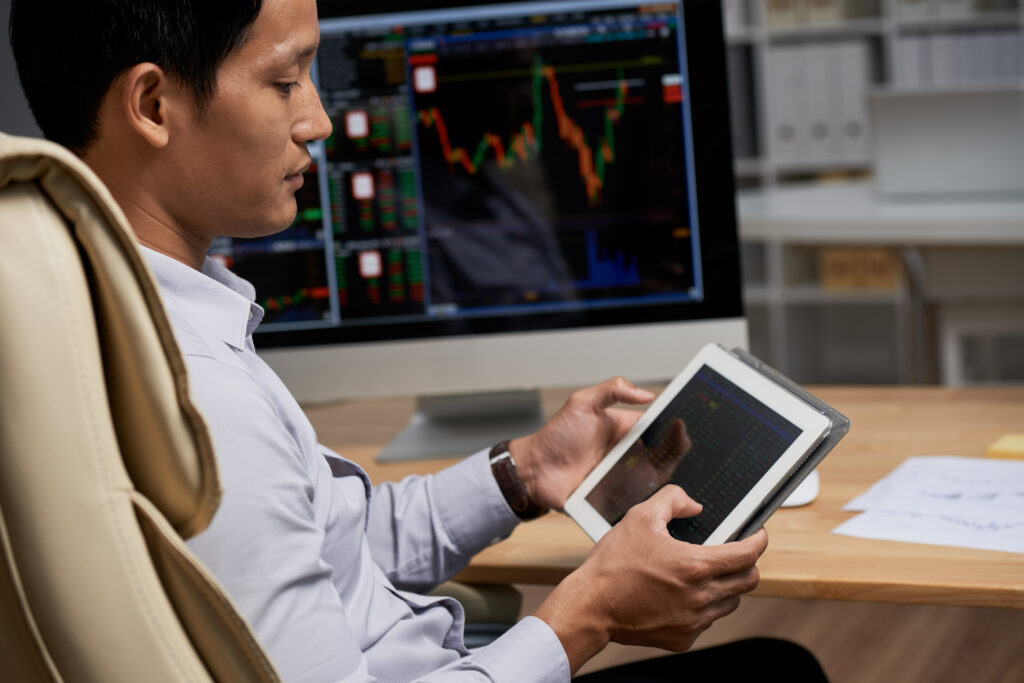
Simple Decision Matrix:
| If You Are… | Consider… |
|---|---|
| A beginner with a simple strategy | Trading Bot |
| An experienced trader in complex markets | AI Agent |
| Focused on scalping or grid trading | Trading Bot |
| Managing multiple assets simultaneously | AI Agent |
| Working with a limited budget | Trading Bot |
| Seeking adaptive, learning-based support | AI Agent |
Future Trends in AI-Powered Trading
The landscape of intelligent trading bots and AI agents is evolving rapidly, and several developments will shape how these technologies are used in the coming years.
Smarter AI agents will deliver increasingly accurate and context-aware market analysis as underlying models improve. Human-AI collaboration will become the dominant model not AI replacing traders, but AI augmenting human capabilities in meaningful, practical ways. Explainable AI will make it easier for traders to understand why an AI agent reached a particular conclusion, building trust and improving oversight. Better risk controls built directly into AI systems will help prevent the kind of runaway automation failures that have historically caused significant market disruptions. Multi-agent systems — where multiple specialized AI agents collaborate on complex tasks will enable more comprehensive analysis than any single system can achieve. Increased personalization will allow AI agents to learn individual trading styles, preferences, and risk tolerances more precisely over time. Regulatory developments will also shape how traders and institutions use AI automation, with greater transparency and accountability requirements likely emerging across global markets.
FAQ
Are AI agents better than trading bots?
Neither is universally better. Trading bots excel at executing simple, repetitive strategies efficiently. AI agents offer greater advantages in complex, fast-changing market environments that require adaptability and multi-source analysis.
Can AI agents replace trading bots?
In some use cases, yes. However, trading bots remain valuable for straightforward strategies where rule-based execution is sufficient. The choice depends on the trader's strategy complexity and goals.
Do AI trading bots use machine learning?
Traditional trading bots do not use machine learning — they follow fixed rules. However, some advanced systems marketed as AI trading bots do incorporate machine learning elements, blurring the line between the two categories.
Are trading bots profitable?
Profitability depends entirely on the underlying strategy, market conditions, and quality of risk management not the technology itself. A bot executing a strategy with no genuine edge will lose money consistently.
Can beginners use AI agents?
Yes, but beginners should first develop a solid understanding of forex and trading fundamentals before relying on AI assistance. AI agents are most effective when used by traders who can evaluate and verify the outputs they receive.
Is rule-based trading still effective?
Yes. Rule-based trading remains effective for strategies with clear, consistent logic that does not need to adapt frequently. Many successful traders use simple rule-based systems alongside manual analysis.
How does machine learning improve trading?
Machine learning allows systems to identify patterns in large datasets that would be impossible to detect manually, adapt to changing market conditions without manual reprogramming, and improve their analytical accuracy over time as they process more data.
Are AI agents fully autonomous?
No. Most AI agents in trading focus on research, analysis, and decision support rather than fully autonomous execution. Traders must maintain human oversight and approval at every stage of responsible AI use.
Which technology is better for long-term trading?
For long-term trading that involves adapting to evolving market conditions, AI agents generally offer greater advantages. For executing a consistent, well-defined strategy over the long term, a reliable trading bot may be entirely sufficient.
Conclusion
The debate around AI agents vs trading bots does not have a single definitive answer — and that is precisely the point. Each technology serves a distinct purpose and performs best in specific conditions.
Trading bots excel at executing predefined, repetitive strategies with speed, consistency, and emotion-free precision. They are accessible, cost-effective, and well-suited to traders with straightforward automation needs. AI agents, on the other hand, introduce adaptability, continuous learning, and broader market analysis that trading bots simply cannot replicate. They are most valuable in complex market environments where flexibility and context awareness determine the quality of decisions.
The better choice ultimately depends on your experience level, strategy complexity, risk tolerance, and long-term trading goals. Rather than expecting either technology to eliminate risk or guarantee profits, focus on understanding what each does well — and build a workflow that uses technology as a support tool rather than a replacement for informed human judgment.
For traders ready to explore AI capabilities in greater depth, our AI Agents in Trading guide provides the complete framework for understanding how these systems work and how to use them responsibly across different markets and trading styles.