

Government bond yields serve as one of the most critical barometers in global finance. Rather than acting as a standalone fixed-income metric, yield movements ripple across international markets, shaping currency exchange rates, precious metal valuations, and equity prices.
Understanding how bond yields affect markets requires looking beyond static interest rates. Markets are forward-looking engines driven by interest-rate expectations, inflation forecasts, and risk sentiment.
Introduction: Why Bond Yields Matter Beyond the Bond Market
In basic terms, a government bond yield represents the return an investor receives for holding a government debt instrument. However, for traders and global investors, bond yields function as a real-time signal of economic health, inflationary pressure, and future central bank policy.
When bond yields adjust, they alter the cost of capital, recalibrate risk-return dynamics, and redirect global capital flows. Rather than treating foreign exchange, precious metals, and equities as isolated silos, institutional investors evaluate them through a interconnected transmission mechanism:
Central Bank Expectations → Bond Yields → Currencies → Gold → Equities
Because bond yields trade continuously in secondary debt markets, they often move long before a central bank officially adjusts its benchmark interest rate. Understanding this transmission mechanism allows traders to gauge market shifts before they manifest in asset prices How Interest Rate Decisions Affect Forex, Gold & Crypto.
What Are Bond Yields? A Simple Explanation
What Is a Bond Yield?
A government bond is a loan made by an investor to a sovereign government. The yield is the effective annual interest rate the investor earns on that bond.
A foundational principle of fixed income is that bond prices and yields move in opposite directions:
- When bond demand rises, bond prices increase, and yields fall.
- When bond demand drops or investors sell off bonds, prices fall, and yields rise.
Bond Price UP —> Yield DOWN
Bond Price DOWN —> Yield UP
Why Do Bond Yields Change?
Yields fluctuate based on continuous shifts in economic conditions and investor expectations:
- Central Bank Expectations: Anticipated rate hikes push yields up; expected rate cuts pull yields down.
- Inflation Expectations: Higher anticipated inflation erodes fixed-income purchasing power, demanding higher yields as compensation.
- Economic Growth & Employment: Strong economic data suggests higher future demand for capital and potential monetary tightening, lifting yields.
- Government Debt Supply: Increased government borrowing increases bond issuance, which can weigh on prices and push yields higher.
- Global Risk Sentiment: During market stress, investors seek safety in government debt, driving up bond prices and lowering yields.
Why Treasury Yields Receive So Much Attention
US Treasury yields particularly the 10-year US Treasury note serve as the risk-free benchmark for global financial markets. Because the US dollar acts as the primary global reserve currency, changes in Treasury yields directly impact international borrowing costs, capital flows, and asset valuations worldwide.
The Core Relationship: Interest Rates, Bond Yields, and Market Expectations
A common point of confusion is the distinction between central bank policy rates and bond yields:
- Policy Rates: Set directly by central banks (e.g., the Federal Reserve, ECB, or Bank of England).
- Bond Yields: Determined by market supply and demand in open debt markets.
Because market participants buy and sell debt based on anticipated future conditions, bond yields reflect expected future policy rates rather than just current ones.
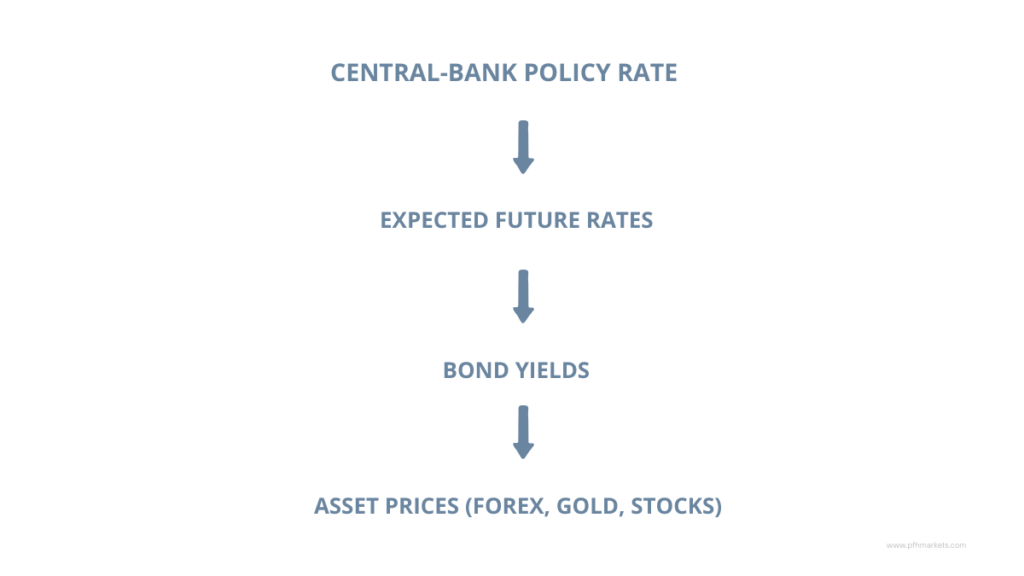
If traders expect a central bank to hike interest rates six months from now, bond yields will rise today How Interest Rate Decisions Affect Forex, Gold & Crypto. Conversely, if economic activity weakens and rate cuts are anticipated, yields drop well before official rate announcements.
How Bond Yields Affect Forex Markets
The forex market reacts dynamically to changes in government bond yields, as capital constantly seeks optimal risk-adjusted returns globally.
Higher Yields and Currency Demand
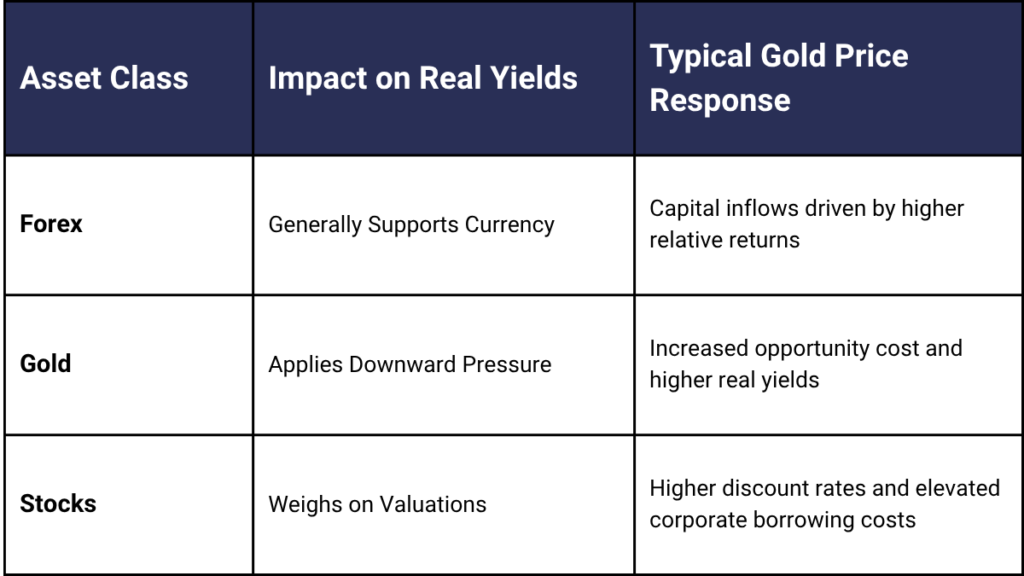
When a country’s government bond yields rise relative to those of other nations, its fixed-income assets become more attractive to foreign investors. To purchase these higher-yielding bonds, investors must convert capital into the issuer’s domestic currency, increasing demand and pushing the currency value upward.
The US Dollar and Treasury Yields
Changes in US Treasury yields exert a pronounced influence on the US Dollar Index (DXY). When US yields rise relative to global benchmarks, global investors reallocate capital into Dollar-denominated fixed income, strengthening the Greenback.
Yield Differentials and Currency Pairs
Forex traders rarely look at a single country’s yield in isolation. Instead, they track yield differentials—the gap between the bond yields of two different countries.
Example: In the USD/JPY currency pair, the yield spread between 10-year US Treasuries and 10-year Japanese Government Bonds (JGBs) has historically shown a strong correlation with price movements. As the US-Japan yield gap widens, USD/JPY tends to rise.
Widening Yield Spread (Country A > Country B) —> Currency A Strengthens vs Currency B
Narrowing Yield Spread (Country A < Country B) —> Currency A Weakens vs Currency B
When Higher Yields Do Not Strengthen a Currency
Higher yields do not automatically guarantee currency appreciation. A currency may weaken despite rising yields under specific circumstances:
- Inflation Fears: If yields are rising primarily due to runaway inflation, real returns deteriorate, scaring off foreign capital.
- Fiscal/Sovereign Debt Concerns: If yields spike because investors distrust a government’s debt sustainability, the domestic currency will sell off.
- Faster Yield Growth Elsewhere: Even if domestic yields rise, the currency may fall if another major nation’s yields are rising faster.
How Bond Yields Affect Gold Prices
Gold holds a unique position in global finance: it is an established store of value and safe-haven asset, but it produces no yield or cash flow.
Why Gold Can React to Rising Yields
Because gold yields 0%, holding bullion carries an opportunity cost—the lost interest an investor could have earned by holding safe, yield-bearing assets like government bonds. When yields rise, the opportunity cost of holding non-yielding gold increases, making bonds relatively more attractive and pressuring gold prices.
Nominal Yields vs Real Yields
To understand how real yields and gold interact, investors must distinguish between nominal yields and inflation-adjusted real yields.
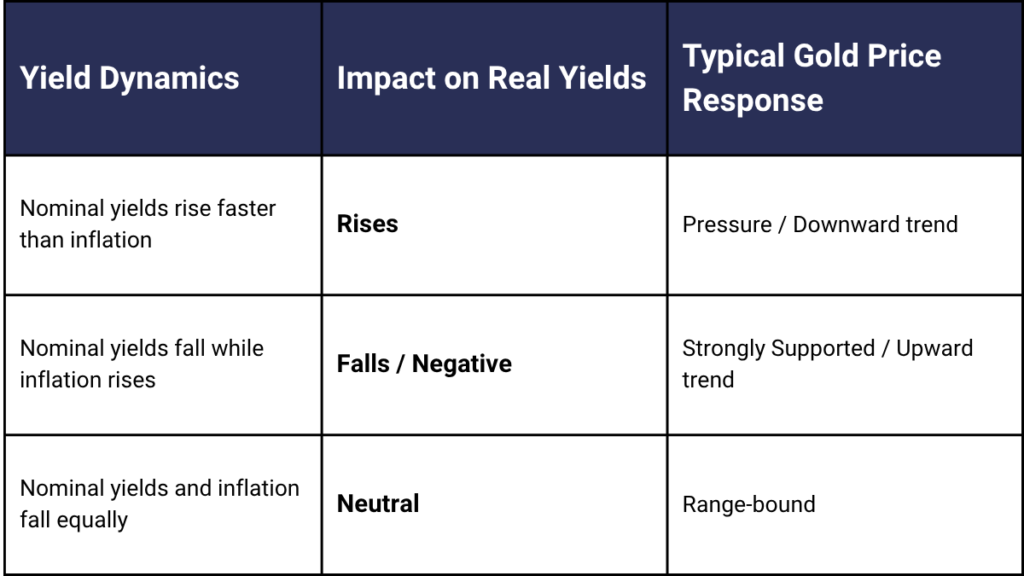
Real Yield = Nominal Bond Yield – Expected Inflation Rate
Gold is primarily sensitive to real yields:
- Rising Real Yields: Bond yields outpace inflation, increasing the real cost of holding gold and creating downward pressure on bullion.
- Falling or Negative Real Yields: Inflation outpaces bond yields, preserving gold’s appeal as an inflation hedge and driving prices higher.
Falling Yields and Gold
When yields decline due to slowing economic growth or anticipated monetary easing, the opportunity cost of holding gold drops significantly, supporting gold price appreciation Gold Price Forecast 2026: Why Central Banks Are Buying While Traders Are Selling.
Why Gold Does Not Always Fall When Yields Rise
While higher real yields generally create headwinds for gold, the metal can rally alongside rising yields if driven by:
- Geopolitical Risks: Safe-haven demand can override yield differentials during heightened international conflict.
- Central Bank Buying: Strategic, structural accumulation by global central banks can maintain high price floors Gold Price Forecast 2026: Why Central Banks Are Buying While Traders Are Selling.
- Severe Currency Devaluation: A falling domestic currency can drive local gold prices higher regardless of global yield conditions.
How Bond Yields Affect Stock Markets
Equities represent ownership in corporate earnings, but their valuations are fundamentally tied to prevailing interest rates and bond yields.
Why Rising Yields Can Pressure Stocks
Rising bond yields can weigh on stock market performance in two primary ways:
- Higher Borrowing Costs: Increased yields mean elevated corporate capital costs, reducing profit margins and curbing expansion plans.
- Discount Rate Adjustments: Institutional equity valuation models (such as Discounted Cash Flow models) use bond yields as a risk-free discount rate. Higher discount rates diminish the present value of future corporate cash flows, reducing equity valuations.
Growth Stocks vs. Value-Oriented Stocks
Changes in yields do not impact all equity sectors equally:
- Growth Stocks (e.g., Tech): Growth companies derive much of their valuation from projected earnings far in the future. Higher discount rates hit these distant earnings hardest, making growth stocks particularly sensitive to rising yields.
- Value & Financial Stocks (e.g., Banks): Value stocks trade closer to current earnings. Additionally, banks often benefit from expanding net interest margins as yields rise, allowing them to outperform during yield spikes.
Falling Yields and Stock Markets
Declining yields lower corporate borrowing costs and reduce the discount rate on future earnings, providing structural support for stock markets. However, if yields drop precipitously because the market is pricing in a severe economic recession, declining earnings expectations can outweigh lower borrowing costs, causing stocks to fall.
Why Rising Yields Don’t Always Mean Falling Stocks
If bond yields rise because of robust economic expansion and strong corporate revenue growth, equities can easily rally alongside yields. In this scenario, strong corporate earnings growth offsets the elevated cost of capital PFH Markets Stocks.
One Yield Move, Three Markets: Forex vs Gold vs Stocks
To summarize how a single shift in government bond yields propagates across asset classes:
Rising Bond Yields: What Are Markets Really Pricing In?
A rise in bond yields is not a uniform signal. Interpreting the market impact requires identifying the underlying catalyst:
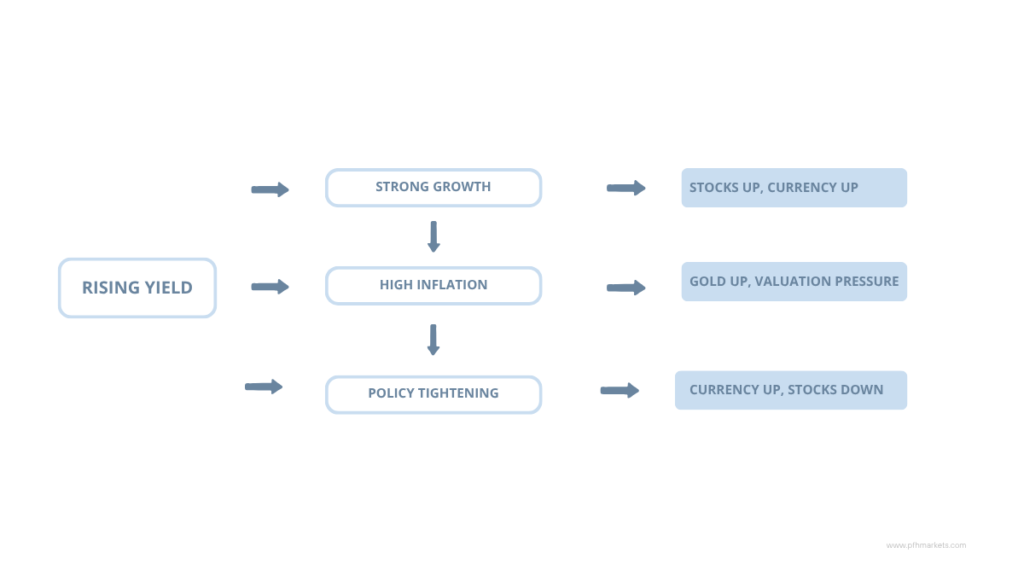
Scenario 1: Stronger Economic Growth
- Driver: Rising productivity, strong employment data, robust GDP.
- Impact: Positive for stocks (earnings expansion), positive for the currency, neutral-to-soft for gold.
Scenario 2: Higher Inflation Expectations
- Driver: Supply chain disruptions, surging commodity prices.
- Impact: Pressure on stock valuations, mixed currency reaction, potential support for gold if real yields stay low.
Scenario 3: Aggressive Central Bank Policy Tightening
- Driver: Central bank hiking cycles to cool an overheating economy.
- Impact: Strong support for domestic currency, notable headwinds for both gold and high-valuation growth stocks.
Scenario 4: Fiscal Deficit & Debt Supply Concerns
- Driver: Uncontrolled government borrowing leading to an oversupply of government debt.
- Impact: Negative for the domestic currency, rising sovereign risk premiums, downward pressure on both stocks and bonds.
What Happens When Bond Yields Fall?
Conversely, falling bond yields signal changing economic dynamics:
- Expectations of Easing: Central banks lowering interest rates to stimulate the economy.
- Slowing Economic Growth: Declining demand for credit across the private sector.
- Flight-to-Safety Demand: Rapid capital reallocation into sovereign bonds during market crises.
Cross-Market Response to Falling Yields:
- Forex: The domestic currency often weakens as yield spreads narrow.
- Gold: Gains significant traction due to declining real yields and lower opportunity cost.
- Stocks: Defensive sectors and dividend-paying equities tend to outperform, while cyclical stocks may lag if recession fears grow.
How Traders Can Read Bond Yields Alongside Other Market Signals
To integrate bond yield analysis into a multi-asset framework:
- Track the Direction of Yields: Determine whether yields are trending, range-bound, or breaking out of technical structures.
- Monitor Yield Differentials: Compare bond yields across economies (e.g., US vs Germany or US vs Japan) rather than viewing local yields in a vacuum.
- Calculate Real Yields: Deduct inflation metrics (like CPI or breakeven inflation rates) from nominal yields to evaluate gold and real asset valuations.
- Cross-Reference with Currency Pairs: Check if currency trends align with yield spread differentials to confirm capital flows.
- Watch Data Surprises: Evaluate economic data releases (NFP, CPI, PMI) relative to market consensus to anticipate yield adjustments.
- Focus on Expected Policy Paths: Recognize that yields adjust to rate expectations weeks and months before official central bank meetings.
Bond Yields and Cross-Market Relationships
In global finance, no market trades in isolation. Sovereign bond yields act as the primary linkage connecting currencies, commodities, real estate, and equities Gold, Oil and the Dollar: Understanding Cross-Market Relationships.
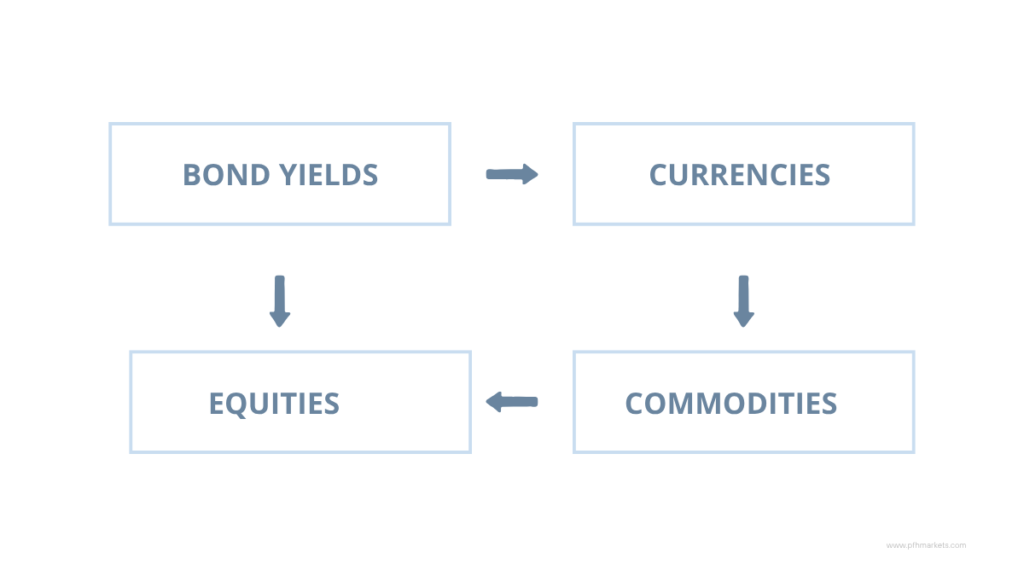
A shift in benchmark yields re-prices currency pairs, which in turn adjusts the relative price of dollar-denominated commodities like crude oil and gold, ultimately feeding back into corporate profit margins and stock market indices [Gold, Oil and the Dollar: Understanding Cross-Market Relationships].
Common Mistakes When Interpreting Bond Yields
- Mistake 1: Assuming Higher Yields Always Strengthen the Currency. Ignoring runaway inflation or sovereign debt stress can lead to wrong market assumptions.
- Mistake 2: Looking Only at Nominal Yields. Gold and currency traders who ignore inflation expectations miss the critical impact of real yields.
- Mistake 3: Assuming Rising Yields Always Depress Stocks. Failing to account for strong economic growth that boosts corporate earnings alongside yields.
- Mistake 4: Assuming Gold Always Falls When Yields Rise. Overlooking safe-haven demand, geopolitical risks, or central bank purchases.
- Mistake 5: Ignoring Why Yields Are Moving. Treating all yield spikes identically without identifying whether the driver is growth, inflation, or fiscal distress.
- Mistake 6: Analyzing Markets in Isolation. Forgetting that capital flows seamlessly across global fixed income, foreign exchange, and equity markets.
A Practical Framework for Understanding Yield-Driven Market Moves
When analyzing a sudden shift in government bond yields, follow this step-by-step diagnostic process:
[Step 1] Identify Yield Direction (Rising or Falling)
[Step 2] Determine the Driver (Growth, Inflation, Central Bank, Supply)
[Step 3] Evaluate Rate Expectations (Is policy tightening or easing anticipated?)
[Step 4] Compare Yield Differentials (How does this compare to global peer yields?)
[Step 5] Assess Currency Reaction (Does the currency reflect yield differentials?)
[Step 6] Calculate Real Yields (Subtract inflation expectations to analyze Gold)
[Step 7] Evaluate Equity Impacts (Assess discount rates vs. earnings growth)
[Step 8] Confirm with Broader Sentiment (Risk-on vs. Risk-off alignment)
FAQ
How do bond yields affect markets?
Bond yields reflect the baseline cost of money across the global economy. Changes in yields reprice corporate borrowing costs, shift global capital flows, alter currency exchange rates, and adjust equity valuation metrics.
How do bond yields affect forex?
Rising yields generally increase demand for a country’s currency as foreign capital enters to secure higher fixed-income returns, provided the yields reflect economic strength rather than runaway inflation.
Why do rising bond yields affect the US dollar?
Because US Treasuries serve as a primary global benchmark, higher US Treasury yields increase foreign demand for Dollar-denominated assets, pushing the US Dollar Index (DXY) higher.
How do bond yields affect gold prices?
Rising real bond yields increase the opportunity cost of holding non-yielding assets like gold, which can apply downward pressure on bullion prices.
Do higher bond yields always cause gold to fall?
No. Gold can rise alongside bond yields if geopolitical risk is high, central bank gold buying is strong, or if inflation is rising faster than nominal yields (keeping real yields low).
How do bond yields affect stocks?
Higher yields increase borrowing costs for businesses and raise the risk-free discount rate used in valuation models, which can pressure stock prices—particularly high-growth tech stocks.
Why can rising bond yields pressure stock valuations?
As yields rise, future corporate earnings are discounted at a higher interest rate, reducing their present value in equity valuation models.
What is the relationship between interest rates and bond yields?
Central bank policy rates directly influence short-term borrowing costs, while bond yields reflect open-market expectations of future interest rates, inflation, and economic growth over longer horizons.
Why are Treasury yields important to global markets?
US Treasury debt is viewed as the global risk-free benchmark asset. Its yields dictate corporate borrowing rates, mortgage rates, and investment returns worldwide.
What is the difference between nominal and real yields?
Nominal yield is the headline percentage rate earned on a bond. Real yield is the nominal rate minus expected inflation, reflecting the true purchasing power return.
Can bond yields move before an interest-rate decision?
Yes. Bond yields trade continuously and adjust instantly to economic data, frequently reflecting anticipated central bank rate changes weeks or months before official announcements.
Conclusion: Read Yields as a Signal, Not an Isolated Indicator
Government bond yields are an essential signal for understanding broader global market dynamics. They reflect collective market pricing on interest rates, economic growth, inflation, and risk sentiment.
When evaluating yields across asset classes:
- In Forex: Track relative yield differentials and monetary policy expectations across currency pairs.
- In Gold: Focus on real yields, inflation expectations, and safe-haven flows.
- In Stocks: Weigh the impact of discount rates against broader corporate earnings and economic growth.
By treating bond yields as a central transmission mechanism rather than an isolated metric, traders and investors can better interpret multi-asset trends and make informed financial decisions.