

In the world of global finance, asset prices rarely move in isolation. Gold, crude oil, and the US dollar form three interconnected pillars of the global marketplace. A shift in central bank policy, an sudden supply disruption, or an unexpected turn in market sentiment can send ripples across all three markets simultaneously. Movements in one asset frequently influence the others through currency pricing dynamics, inflation expectations, interest rates, and overall investor appetite for risk.
However, navigating these financial flows requires an understanding that cross-market connections are conditional rather than fixed rules. Gold and oil can rally in tandem during inflationary periods, diverge when energy supply shocks occur, or respond to completely different macro drivers. Understanding the nuances of the gold, oil and dollar relationship enables traders to decode broader market signals and evaluate shifting economic regimes without falling into the trap of assuming historical correlations always hold.
Why Gold, Oil and the US Dollar Are Connected
To understand cross-market dynamics, it is essential to first look at the underlying macroeconomic infrastructure that binds these assets together.
Why Commodities Are Commonly Priced in US Dollars
The primary bridge between physical commodities and currency markets is the global reserve currency. Key benchmark commodities ranging from precious metals to industrial energy sources are internationally quoted and traded in US dollars (USD). Because transactions occur in USD, any revaluation of the dollar directly modifies the nominal cost of these resources on the international stage.
How Currency Movements Affect International Purchasing Power
When the US dollar strengthens against a basket of foreign currencies, dollar-priced commodities become effectively more expensive for international buyers holding non-USD currencies. To maintain purchasing power, buyers in Europe, Asia, or emerging markets may curtail their import volumes, dampening global demand and putting downward pressure on nominal commodity prices. Conversely, a depreciating dollar lowers the local-currency cost of purchasing commodities, often stoking international demand.
Why Inflation, Interest Rates and Risk Sentiment Connect Different Markets
Beyond currency mechanics, three core macroeconomic drivers link these asset classes:
- Inflation: Rising energy costs (such as crude oil) feed directly into headline consumer price indices, triggering inflationary pressure. Gold often experiences increased demand as a store of value during persistent inflation.
- Interest Rates: In response to inflation, central banks adjust policy rates. Higher yields increase the opportunity cost of holding non-yielding assets like gold while supporting the national currency.
- Risk Sentiment: During periods of economic expansion, industrial energy demand drives oil higher. During crises, capital often rotates away from cyclical commodities and flees toward perceived safe-haven assets, including gold or the dollar.
Understanding the Gold–US Dollar Relationship
The interaction between gold prices and the US dollar represents one of the most widely followed cross-market pairings in financial history.
Why Gold and the Dollar Often Move in Opposite Directions
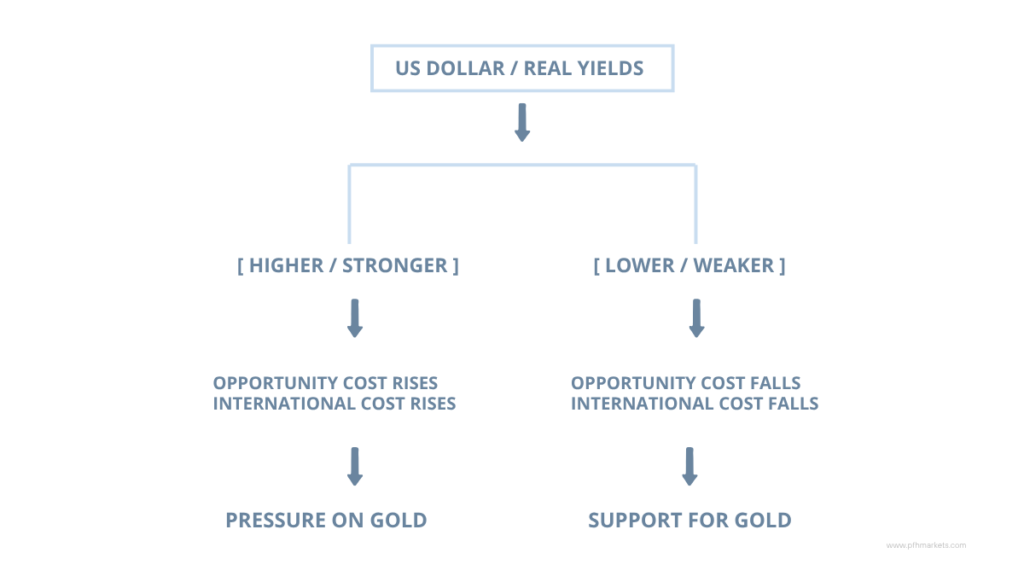
Historically, gold and the dollar exhibit an inverse relationship. Because gold is quoted in USD, a declining dollar reduces the price of gold for overseas buyers, encouraging demand. Furthermore, gold is viewed as an alternative monetary asset; when faith in fiat currency declines or currency devaluation occurs, investors frequently allocate capital to precious metals.
How Real Interest Rates and Monetary Policy Influence Gold
While nominal interest rates receive significant attention, gold is particularly sensitive to real interest rates (the nominal yield minus inflation expectations). Because gold generates no yield or coupon payment, holding gold incurs an opportunity cost.
- When real yields rise, cash and government bonds offer strong inflation-adjusted returns, making non-yielding precious metals less attractive.
- When real yields fall or turn negative, the opportunity cost of holding gold disappears, encouraging inflows into precious metals markets.
For a deeper look into institutional buying trends, monetary shifts, and structural demand, explore key gold price drivers and market outlook insights.
When Gold and the Dollar Can Rise or Fall Together
The inverse correlation between gold and the greenback is far from absolute. There are notable market conditions where both assets appreciate simultaneously:
- Global Liquidity & Geopolitical Crises: In acute international crises, risk aversion surges. Investors seek both the liquidity of the US dollar and the credit-risk-free nature of gold as safe havens.
- Stagflationary Fears: If economic growth stalls while inflation remains elevated, real yields can fall rapidly even as the Federal Reserve attempts to tighten policy, boosting gold while dollar demand remains elevated.
To evaluate broader currency strength dynamics, review the primary factors that influence US dollar strength.
Understanding the Oil–US Dollar Relationship
While gold is primarily a financial asset and store of value, crude oil is a physical consumption commodity tied directly to global economic activity and supply chains.
How Dollar Strength Can Affect International Oil Demand
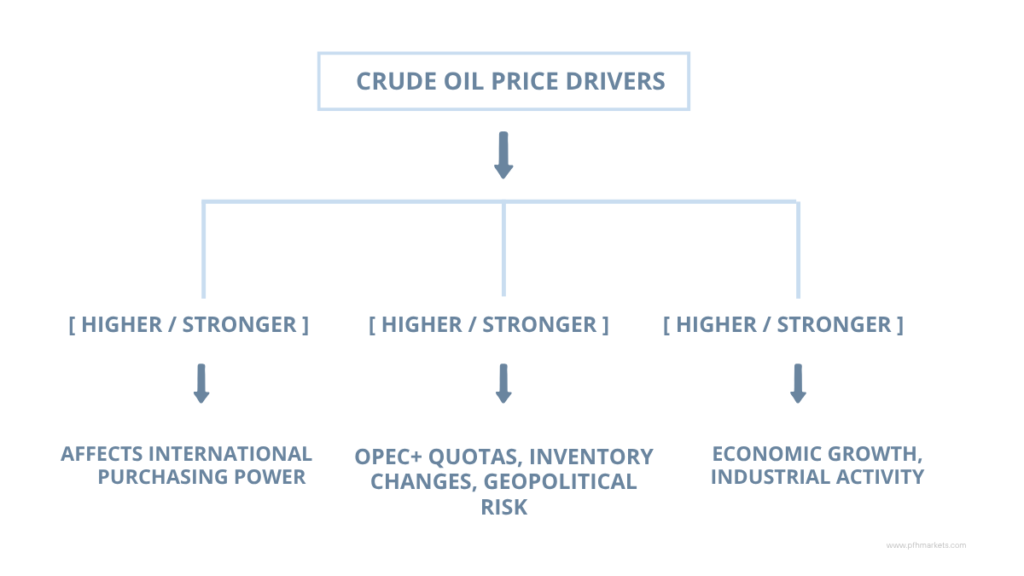
As with gold, the pricing of crude oil in US dollars links energy markets directly to FX fluctuations. A soaring dollar forces non-US refiners and industrial consumers to pay higher local-currency prices for oil imports. Over time, this currency friction can act as a drag on physical consumption and lower overall demand for energy products.
Why Oil Supply and Demand Can Outweigh Currency Effects
Despite the currency overlay, physical fundamentals frequently override dollar movements. If global demand surges during a economic boom, or if production cuts create an inventory deficit, crude oil prices can rally forcefully even in the face of a strengthening US dollar.
Understanding benchmarks like What Brent crude oil is is essential for monitoring global energy pricing mechanics.
How Geopolitical Developments and Production Decisions Influence Crude Oil Prices
Unlike financial assets, crude oil relies on fragile physical supply chains. Key drivers include:
- OPEC+ Output Quotas: Decisions by the Organization of the Petroleum Exporting Countries and partner nations to restrict or expand supply.
- Geopolitical Disruptions: Conflict or supply-route choke points in key producing regions.
- Inventory Data: Weekly storage reports detailing commercial crude stocks.
For a detailed analysis of physical energy variables, consult our guide covering the primary factors affecting Brent crude oil prices. Traders seeking direct exposure can analyze these dynamics via energy market instruments.
How Gold and Oil Prices Relate to Each Other
Comparing gold directly against crude oil reveals crucial insights into economic regimes, consumer confidence, and inflationary cycles.
When Rising Oil Prices and Gold Prices Move Together
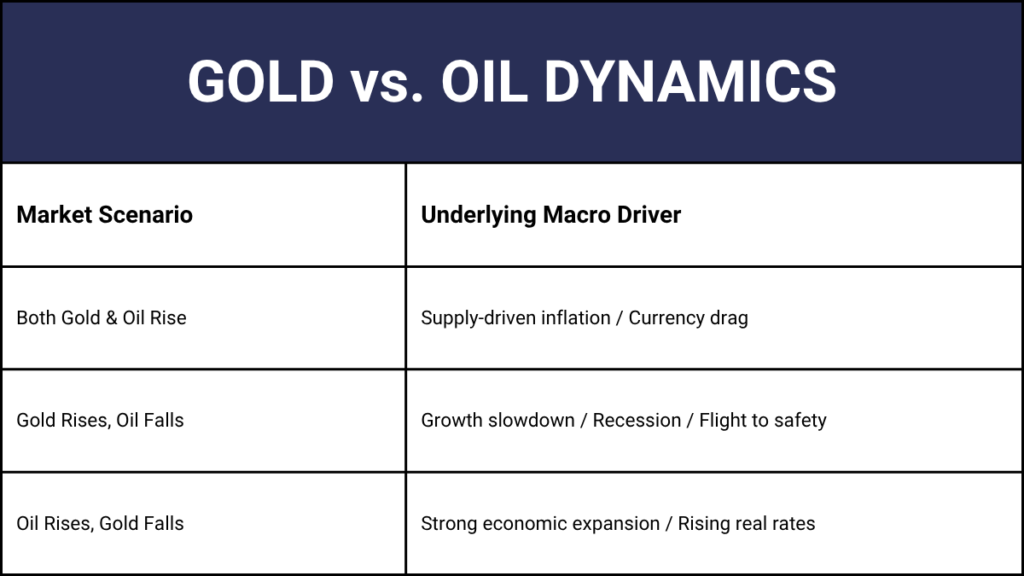
Gold and oil frequently move in tandem during cost-push inflationary cycles. A rapid surge in crude oil prices increases transportation, manufacturing, and agricultural costs throughout the economy. As headline inflation accelerates, investor demand for gold as a portfolio hedge often increases alongside rising energy prices.
When Gold Rises but Oil Falls
During economic downturns or recessions, these two commodities tend to diverge sharply:
- Crude oil drops due to falling industrial production, declining consumer travel, and weakening demand for energy.
- Gold rallies as central banks cut interest rates to stimulate the economy, causing real yields to fall while demand for safe-haven protection rises.
When Oil Rises but Gold Remains Under Pressure
In a late-cycle economic expansion, surging demand can drive oil prices higher. If central banks aggressively hike interest rates to cool down the overheating economy, rising real yields can suppress gold prices even as crude oil continues its upward trajectory.
Why the Relationship Changes Across Economic Cycles
The structural difference between the two markets stems from their economic function. Oil is consumed and relies heavily on ongoing industrial growth and physical transportation. Gold is accumulated and responds strongly to financial variables, monetary policy, real yields, and systemic risk.
Four Economic Scenarios That Can Move All Three Markets
To apply cross-market analysis effectively, traders should evaluate how specific macroeconomic environments impact all three assets simultaneously.
1. Inflation Rises and Oil Supply Tightens
- Mechanism: Geopolitical tensions or supply disruptions restrict oil production, driving crude prices sharply higher. Rising energy costs fuel broader price inflation across consumer markets.
- Asset Movements:
- Oil: Rises sharply on supply constraints.
- Gold: Gains support as investors seek inflation protection.
- US Dollar: Mixed; may strengthen if the Federal Reserve is expected to hike rates, or weaken if high energy prices threaten domestic growth.
- Alternative Outcome: If central banks signal overly aggressive monetary tightening that threatens to trigger a recession, gold may stall due to rising yield expectations.
2. Interest Rates Rise and the Dollar Strengthens
- Mechanism: Strong economic performance leads central banks to raise interest rates aggressively to prevent overheating.
- Asset Movements:
- US Dollar: Gains strength as higher yields attract global capital.
- Gold: Experiences downward pressure due to rising real yields and a stronger dollar.
- Oil: May face headwinds from currency conversion costs, though underlying physical demand can keep prices elevated temporarily.
- Alternative Outcome: If rate hikes coincide with strong global GDP expansion, raw physical demand for crude oil can outweigh dollar headwinds.
3. Economic Growth Slows and Oil Demand Weakens
- Mechanism: Global manufacturing activity contracts, consumer confidence declines, and corporate earnings drop.
- Asset Movements:
- Oil: Declines significantly on falling physical demand.
- Gold: Receives support as central banks pivot toward monetary easing and rate cuts.
- US Dollar: Often strengthens initially due to liquidity demand (“dollar smile”), but may weaken later as yields fall.
- Alternative Outcome: If a economic slowdown is accompanied by persistent inflation (stagflation), gold can rally aggressively while oil experiences volatile rangebound trading.
4. Geopolitical Uncertainty Increases Demand for Safe Havens
- Mechanism: Escalating international conflict or banking sector instability creates widespread market uncertainty.
- Asset Movements:
- Gold: Rallies strongly as capital flees risk assets.
- US Dollar: Gains support as institutional market participants seek liquid reserve assets.
- Oil: Direction depends entirely on whether the disruption involves major oil-producing regions or critical shipping lanes.
- Alternative Outcome: If a crisis occurs far from key energy infrastructure and triggers a global downturn, oil prices may fall while gold and the dollar rally.
Cross-Market Relationship Cheat Sheet
Use this reference table to evaluate typical market responses across key economic drivers:
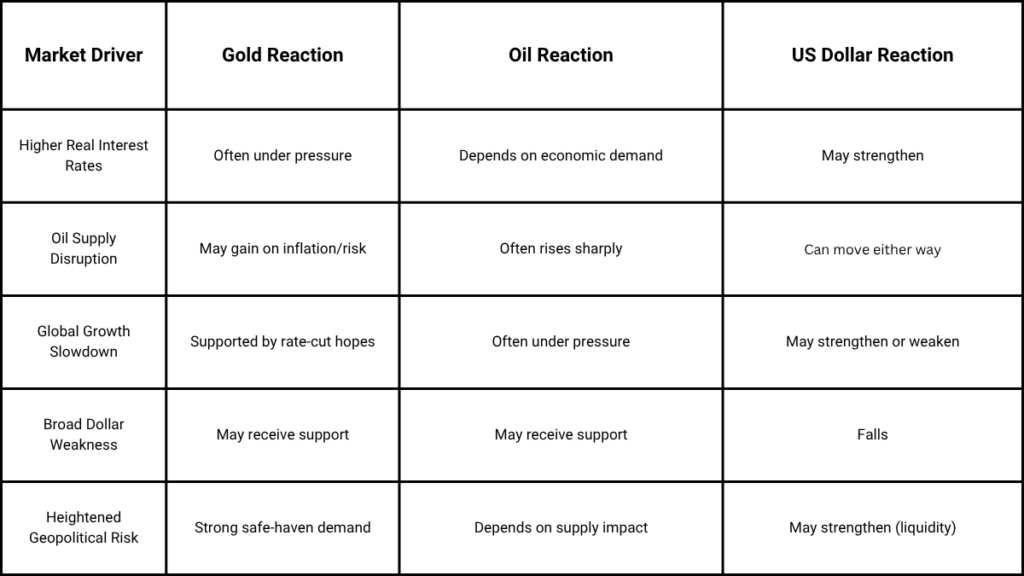
Note: The reactions outlined above represent typical directional responses based on historical precedent. They should be evaluated as potential scenarios rather than guaranteed signals.
How Traders Can Read Cross-Market Signals
Rather than relying on single-market indicators, incorporating cross-market analysis into your workflow offers a broader perspective on market context.
Step 1: Assess US Dollar Direction & Drivers
Step 2: Evaluate Oil Supply & Demand Dynamics
Step 3: Monitor Real Yields & Monetary Policy
Step 4: Compare Intermarket Relative Strength
Step 5: Confirm with Price Action & Risk Management
- Check the Dollar’s Direction and Underlying Drivers: Identify whether USD movements are driven by interest rate differentials, economic growth outperformance, or risk-off liquidity flows. Assess FX market trends using currency market movements to gauge broader foreign exchange momentum.
- Review Energy Market Fundamentals: Examine crude oil inventories, OPEC+ policy announcements, and global manufacturing PMIs to differentiate currency-driven price changes from physical supply-and-demand shifts.
- Monitor Real Yields and Inflation Expectations: Track 10-year inflation-indexed bond yields (TIPS) alongside inflation swaps. Changing real yields provide valuable context for precious metals movements.
- Compare Price Movements Across Related Assets: Look for confirmations or divergences across markets. For instance, if the dollar drops significantly but gold fails to rally, underlying demand for precious metals may be weaker than expected.
- Confirm Signals with Technical Analysis and Risk Management: Never trade on intermarket assumptions alone. Confirm setups using clear market structure, price action, defined timeframes, and robust position-sizing rules.
Common Mistakes When Interpreting Commodity Correlations
Interpreting intermarket relationships requires avoiding oversimplified rules. Here are several common pitfalls to avoid:
- Assuming Gold Always Rises When the Dollar Falls: While historically inverse, strong real yields or robust performance in competing assets can cause gold to lag even during periods of dollar weakness.
- Treating Oil as a Direct Indicator of Inflation: Crude oil impacts headline CPI, but core inflation (excluding energy and food) often dictates central bank policy. An energy spike caused strictly by short-term supply friction may not trigger rate hikes if broader demand is weak.
- Assuming Gold and Oil Must Move Together: As highlighted across economic regimes, gold and oil respond to fundamentally different demand mechanisms. Assuming they must move in tandem ignores key macro context.
- Ignoring Real Interest Rates and Supply Shocks: Focusing strictly on nominal currency levels while overlooking real yields or physical supply outages leads to incomplete market analysis.
- Treating Historical Correlations as Fixed Rules: Financial market correlations evolve over time. Structural shifts in monetary policy, domestic energy production, or global trade settlement methods can alter historical relationships.
FAQ
Why do gold prices often rise when the dollar weakens?
A weaker US dollar makes dollar-priced gold more affordable to international buyers, which can increase physical and investment demand. Additionally, a declining dollar often reflects falling real interest rates or currency debasement, conditions that historically increase demand for gold as a store of value.
Does a stronger US dollar always push oil prices lower?
Not necessarily. While a stronger dollar increases local-currency purchasing costs for overseas buyers potentially dampening demand—major physical supply shortages, OPEC+ output cuts, or booming global industrial activity can push oil prices higher regardless of dollar strength.
Can gold and oil prices rise at the same time?
Yes. Gold and oil frequently rise together during cost-push inflationary shocks, periods of broad dollar depreciation, or severe geopolitical crises that simultaneous impact energy infrastructure and drive risk-off demand into safe-haven assets.
How do interest rates affect gold, oil and the dollar?
Higher interest rates generally strengthen a country's currency by attracting capital inflows. Higher real rates increase the opportunity cost of holding non-yielding gold, creating headwinds for the metal. For crude oil, higher rates can slow down economic growth and industrial activity, indirectly reducing energy demand.
How can traders use cross-market relationships in market analysis?
Traders use cross-market relationships to gain context rather than direct entry signals. By monitoring dollar strength, bond yields, and energy trends together, traders can identify macro regimes, spot market divergences, and confirm technical price action before making informed trading decisions.
Key Takeaways
- Currency Mechanics Matter: Because gold and oil are globally priced in US dollars, shifts in USD value influence international purchasing power and overall demand dynamics.
- Distinct Fundamental Drivers: Gold is primarily driven by monetary policy, inflation expectations, real yields, and safe-haven flows. Oil is governed predominantly by industrial demand, inventory levels, OPEC+ production policies, and supply chain logistics.
- Context Over Fixed Rules: Intermarket relationships are dynamic and shift across different stages of the economic cycle. Treat cross-market signals as analytical context to supplement your risk management strategy, rather than standalone entry triggers.