

How do you actually trade Brent Crude Oil if you are new to energy markets? For many beginners, stepping into energy trading can feel overwhelming due to complex terminology, rapid market movements, and endless global headlines.
Brent Crude Oil serves as a primary benchmark for the global energy sector. Learning how to trade it requires an understanding of both the physical market drivers and the financial instruments used to gain price exposure.
This guide breaks down the essential steps to trading Brent Crude Oil from the ground up:
- What Brent Crude Oil is and how it functions as a global baseline
- How financial energy trading works
- Key instruments available to market participants
- Fundamental drivers behind daily price movements
- How to combine fundamental, technical, and sentiment analysis
- Step-by-step instructions to build a structured trading plan
- Core risk management principles and common beginner mistakes
- A practical checklist to evaluate market setups before executing a trade
If you are new to this benchmark, start by reviewing what is Brent Crude Oil to establish a solid foundation before exploring active trading concepts.
What Is Brent Crude Oil?
Brent Crude Oil is a major classification of sweet, light crude oil that serves as a benchmark price for purchases of oil worldwide.
Extracted primarily from North Sea fields situated between Western Europe and Scandinavia, Brent’s pricing reference governs approximately two-thirds of all globally traded physical crude contracts. Because of its location in ocean waters, it is easily transported via seaborne tankers, making it highly sensitive to international trade, maritime supply chains, and broader global demand.
Why Is Brent Important to Global Markets?
Brent is not just a financial contract; it is an economic driver. It directly impacts multiple sectors across the global economy:
- Energy Markets: Establishes base pricing for heating, power generation, and refined fuel products.
- Transportation: Directly influences fuel costs for shipping lines, aviation networks, and road transport.
- Manufacturing: Serves as a raw material input for plastics, synthetic materials, and industrial chemicals.
- Inflation and Consumer Costs: Rising oil prices increase input costs across supply chains, contributing to broader inflationary pressures.
- Global Economic Activity: Sharp price movements can alter corporate earnings, trade balances, and central bank monetary policies worldwide.
Brent Crude Oil vs Physical Oil
A common point of confusion for beginners is the difference between physical commodity markets and financial trading.
Trading Brent Crude Oil in financial markets does not mean taking delivery of actual steel barrels of oil. Physical crude trading involves oil producers, refinery operators, and shipping firms managing actual energy inventories. Financial traders, by contrast, utilize derivative products or contracts that track the underlying price movements of Brent to capture value from market fluctuations without managing physical storage or transport logistics.
How Does Brent Crude Oil Trading Work?
Financial energy trading operates by taking positions on whether the price of Brent crude will rise or fall relative to another asset, typically the U.S. Dollar.
The trading process involves selecting market exposure, analyzing market conditions, calculating risk parameters, executing an order, and managing the position through its exit.
What Can You Trade?
Traders can gain exposure to Brent Crude Oil prices through several distinct financial instruments:
- Futures Contracts: Standardized agreements traded on centralized exchanges (such as ICE) to buy or sell a specific quantity of oil at a predetermined price on a specified future date.
- Options Contracts: Financial derivatives that give the buyer the right, but not the obligation, to buy or sell oil contracts at a specified price within a designated timeframe.
- Contracts for Difference (CFDs): Derivative instruments that allow traders to speculate on live price movements without owning the underlying contract, settling the price difference between entry and exit in cash.
- Exchange-Traded Funds (ETFs): Investment funds traded on stock exchanges that track oil indexes or a basket of energy assets.
What Does Going Long Mean?
Going “long” means entering a trade with the expectation that the price of Brent Crude Oil will increase.
- Scenario: You analyze the market and expect global oil demand to rise while production remains constrained.
- Execution: You open a buy position at $75.00 per barrel.
- Outcome: If the price rises to $78.00, you close the position to capture the $3.00 gain per unit (minus fees and costs). Conversely, if the price drops to $72.00, the trade incurs a loss.
What Does Going Short Mean?
Going “short” means entering a trade with the expectation that the price of Brent Crude Oil will decline.
- Scenario: You anticipate that rising global supply and weakening economic activity will create an oil surplus.
- Execution: You open a sell position at $75.00 per barrel.
- Outcome: If the price falls to $71.00, you buy back to close the position, capturing the $4.00 price decline as a profit (minus fees and costs). If the price rises to $78.00, the position incurs a loss.
What Moves Brent Crude Oil Prices?
Before placing your first derivative order, it is essential to understand what moves Brent Crude Oil prices. The benchmark is primarily driven by three core forces: OPEC+ supply quotas, macroeconomic demand trends, and geopolitical risk premiums.
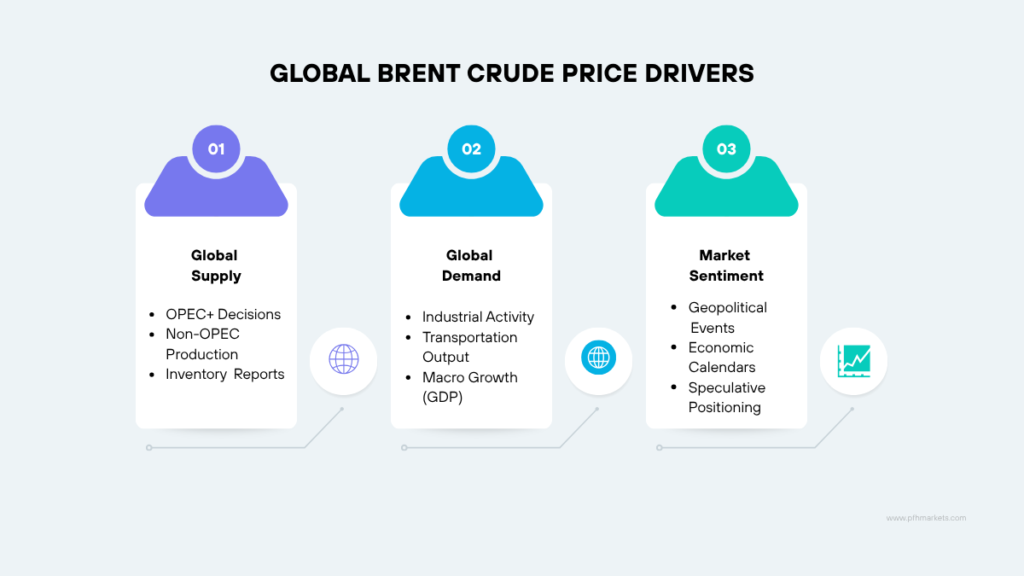
Global Oil Supply
Prices respond directly to changes in current or expected physical supply:
- Production Volumes: Shifts in output from major producing nations alter available global supply.
- Supply Disruptions: Unplanned outages caused by weather events, infrastructure damage, or labor disputes temporarily reduce supply.
- Export Capacity: Infrastructure constraints, pipeline capacity, and maritime shipping availability dictate how effectively oil reaches global buyers.
Global Oil Demand
Demand metrics reflect global macroeconomic health:
- Economic Expansion: Strong industrial activity, manufacturing expansion, and robust consumer spending increase energy consumption.
- Transportation Trends: Seasonal shifts, such as summer travel seasons or agricultural harvests, increase demand for refined products like gasoline and diesel.
OPEC+ Production Decisions
The Organization of the Petroleum Exporting Countries along with non-OPEC allies (collectively known as OPEC+) controls a substantial share of global crude output. OPEC+ policy announcements regarding voluntary production cuts, quota increases, or supply targets can shift market expectations instantly.
Oil Inventories
Market participants closely track weekly inventory releases to evaluate physical supply and demand balances:
- EIA (U.S. Energy Information Administration) Data: Weekly inventory reports provide snapshots of U.S. crude, gasoline, and distillate stockpiles.
- API (American Petroleum Institute) Reports: Preliminary inventory estimates that offer early market insights.
- Surplus vs. Deficit: Inventory builds (larger-than-expected supply) often weigh on prices, whereas inventory draws (unexpected supply reductions) can drive prices upward.
Geopolitical Developments
Because Brent is a seaborne benchmark heavily tied to international shipping lanes, it carries a “geopolitical risk premium.” Conflicts near major production regions or maritime choke points such as the Strait of Hormuz or the Suez Canal create immediate supply concerns that can trigger rapid price surges.
Economic Conditions
- Inflation: High energy prices drive inflation, which can prompt central banks to raise interest rates.
- Interest Rates: Higher borrowing costs can slow economic growth, eventually reducing energy consumption and oil demand.
- Currency Fluctuations: Because crude oil is priced globally in U.S. Dollars (USD), a stronger dollar can make crude more expensive for international buyers holding other currencies, potentially dampening global demand.
To explore these fundamental dynamics in greater detail, review our complete guide on factors affecting Brent Crude Oil prices
How to Analyse the Brent Crude Oil Market
Successful market participants avoid relying on a single source of information. Instead, they combine multiple analytical approaches to form a cohesive view.
Fundamental Analysis
Fundamental analysis focuses on why the market is moving. Traders examine macroeconomic data, supply-and-demand reports, geopolitical headlines, and OPEC+ guidance to evaluate whether Brent Crude Oil is fundamentally undervalued or overvalued at current prices.
Technical Analysis
Technical analysis focuses on when and where to plan a trade. By studying historical price charts, market participants identify key price levels and patterns:
- Trend Identification: Determining whether the market is making higher highs and higher lows (uptrend) or lower highs and lower lows (downtrend).
- Support and Resistance: Identifying price areas where buying interest historically prevents further declines (support) or selling pressure halts price advances (resistance).
- Breakouts: Spotting moments when prices break beyond established boundaries, signaling potential momentum shifts.
Market Sentiment
Sentiment reflects the collective mood or positioning of market participants. When the majority of market participants are positioned aggressively long, even minor negative news can trigger sharp sell-offs as traders rush to exit. Sentiment can be monitored through positioning reports like the Commitment of Traders (COT) report.
Economic Calendar
Key economic data releases trigger immediate volatility in energy markets. Traders monitor scheduled updates to adjust their positions ahead of high-impact events:
- Interest rate decisions by major central banks
- Consumer Price Index (CPI) and inflation data
- Purchasing Managers’ Indexes (PMI) showing manufacturing activity
- Weekly EIA oil inventory releases
Learn more about tracking these events in our guide on economic calendars
How to Build a Brent Crude Oil Trading Plan
A trading plan removes emotion from market decisions by establishing objective rules before a trade is opened.
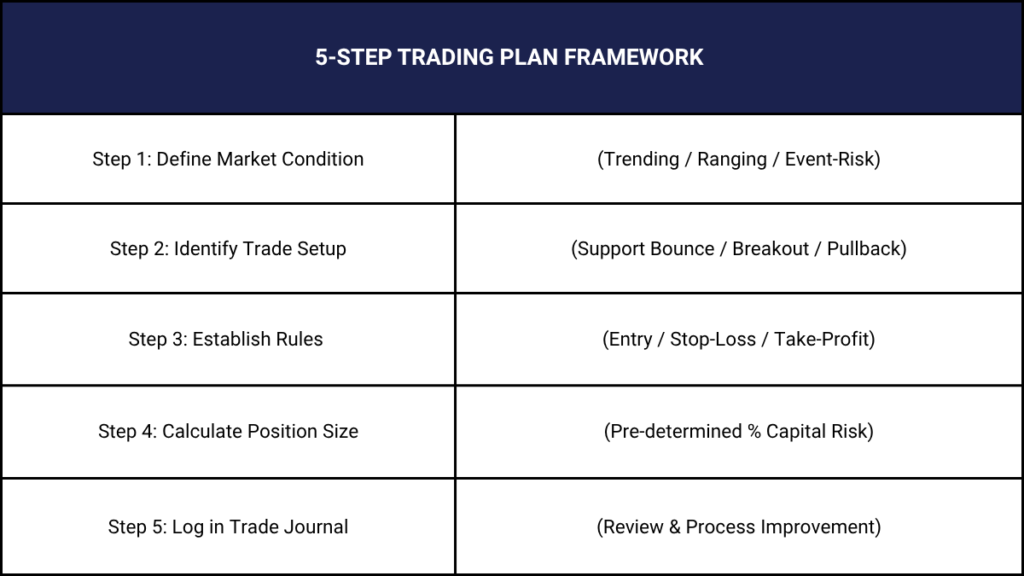
Step 1 — Define the Market Condition
Identify the current environment before looking for trade setups:
- Is Brent moving in a strong, clear trend?
- Is the price consolidating within a horizontal range?
- Is volatility elevated due to upcoming economic releases or geopolitical headlines?
Step 2 — Define the Trade Setup
Specify the exact conditions required to consider a trade. For example, a trader might decide: “I will only look for long positions if price retests a major daily support level during a fundamental market deficit.”
Step 3 — Define Entry and Exit Conditions
Know your numbers before placing an order:
- Entry Point: The precise price or signal required to open the position.
- Invalidation / Stop-Loss Level: The price level where your trade thesis is proven wrong, requiring an immediate exit to limit loss.
- Profit Target: The pre-determined price level where you will close the trade to secure gains.
Step 4 — Calculate Position Size
Determine the appropriate size of your trade based on your total account capital and the distance to your stop-loss level. Never alter your position size based on subjective confidence in a single trade setup.
Step 5 — Record the Trade
Keep a detailed trading journal. Document the reason for entry, the risk-to-reward ratio, the execution details, and the eventual outcome. Reviewing past trades helps identify recurring mistakes and refine your process over time.
Brent Crude Oil Trading Strategies for Beginners
No single trading strategy works across all market conditions. Beginners should focus on understanding how different strategic frameworks apply to specific environments.
Trend-Following
Trend traders aim to align their positions with the prevailing direction of the market.
- Concept: If global economic growth and supply deficits drive Brent higher, trend traders look for minor price pullbacks to join the upward move.
- Application: Moving averages and trend lines are commonly used to identify trend direction and potential entry areas.
Breakout Trading
Breakout strategies aim to capture price momentum when Brent moves out of a period of consolidation.
- Concept: When price consolidates between tight support and resistance bounds, energy builds up. A strong candle close outside this range can signal the start of a new directional move.
- Risk: False breakouts can occur, where price briefly pushes beyond a level before reversing sharply back into the range.
Range Trading
Range trading applies when the market lacks a strong trend and moves sideways between defined boundaries.
- Concept: Traders buy near established support levels and sell or go short near established resistance levels.
- Application: Oscillators (such as the Relative Strength Index) are frequently used to identify potential turning points near range boundaries.
Event-Driven Trading
This strategy focuses on trading around major scheduled economic announcements, OPEC+ meetings, or weekly inventory reports.
- Concept: Traders position themselves based on anticipated shifts between market forecasts and actual reported figures.
- Caution: Event-driven trading carries significant volatility risk due to wide price slippage and sudden reversals.
Combining Fundamental and Technical Analysis
Combining approaches often yields clearer context. A trader might use fundamental analysis to establish a directional bias (e.g., expecting higher oil prices due to an OPEC+ production cut) and technical analysis to select a precise entry point on the chart.
To explore strategic frameworks across different commodities, read our guide on commodity trading strategies
When Can You Trade Brent Crude Oil?
Brent Crude Oil is traded nearly 24 hours a day across global financial networks, but market activity, liquidity, and volatility vary significantly depending on the trading session.
- Asian Session: Features steady liquidity, though major price moves during these hours usually depend on economic headlines out of China or regional energy developments.
- European Session: Activity increases as European markets and physical energy desks open. This period aligns with North Sea physical market operations.
- North American Session: The busiest trading period occurs when European and U.S. trading hours overlap. The release of major U.S. economic data and EIA inventory reports during this session often triggers peak intraday volatility.
Timing your trades depends on your strategy. Intra-day momentum traders often prefer high-volatility overlaps, whereas swing traders focused on multi-day trends are less reliant on specific execution windows.
For a complete breakdown of global trading hours and session overlaps, read our detailed guide on Brent Crude Oil market hours
How Geopolitical Events Can Affect Brent Trading
Because Brent crude is heavily transported via ocean logistics, it is especially sensitive to international political and military developments.
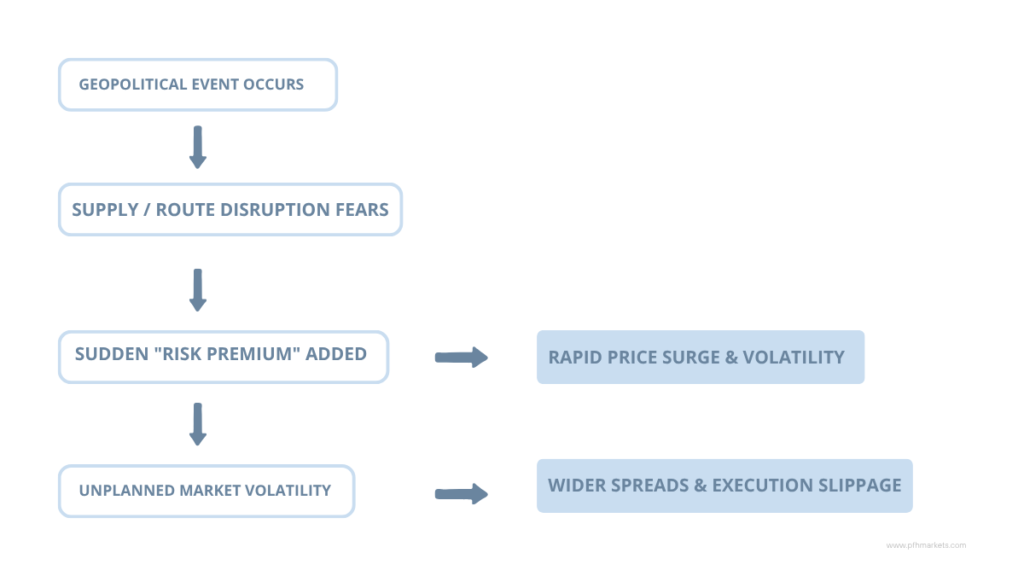
When unexpected geopolitical events occur, markets reprice risk immediately:
- Rapid Volatility: Prices can gap sharply higher or lower within seconds of major breaking news.
- Shifting Supply Assumptions: Anticipated sanction enforcement or shipping route diversions alter global supply calculations instantly.
- Emotional Overreaction: Market participants frequently react emotionally during initial headlines, leading to sharp price spikes followed by severe pullbacks once facts are confirmed.
Practical Implication for Traders: Experienced traders manage risk before high-risk geopolitical headlines occur. Chasing sudden price spikes out of emotion often leads to poor entry execution and severe losses.
To learn more about how macro headlines impact financial markets, explore our article on geopolitical events and commodities
How to Manage Risk When Trading Brent Crude Oil
Risk management is the single most important factor determining long-term survival in commodity trading. Without clear risk constraints, a single adverse price move can cause significant capital damage.
Understand Leverage
Financial instruments such as CFDs or futures often utilize leverage, allowing traders to control a large position with a relatively small initial margin deposit. While leverage increases profit potential on successful trades, it equally magnifies losses if the market moves against you.
Use Appropriate Position Size
Adjust your position size according to current market conditions. When market volatility expands significantly, reduce your position size to ensure that your monetary risk per trade remains within planned limits.
Consider Stop-Loss Orders
A stop-loss order requests that your position be closed once the market reaches a pre-determined price level. Placing stop-loss orders helps enforce discipline and prevents losses from expanding beyond your comfort level.
Understand Slippage
During periods of extreme market volatility or thin liquidity, price gaps can occur. Slippage happens when an order is executed at a different price than originally requested because no matching orders were available at the exact target price.
Monitor Volatility
Oil prices can experience rapid intraday moves following economic releases or unexpected headlines. Avoid opening positions immediately prior to major market updates unless your strategy specifically accounts for elevated volatility.
Avoid Concentrating Too Much Risk
Keep individual trade risk consistent. Avoid allocating an excessive portion of your total trading capital to a single position, regardless of how confident a setup appears.
Review our dedicated guides on CFD trading risks and slippage to build a resilient risk strategy.
Brent Crude Oil vs WTI
While Brent Crude Oil is the primary global benchmark, West Texas Intermediate (WTI) is the main reference price for North American crude.
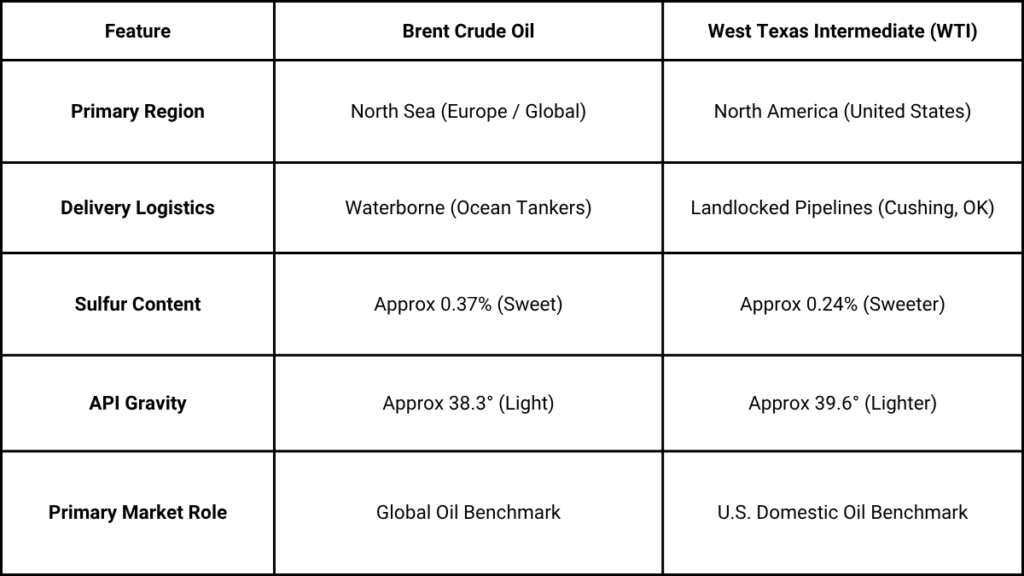
To read a detailed comparison covering physical characteristics, transportation logistics, and spread dynamics, check out our comprehensive post on Brent Crude Oil vs WTI
Common Brent Crude Oil Trading Mistakes
Beginners frequently fall into predictable traps when starting out in energy markets:
- Trading Without Understanding the Instrument: Opening positions without knowing contract sizes, point values, overnight holding fees, or leverage requirements.
- Using Excessive Leverage: Taking on position sizes that are far too large relative to account balance, leading to margin calls during normal price fluctuations.
- Ignoring Major Market Events: Placing trades right before high-impact economic releases or EIA inventory updates without accounting for sudden volatility spikes.
- Entering After an Emotional Price Spike: Buying at the top of a sudden price surge out of Fear Of Missing Out (FOMO), only to get caught in the subsequent pullback.
- Using Oversized Positions: Risking too much account capital on a single trade setup.
- Changing the Plan Mid-Trade: Moving stop-loss levels further away as price approaches them, allowing manageable losses to become severe.
- Overtrading: Opening trades without a clear setup simply because the market is moving fast.
- Focusing Only on Entries: Spending all energy on finding entry signals while failing to plan exit points and risk management parameters.
Brent Crude Oil Trading Checklist for Beginners
Use this pre-trade checklist to evaluate setups before opening a position:
- Instrument: Do I fully understand the contract specifications, leverage, and margin requirements?
- Fundamental Context: What are the current supply, demand, and OPEC+ drivers influencing Brent?
- Market Condition: Is the chart clearly trending, ranging, or showing heightened volatility?
- Event Risk: Are there upcoming EIA inventory reports, central bank announcements, or major economic releases today?
- Entry Rule: Does this setup meet all criteria outlined in my written trading plan?
- Invalidation Point: Have I identified the exact price level where this trade setup is proven wrong?
- Risk Assessment: Is my stop-loss placed at a logical technical level, and does the potential reward justify the risk?
- Position Size: Is my trade size calculated to risk only a small, predetermined percentage of my total account capital?
- Exit Strategy: Do I have clear profit target levels set before placing the order?
- Journal: Am I prepared to log this trade’s entry reasons, rules, and management details in my trading journal?
Brent Crude Oil and Other Financial Markets
Crude oil does not trade in isolation. Energy prices interact continuously with other asset classes across the global financial system.
Brent and Broader Commodity Markets
Energy assets frequently move in tandem with or in contrast to other key commodities. For instance, rising energy prices increase production and shipping costs for industrial metals and agricultural goods. To explore how crude oil compares to precious metals and natural gas, read our comparison guide on oil and other commodities
Brent and Other Asset Classes
Cross-asset traders monitor relationships across multiple markets:
- Equities: High oil prices can weigh on transport and consumer stock performance while benefiting energy sector shares.
- Currencies: Currencies of major oil-exporting nations often show correlation with crude price shifts.
- Digital Assets: Traders who analyze multi-asset volatility also track crypto markets, where market structure, continuous liquidity, and risk drivers operate differently from traditional energy benchmarks.
FAQ
What moves Brent Crude Oil prices?
Brent crude prices are primarily moved by global supply levels, demand trends, OPEC+ output policy decisions, weekly inventory reports, geopolitical developments in shipping regions, and broader macroeconomic conditions.
What is the best strategy for trading Brent Crude Oil?
There is no universally "best" strategy. Suitable approaches depend on prevailing market conditions (trending vs. ranging), trading timeframes, and an individual's personal risk tolerance and discipline.
What is the best time to trade Brent Crude Oil?
Peak liquidity and volatility generally occur during the overlap of European and U.S. trading sessions, particularly when major economic data releases or EIA inventory reports are published.
Is Brent Crude Oil highly volatile?
Yes. Energy markets can experience significant price swings driven by geopolitical headlines, sudden supply disruptions, or shifts in global demand forecasts.
What is the main difference between Brent and WTI?
Brent originates in the North Sea and serves as the primary international benchmark for seaborne crude, whereas WTI is extracted in the United States and serves as the primary North American domestic benchmark.
What risks should beginners understand before trading Brent?
Key risks include leverage magnification, price volatility, market gaps, execution slippage, and unexpected headline risk.
Can you trade Brent Crude Oil without owning physical oil?
Yes. Financial trading instruments such as CFDs, futures, options, and ETFs allow market participants to gain price exposure to Brent Crude Oil without taking physical delivery of crude barrels.
Final Thoughts on Trading Brent Crude Oil
Learning how to trade Brent Crude Oil successfully is an ongoing process of education, market observation, and risk management.
Instead of treating energy trading as a game of predicting where prices will head next, approach it as a structured discipline:
- Understand the underlying physical market and financial instruments.
- Analyse global supply, demand, technical patterns, and upcoming economic events.
- Plan every trade with defined entry, exit, and invalidation parameters.
- Manage Risk through proper position sizing and stop-loss placement.
- Execute objectively without emotional bias.
- Review past performance to continually improve your process.
By focusing on risk preservation and structured execution, you can build a methodical approach to navigating global energy markets.