

In global energy markets, there is no single, unified price for crude oil. Instead, financial media outlets and commodity exchanges track several key benchmarks. Among these options, Brent Crude Oil and West Texas Intermediate (WTI) stand out as the two most prominent choices.
While both serve as vital indicators of global energy conditions, they represent distinct production regions, physical characteristics, transportation networks, and market exposures. Therefore, a price change in one benchmark does not always guarantee an identical move in the other.
Whether you follow global macroeconomic trends or actively participate in commodity trading, understanding a Brent WTI comparison is essential. This guide covers what each benchmark represents, how physical and logistical traits differ, why the Brent-WTI price spread fluctuates, and what key factors to monitor when tracking these energy markets.
To understand the core foundations of the international oil benchmark, start by reading what is Brent Crude Oil before exploring how it compares to its North American counterpart.
What Is Brent Crude Oil?
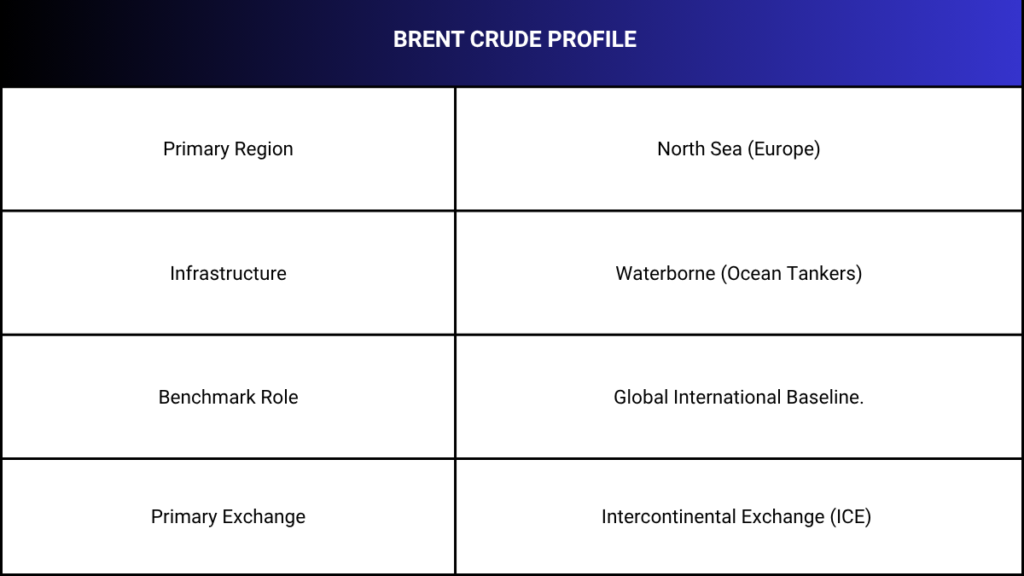
Brent Crude Oil is an international pricing standard that serves as a benchmark for approximately two-thirds of all globally traded physical crude oil.
Where Does Brent Crude Oil Come From?
Brent originates in the North Sea the body of water situated between the United Kingdom, Norway, Denmark, Germany, the Netherlands, Belgium, and France. Today, “Brent” does not refer to a single well, but to a basket of North Sea crude grades known as BFOET (Brent, Forties, Oseberg, Ekofisk, and Troll). Because these extraction platforms operate offshore, Brent Crude Oil can be loaded directly onto ocean tankers for global distribution.
Why Is Brent Important to Global Oil Markets?
The U.S. Energy Information Administration (EIA) recognizes Brent as the primary reference price for internationally traded crude oil. Furthermore, its waterborne nature means it can be shipped anywhere in the world, making its price reflective of global geopolitical shifts, international supply-demand balances, and maritime trade flows.
What Is WTI Crude Oil?
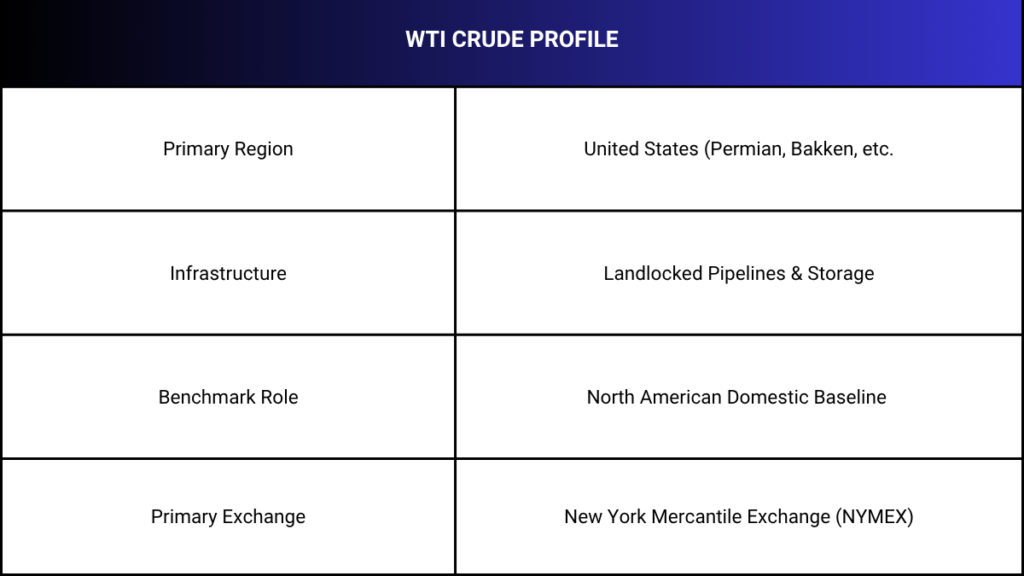
West Texas Intermediate (WTI) serves as the primary crude oil benchmark for the United States and North America.
Where Does WTI Come From?
WTI crude oil is extracted onshore across major U.S. production basins, including the Permian Basin in Texas and New Mexico, the Bakken Formation in North Dakota, and fields in Oklahoma and Louisiana.
Why Is WTI Important?
As an asset, WTI forms the underlying commodity for futures contracts traded on the New York Mercantile Exchange (NYMEX). Consequently, it provides a baseline for North American domestic oil production economics, U.S. refining activity, and regional supply conditions. Unlike Brent, WTI is landlocked in its primary delivery network, centering around a major storage hub in Cushing, Oklahoma.
Brent Crude Oil vs WTI: Key Differences
While both assets track the energy sector, examining specific Brent crude oil differences reveals structural divergence across geography, physical composition, and transportation networks.
Geographic Origin
- Brent: Extracted offshore in the North Sea, this grade reflects global market dynamics across Europe, Africa, the Middle East, and Asia.
- WTI: Harvested onshore in North America, this baseline is primarily sensitive to U.S. domestic production, inland pipeline networks, and domestic inventory balances.
Physical Characteristics
Evaluating WTI crude oil characteristics alongside Brent shows minor variations in density and purity:
API Gravity = (141.5 / Specific Gravity at 60°F) – 131.5
- Density (API Gravity): Higher API gravity indicates lighter oil. WTI typically features an API gravity of around 39.6°, while Brent sits around 38.3°. As a result, WTI is slightly lighter.
- Sulfur Content: Crude with sulfur under 0.5% is considered “sweet”. Specifically, WTI contains roughly 0.24% sulfur, whereas Brent contains roughly 0.37% to 0.40%. Thus, WTI is marginally sweeter, making it slightly easier and cheaper to refine into high-grade gasoline.
Both belong to the light, sweet category, but WTI is chemically slightly higher in quality.
API Gravity (Higher = Lighter)
WTI   [ 39.6° ]  =======================================>
Brent [ 38.3° ]  ===================================>

                 Sulfur Content (Lower = Sweeter)
WTI   [ 0.24% ]  ========>
Brent [ 0.37% ]  =============>
Transportation and Delivery
- Brent: Fully waterborne logistics allow this crude to be loaded onto ocean tankers directly from coastal facilities. As a result, transport costs to international buyers remain lower and shipping routes remain flexible.
- WTI: Dependent on land-based pipeline infrastructure, this crude settles physically at Cushing, Oklahoma. If pipelines or storage tanks in Oklahoma become bottlenecked, WTI prices can drop locally even when international demand is strong.
Market Role
As primary global oil benchmarks, Brent acts as an international proxy for global supply-demand dynamics and geopolitical risk premiums. In contrast, WTI serves as the benchmark for U.S. shale production and domestic consumption.
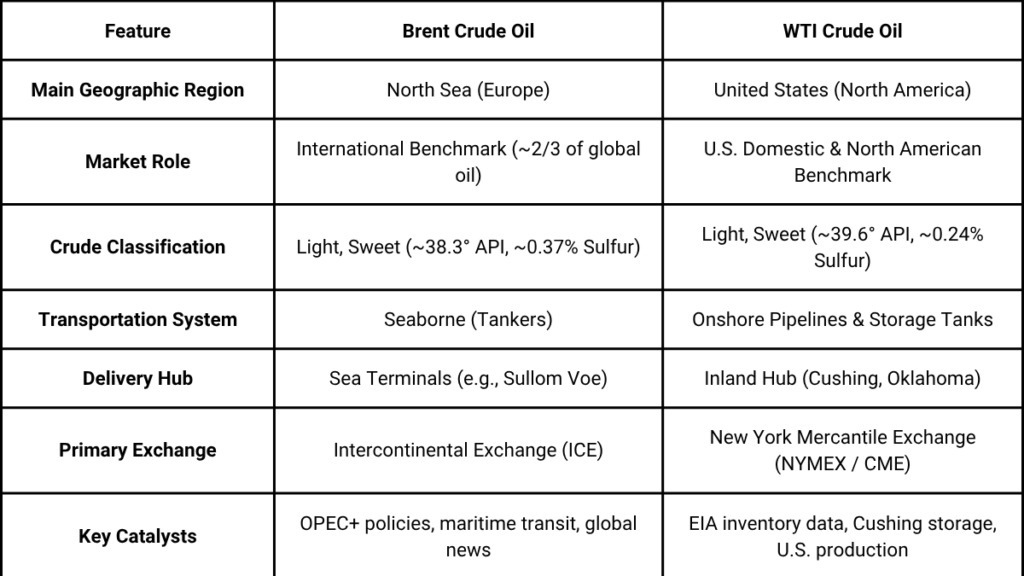
Brent vs WTI Comparison Table
The following table summarizes the structural differences between both benchmarks:
Why Do Brent and WTI Prices Differ?
Although both assets represent light crude oil, Brent vs WTI prices do not trade at parity. Several physical and market factors cause their prices to diverge:
- Regional Supply and Demand: Surging U.S. domestic supply due to high shale output can depress WTI prices while international supply disruptions keep Brent elevated.
- Transportation Costs: Moving oil via ocean tankers is generally cheaper over long distances than shipping it across land through multi-state pipeline systems.
- Storage Bottlenecks: When storage levels at Cushing, Oklahoma near maximum capacity, local spot prices for WTI drop sharply as buyers demand discounts to take delivery.
- Quality Differences: A slightly lower sulfur content gives WTI a small refining premium under normal local conditions, though transport constraints frequently outweigh this factor.
- Geopolitical Exposure: Events affecting major ocean shipping routes or international producers impact Brent immediately. Meanwhile, WTI can remain partially insulated by U.S. domestic reserves.
What Is the Brent-WTI Spread?
The Brent-WTI spread refers to the price difference between one barrel of Brent crude oil and one barrel of WTI crude oil.
Brent-WTI Spread = Price of Brent Crude – Price of WTI Crude
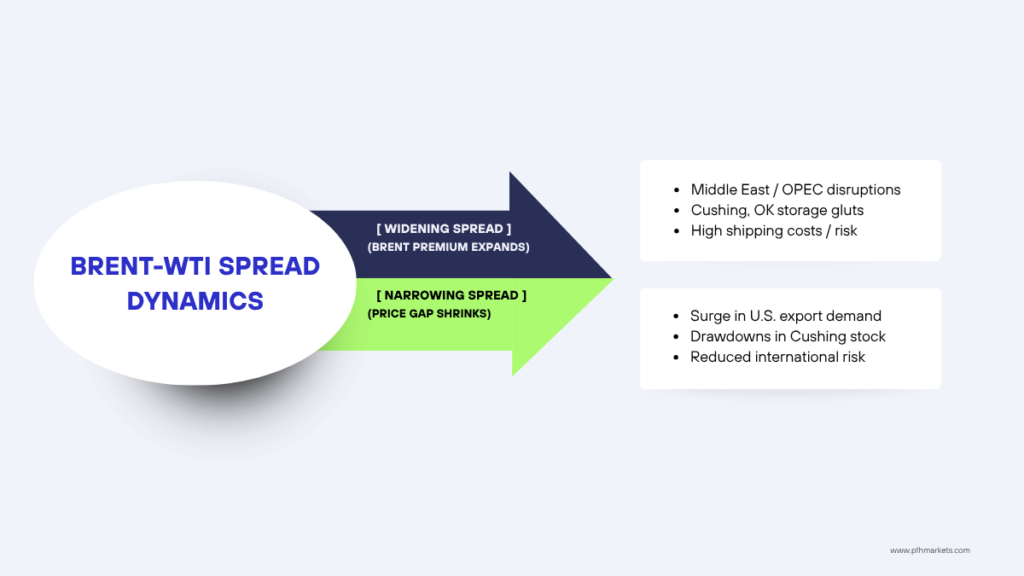
Historically, WTI traded at a premium to Brent due to its superior refining quality. However, following the U.S. shale boom and increased North American production, Brent has typically traded at a premium over WTI.
What Can Cause the Spread to Widen?
- International supply disruptions or OPEC+ production cuts that restrict seaborne crude.
- Pipeline bottlenecks or surplus storage builds at Cushing, Oklahoma, dragging down WTI prices.
- Escalating geopolitical tensions near international maritime chokepoints.
What Can Cause the Spread to Narrow?
- Strong global demand for U.S. crude exports that reduces domestic inventories.
- Expansion of U.S. pipeline infrastructure connecting inland storage directly to Gulf Coast export facilities.
- Rising North Sea production or reduced international demand relative to North American consumption.
What Factors Influence Both Brent and WTI?
While regional conditions create price gaps, both benchmarks share fundamental macroeconomic drivers.
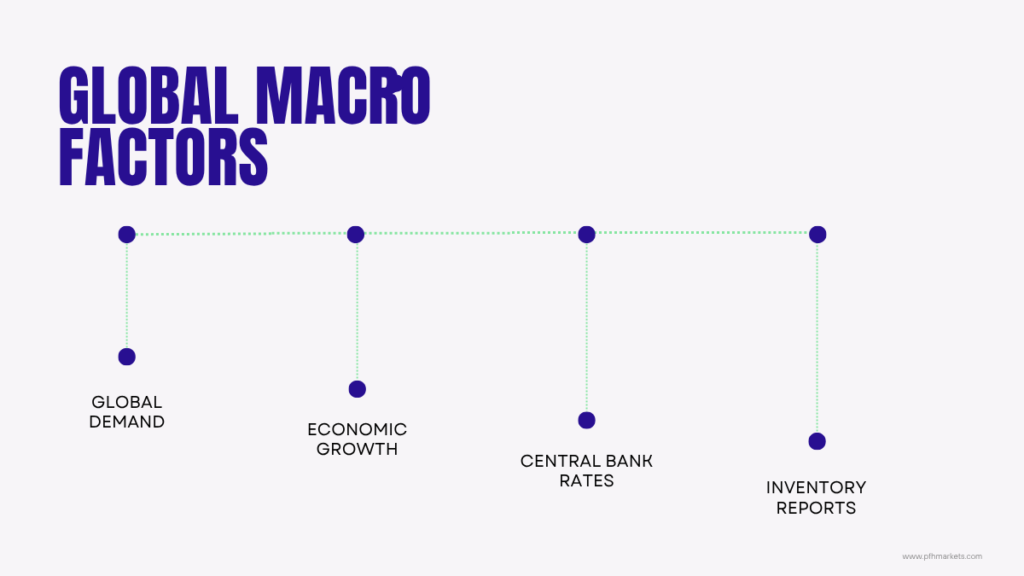
- Global Oil Supply and Demand: Global economic health dictates overall fuel consumption, setting the broader trend for both benchmarks.
- Economic Growth: Strong GDP expansion and elevated industrial production increase energy consumption across all markets.
- Geopolitical Events: Tensions involving major oil-producing nations create uncertainty that influences energy prices worldwide.
- Oil Inventories: Market participants evaluate weekly inventory data from the EIA and API to gauge physical supply balance.
- Currency Valuations: Because crude oil is priced internationally in U.S. Dollars (USD), changes in dollar strength alter purchasing power for global buyers.
For a deep dive into the specific mechanisms that drive daily energy price movements, read our companion guide on factors affecting Brent Crude Oil prices.
How Geopolitical Events Can Affect Brent and WTI Differently
International events do not impact both benchmarks equally. Because Brent pricing reflects seaborne trade, it incorporates an international risk premium whenever maritime routes or foreign production fields face security threats.
For example, conflict in the Middle East or shipping friction in the Red Sea directly threatens Brent delivery routes. WTI may also experience price increases due to general market sentiment. However, its domestic production infrastructure remains physically isolated from international shipping hazards.
To explore how geopolitical headlines alter market volatility across multiple asset classes, read our full article on geopolitical events and oil prices.
How Economic Data Can Influence Brent and WTI
Economic releases alter demand expectations for energy products. However, the location of the data determines which benchmark reacts first:
- U.S. Data Releases: Reports covering U.S. Non-Farm Payrolls, domestic GDP updates, and EIA weekly inventories usually trigger an immediate reaction in WTI.
- Global / Chinese Data Releases: Output metrics from China, European inflation updates, or global trade figures exert a stronger influence on Brent.
Traders monitor these scheduled data releases using tools explained in our guide on economic calendars and commodity prices.
Brent vs WTI for Traders
What Should Traders Monitor?
To follow both crude markets effectively, traders maintain a structured observation routine:
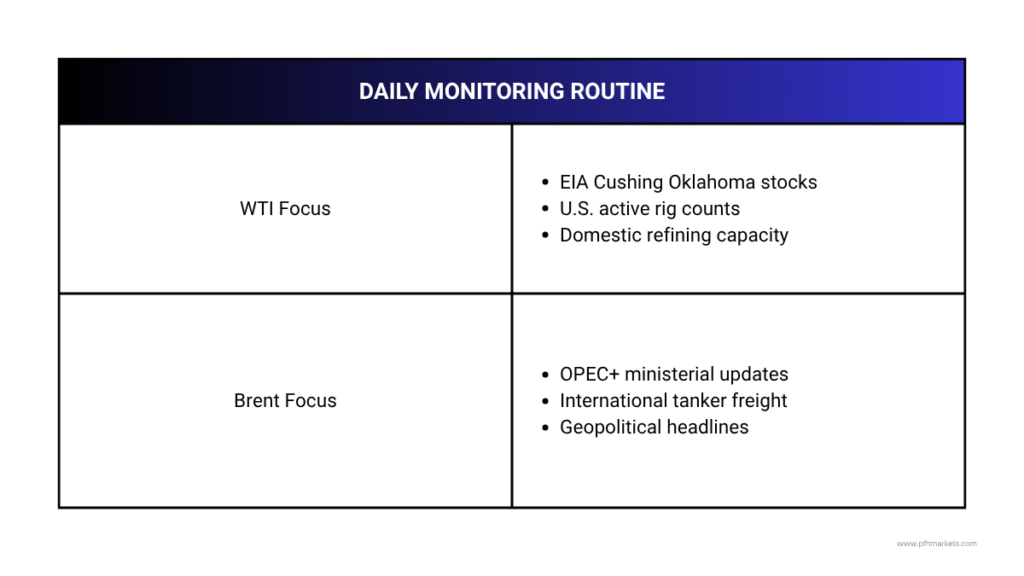
Why Understanding the Benchmark Matters
Selecting the correct market instrument depends on what event you are tracking. If your objective is to trade around domestic U.S. inventory reports or North American logistics, WTI offers direct exposure. Conversely, if your focus centers on international supply cuts, OPEC+ decisions, or geopolitical risk premiums, Brent provides a closer match.
Brent vs WTI and Broader Commodity Markets
Crude oil does not trade in an isolated bubble. Price shifts in energy benchmarks ripple across adjacent financial markets:
- Natural Gas & Refined Products: Changes in crude oil prices impact power generation costs and refining margins.
- Precious Metals: Rising oil prices can drive inflation, influencing investor demand for safe-haven assets like Gold.
- Broader Assets: Energy assets are frequently evaluated alongside other asset classes. Traders looking at diversified portfolios often evaluate oil and other commodities to measure relative risk across different economic sectors.
Furthermore, traders monitoring global cross-asset sentiment occasionally review non-traditional markets like crypto markets, where liquidity and risk appetite can behave differently from traditional energy markets.
Risks to Consider When Trading Crude Oil
Trading crude oil derivative contracts involves substantial risk due to energy market dynamics:
- High Volatility: Unscheduled geopolitical news or sudden OPEC+ statements can cause rapid price spikes or drops.
- Leverage Risks: Leveraged derivative instruments magnify both potential gains and potential losses.
- Slippage and Spreads: Fast-moving markets can lead to widening bid-ask spreads and execution slippage during major news events.
Market participants should thoroughly evaluate CFD trading risks and implement strict risk management tools, such as stop-loss orders, prior to opening positions.
Brent Crude Oil vs WTI: What Should Beginners Remember?
To summarize this Brent WTI comparison, keep these key principles in mind:
- Two Benchmarks: Brent and WTI represent different regional markets and physical delivery networks.
- Quality Profile: Both are light, sweet crudes, though WTI is marginally lighter and sweeter.
- Logistics: Brent relies on seaborne ocean tankers, whereas WTI relies heavily on inland pipeline networks and storage at Cushing, Oklahoma.
- The Spread: The price gap between them is called the Brent-WTI spread and changes based on regional supply and demand conditions.
- Geopolitical Risk: Brent carries higher direct exposure to international geopolitical events and shipping route disruptions.
FAQ
Is Brent or WTI the global oil benchmark?
Brent is considered the primary global baseline, pricing roughly two-thirds of all internationally traded physical crude cargoes.
Why are Brent and WTI prices different?
Prices differ due to distinct regional supply balances, local inventory levels, transport infrastructure costs, and varying exposure to international geopolitical risks.
What is the Brent-WTI spread?
The Brent-WTI spread is the price difference between one barrel of Brent crude oil and one barrel of WTI crude oil.
Is WTI lighter than Brent?
Yes. WTI has an API gravity of around 39.6° compared to Brent’s 38.3°, making WTI slightly lighter in density.
What factors affect both Brent and WTI?
Both benchmarks are driven by overall global economic growth, central bank policies, consumer fuel demand, and global oil inventory trends.
Can Brent and WTI prices move in different directions?
Yes. Regional events such as localized storage bottlenecks in Oklahoma or isolated shipping disruptions in Europe can cause their prices to temporarily move independently.
Why should traders understand the difference between Brent and WTI?
Understanding the differences helps traders select the appropriate asset for their analysis, ensuring their position aligns with domestic U.S. data or international market catalysts.
Final Thoughts
Brent and WTI are both vital crude oil benchmarks, but they reflect different geographic markets, supply chains, and pricing conditions. Recognizing their physical traits, transportation networks, and regional drivers provides a solid foundation for evaluating price charts and interpreting market news.
To build your practical knowledge of energy markets, explore our comprehensive energy trading section to review available market instruments and analysis tools.