
When financial news headlines report that the US Dollar (USD) is rallying or slumping, it can often feel as though a single headline triggered the move. However, the world’s primary reserve currency does not move in response to isolated events. The value of the greenback is a dynamic reflection of changing global expectations surrounding interest rates, inflation, economic momentum, bond yields, central bank policy, risk sentiment, and international capital flows.
Crucially, currency markets operate on relative valuation. The US dollar can strengthen not only when the US economic outlook improves, but also when the US outlook merely appears stronger or less vulnerable than that of other major economies.
Understanding why the dollar strengthens or weakens requires analyzing how these macroeconomic puzzle pieces fit together.
What Determines the Strength of the US Dollar?
At its core, the exchange rate of the US dollar is driven by supply and demand. When global demand for dollars or dollar denominated financial assets outstrips supply, the currency appreciates. When demand wanes or supply expands relative to demand, the dollar depreciates.
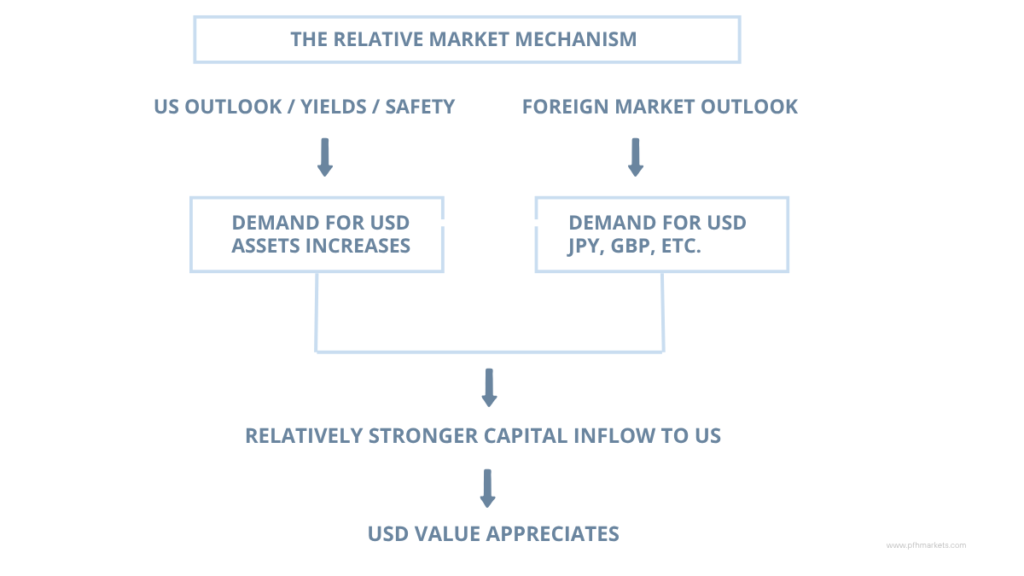
Because foreign exchange trading always involves currency pairs (e.g., EUR/USD or USD/JPY), valuation is inherently relative. If the US economy expands by 2%, but the Eurozone economy contracts by 1%, the dollar will often gain ground against the Euro simply due to the divergent trajectory.
Furthermore, currency markets are forward-looking. Prices rarely wait for official economic publications; they shift in real time as market participants continuously adjust their forecasts and position ahead of expected data releases.The US dollar is involved in many of the world’s most actively traded currency pairs, making it an important part of the global forex trading market.
Factor #1: Interest Rates and Federal Reserve Policy
Interest rates set by the Federal Reserve represent one of the most powerful drivers of US dollar strength.
The Mechanism: Yield Differential
Capital naturally flows toward environments offering higher risk-adjusted returns. When the Fed raises interest rates, yields on short-term US dollar-denominated assets (such as Treasury bills and commercial paper) increase. Foreign and domestic investors seek to capture these higher yields, creating sustained demand for USD to purchase those assets.
- Higher or Rising US Rates: Generally supports USD strength as capital flows in to capture higher yields.
- Lower or Falling US Rates: Generally pressures the USD downward as yield differentials narrow or favor other currencies.
Federal Reserve Raises Rates ──► US Asset Yields Increase ──► Global Capital Demand Rises ──► USD Strengthens
Expectations vs. Actual Announcements
Markets price in central bank moves long before they occur. If the market already expects a 25-basis-point rate hike, the announcement itself may produce little market movement. Instead, traders focus on forward guidance the Fed’s subtle hints regarding future monetary policy path. To understand how monetary-policy expectations can ripple across asset classes, see our detailed guide on how interest rate decisions affect forex markets, gold, and digital assets.
Factor #2: Inflation and Purchasing Power
Inflation measures the rate at which the purchasing power of a currency erodes. However, its impact on the exchange rate is two-sided and strongly mediated by central bank policy.
The Inflation Transmission Mechanism
In traditional economics, high inflation diminishes a currency’s domestic purchasing power, which can lead to depreciation over the long term. In modern foreign exchange markets, however, short-to-medium-term price action is dominated by how central banks are expected to react to inflation data.
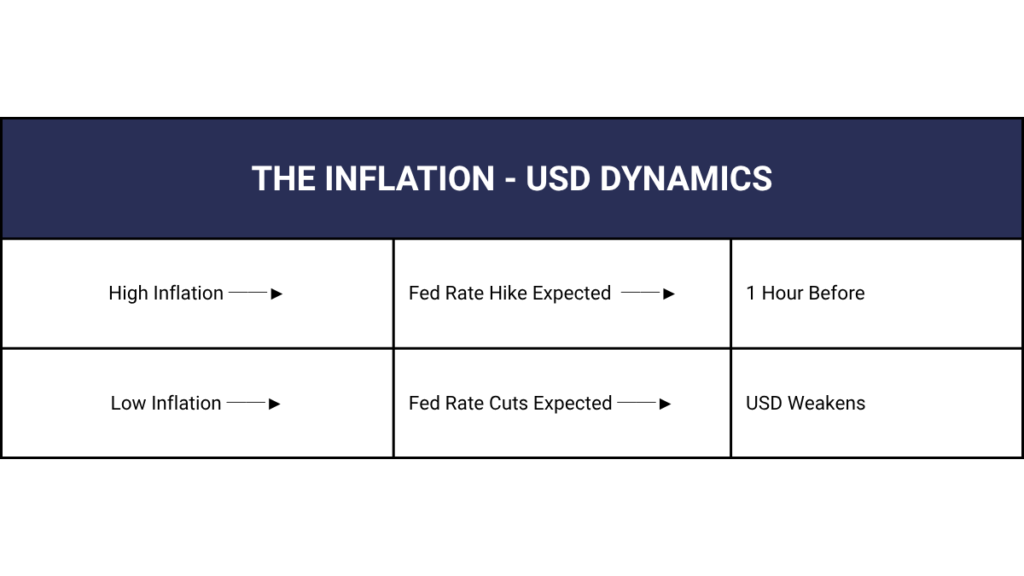
- High Inflation (Hawkish Catalyst): When indicators like the Consumer Price Index (CPI) or Personal Consumption Expenditures (PCE) price index print higher than anticipated, traders expect the Fed to maintain tight monetary policy or raise interest rates. This expectation often boosts the dollar.
- Falling Inflation (Dovish Catalyst): As inflation cools toward the Fed’s target, expectations for interest rate cuts build, which can reduce the dollar’s yield advantage and lead to weakness.
Factor #3: US Economic Growth and Economic Data
Strong economic performance attracts foreign investment into domestic equity markets, real estate, and business ventures, all of which require converting foreign capital into US dollars.
Key Economic Indicators to Watch
Traders monitor high-impact data points to evaluate the momentum of the US economy:
- Gross Domestic Product (GDP): Broadest measure of economic output and health.
- Employment Data (Non-Farm Payrolls, Unemployment Rate): A strong labor market fuels consumer spending and wage growth, influencing monetary policy.
- Retail Sales & Consumer Confidence: Measures the health of the US consumer, which accounts for roughly 70% of US GDP.
- Purchasing Managers’ Index (PMI): Gauges business expansion or contraction across manufacturing and services.
When economic releases beat consensus expectations, the dollar often rallies as growth projections improve. Conversely, weak data prints can drag the dollar down. To track these scheduled releases, learn how to read an economic calendar to effectively anticipate market volatility.
Factor #4: US Treasury Yields and Bond Markets
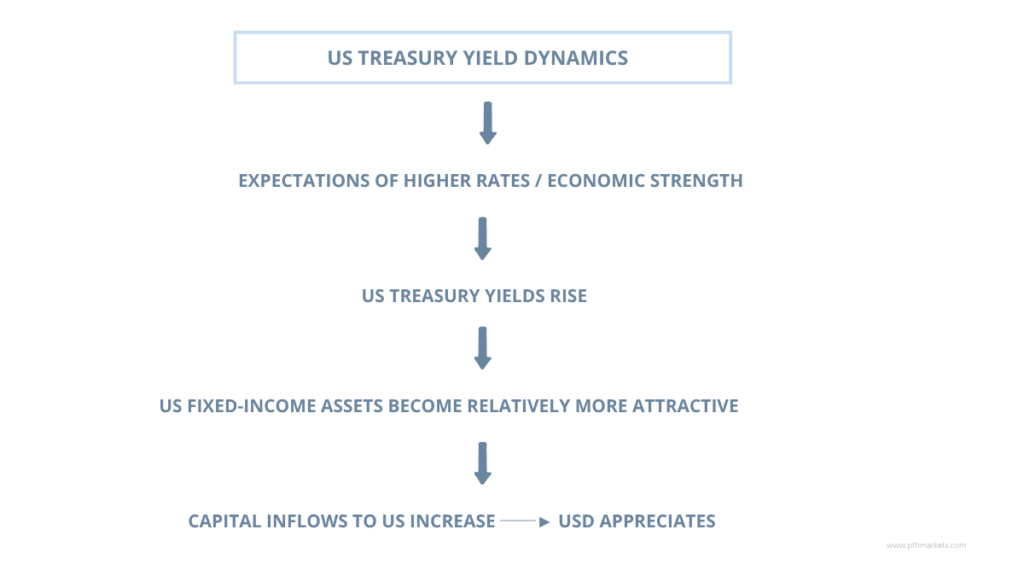
The US Treasury market is the largest and most liquid sovereign debt market in the world. Yields on Treasury benchmark bonds especially the 2-year and 10-year notes—act as a real-time gauge of global interest rate expectations and risk sentiment.
How Yields Influence the Dollar
When US Treasury yields rise faster than bond yields in Europe, Japan, or the UK, the “yield spread” widens in favor of the US. International portfolio managers relocate capital into Treasuries to lock in higher returns, driving up the value of the dollar.
However, context matters: if Treasury yields are spiking specifically due to fears of unsustainable government debt expansion or hyperinflation, rising yields can occasionally coincide with a weaker dollar.
Factor #5: Global Risk Sentiment and Safe-Haven Demand
The US dollar occupies a unique position in global finance: it serves as both a high-yielding growth currency during stable times and the world’s ultimate safe-haven currency during periods of global crisis.
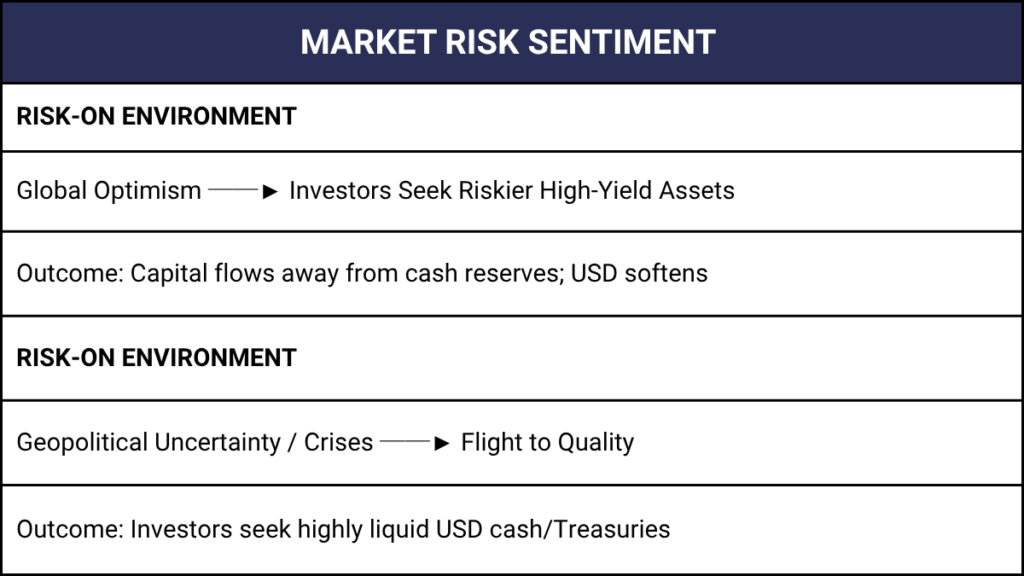
Risk-On vs. Risk-Off Environments
- Risk-On Sentiment: When global economic growth is synchronized and financial markets are calm, investors feel comfortable deploying capital into higher-yielding emerging market currencies, commodities, or equities. Demand for cash reserves diminishes, which can exert downward pressure on the USD.
- Risk-Off Sentiment: During periods of geopolitical conflict, international banking stress, or fears of global recession, investors prioritize capital preservation over return. Capital flees risk assets and moves directly into US dollars and Treasuries due to their unmatched market liquidity and institutional safety.
Interestingly, the US dollar can strengthen during a global crisis even if the source of the distress originates within the United States, simply because international institutions still require USD liquidity to settle debts and balance obligations. To learn more about how broader market moods shift capital across currency pairs, read our detailed analysis on global risk sentiment in forex.
Factor #6: Capital Flows and Demand for US Assets
Beyond central bank policies and economic data, long-term structural demand for US financial assets heavily influences the dollar’s valuation.
What Are Capital Flows?
Capital flows track the net movement of funds for investment across international borders. Because the US hosts the world’s deepest financial markets including major stock exchanges like the NYSE and Nasdaq global investors continuously exchange local currencies for dollars to participate in American corporate equity and debt markets.
Foreign Sovereign / Pension Funds ──► Buy US Equities/Bonds ──► Net Inflow of USD ──► Structural Support
When foreign institutional investors expand their exposure to US technology companies or corporate bonds, capital inflows provide structural support to the dollar. If foreign allocations toward US assets drop or reverse into net capital outflows, dollar demand declines accordingly.
Factor #7: Relative Strength of Other Major Economies
Because currencies trade in pairs, a fundamental shift in another major economy can cause the dollar to move even if there is no news in the US.
The Comparative Assessment
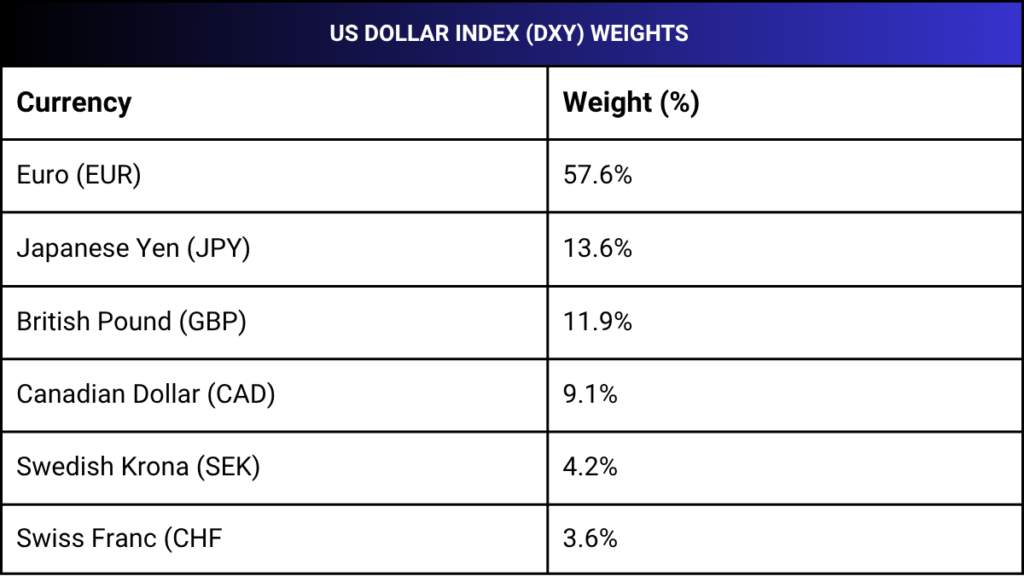
For example, if the US economy is experiencing moderate growth, but the European Central Bank (ECB) unexpectedly cuts interest rates due to economic contraction in the Eurozone, the Euro will depreciate. Because the Euro makes up over 57% of the US Dollar Index (DXY), a falling Euro automatically propels the dollar higher on a relative basis.
Understanding this relative framework is essential when evaluating major USD currency pairs like EUR/USD, GBP/USD, or USD/JPY, where performance depends on the economic differential between two nations.
How the Dollar Index (DXY) Helps Traders Measure USD Strength
To evaluate whether the US dollar is strengthening globally or merely fluctuating against a single currency, market participants use the US Dollar Index (DXY).
DXY vs. a Single USD Pair: What’s the Difference?
- Single Pair (e.g., USD/CAD): Reflects bilateral economic conditions specifically between the US and Canada (such as crude oil prices affecting the Canadian dollar).
- Dollar Index (DXY): Measures broad, basket-wide dollar strength. If USD/CAD is rising but DXY is falling, it indicates that the move is driven by Canadian dollar weakness rather than broad-based US dollar strength.
Why the US Dollar Can Strengthen When the US Economy Looks Weak
It can be confusing when the US dollar rallies following a dismal economic announcement. This counterintuitive behavior usually occurs under four specific conditions:
- Rival Economies Are Fairing Worse: If the US economy slows down, but European or Asian economies contract at a much faster rate, the US remains the “cleanest shirt in the dirty laundry.”
- Global Safe-Haven Demand Triggers: Weak US data can raise fears of a broader global recession, prompting international investors to abandon risky assets and hide in liquid USD cash.
- Rates Remain Relatively Higher for Longer: Even if US growth stumbles, if US interest rates remain higher than those in Europe or Japan, yield differentials continue to favor the dollar.
- Treasury Yield Alignment: If weak domestic economic news drives investors out of US stocks and into safe-haven US government bonds, the surge in bond demand can support the dollar.
Why the US Dollar Can Weaken When US Data Looks Strong
Conversely, robust economic reports do not always guarantee a stronger greenback. The dollar can slump despite strong domestic numbers when:
- Good News Was Already “Priced In”: If traders aggressively bought the dollar in anticipation of strong data, the actual release can trigger “sell the fact” profit-taking.
- Foreign Central Banks Turn Hawkish: Strong global growth may encourage the European Central Bank or Bank of England to hike rates faster than the Fed, shifting capital toward non-USD currencies.
- Risk Appetite Surge (Risk-On): Strong US data can reassure global markets that a severe recession will be avoided, encouraging investors to move capital out of defensive USD cash and into higher-yielding emerging market currencies.
USD and Gold: Understanding the Inverse Relationship
Gold and the US dollar historically share an inverse relationship, making cross-asset tracking popular among macro traders.
USD Appreciates / Yields Rise ──► Gold Becomes More Expensive for Foreign Buyers ──► Gold Prices Soften
The Drivers Behind the Correlation
- Pricing Currency Effect: Because physical gold is priced globally in US dollars, a stronger dollar makes gold more expensive for holders of foreign currencies, dampening global demand.
- Opportunity Cost & Yields: Gold yields 0%. When US dollar yields and Treasury returns rise, holding non-yielding gold carries a higher opportunity cost, steering capital into USD assets.
To dive deeper into how these assets interact, read our analysis on USD and gold correlation in financial markets.
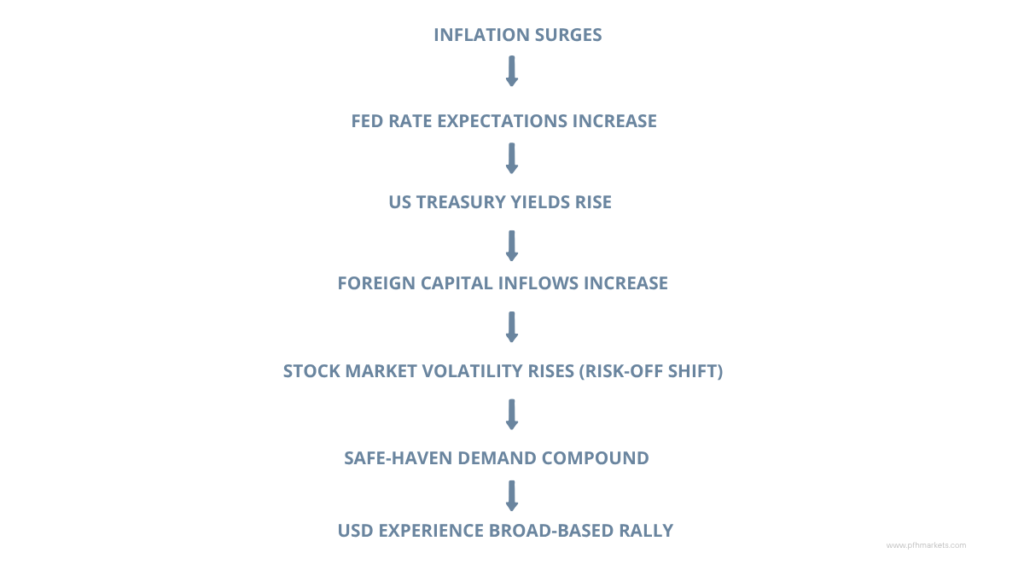
How the 7 USD Drivers Work Together
In live markets, these seven factors operate as a connected web rather than in isolation. A change in one variable sets off a chain reaction across the others:
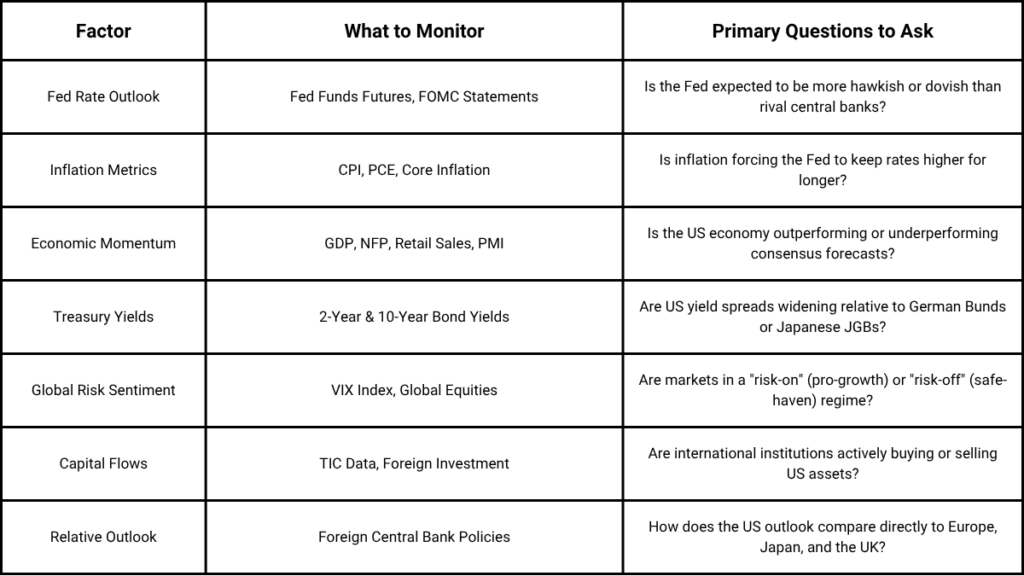
A Practical USD Strength Checklist for Traders
Before taking a position on a dollar-denominated currency pair or commodity, evaluate these core market variables:
Common Mistakes When Analyzing US Dollar Strength
- Assuming Strong Data Always Means a Stronger Dollar: Ignoring what the market had already anticipated or failing to check global risk sentiment.
- Evaluating the USD in Isolation: Forgetting that currency values are relative to the counter-currency in the pair.
- Confusing Single-Pair Moves with Broad Dollar Trends: Looking at a spike in USD/CAD (which might be driven entirely by dropping crude oil prices) and assuming the dollar is strengthening across the board.
- Ignoring the Bond Market: Tracking equity charts while overlooking shifts in US Treasury yields and yield differentials.
- Treating Historical Correlations as Fixed Rules: Expecting gold or stocks to move in strict opposition to the dollar 100% of the time, ignoring periods when both rise simultaneously due to systemic risk.
FAQ
Why does the US dollar weaken?
The US dollar weakens when expectations for US interest rates fall, domestic economic data underperforms, inflation cools rapidly, or global risk sentiment improves (prompting investors to shift capital into higher-yielding non-USD assets).
Does higher inflation strengthen or weaken the dollar?
In the short term, higher inflation often strengthens the dollar because it increases expectations that the Federal Reserve will raise interest rates to combat rising prices. In the long term, sustained high inflation erodes currency purchasing power.
What is the US Dollar Index (DXY)?
The US Dollar Index (DXY) is a weighted benchmark that measures the value of the US dollar against a basket of six major foreign currencies: the Euro, Japanese Yen, British Pound, Canadian Dollar, Swedish Krona, and Swiss Franc.
Why does the dollar rise during times of market crisis?
During periods of economic or geopolitical crisis, investors prioritize liquidity and capital preservation. Because the US dollar is the world's primary reserve currency and US Treasuries are considered highly secure, capital moves into USD as a safe haven.
Conclusion: Think in Relationships, Not Isolated Indicators
Analyzing the movements of the US dollar requires adopting a macro perspective centered on relative expectations. The greenback does not operate in a vacuum. By evaluating interest rate differentials, Treasury yield trends, global risk sentiment, and relative economic growth together, traders can build a clearer picture of broad currency trends.
Understanding these relationships can help traders develop a broader view of global financial markets. PFH Markets provides access to multiple markets through its trading environment. Rather than asking “Is the US economy strong?”, traders should ask:
How does the US economic trajectory and rate environment compare to the rest of the world, and what are markets already pricing in?