

It is a familiar scenario for anyone observing financial markets: a major economic report such as an inflation update or employment report is scheduled for release at 8:30 AM. Yet long before the official announcement arrives, prices across currencies, commodities, and stock indices have already begun moving significantly. When the actual data is finally published, the market might barely react or it might even reverse and move in the opposite direction.
Why do prices adjust before the news comes out?
The short answer is that financial markets do not simply react to what happens; they continuously adjust to what participants expect to happen.
Understanding why markets move before scheduled news releases requires examining the mechanics of market expectations, how forecasts shape positioning, and what happens when reality diverges from consensus predictions.
What Does “Market Expectations” Mean?
To understand pre-news price action, one must first grasp how market consensus is formed and evaluated.
Market Expectations Explained
In trading and investing, market expectations represent the collective anticipation of market participants regarding an upcoming economic event, financial metric, or policy decision.
These expectations encompass predictions about:
- Inflation indicators (e.g., Consumer Price Index / CPI)
- Interest rate decisions by central banks like the Federal Reserve or European Central Bank
- Employment metrics (e.g., Non-Farm Payrolls, unemployment rates)
- Economic growth data (e.g., Gross Domestic Product / GDP)
- Corporate earnings reports and industry surveys
Rather than waiting passively, traders, algorithms, and institutional investors constantly assess available evidence to estimate what the upcoming figure will be.
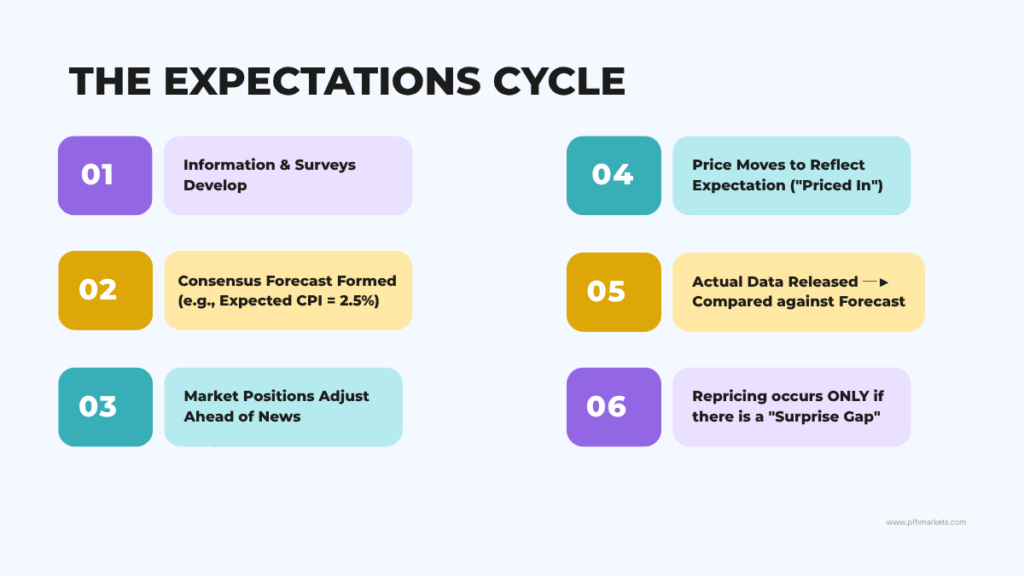
Forecast vs. Actual Data
Before every major economic release, economists and analysts submit forecasts, which are aggregated into a consensus forecast.
- Forecast (Consensus): The expected benchmark number based on analyst surveys and economic models.
- Actual Data: The official quantitative figure published by government agencies or statistical bureaus.
Consider two simplified scenarios for an inflation report with a consensus forecast of 2.5%:
- Scenario A: Forecast = 2.5%, Actual = 2.5%. There is zero deviation; the outcome confirms what the market anticipated.
- Scenario B: Forecast = 2.5%, Actual = 3.2%. The actual release deviates significantly, creating a data surprise.
Why the Forecast Matters Before the Release
Financial assets are priced in real time based on available information. If a central bank is widely expected to raise interest rates next week, investors do not wait until the official press conference to adjust their portfolios. They begin buying or selling beforehand to reflect the higher probability of that rate hike. Consequently, the consensus forecast serves as the baseline against which current prices are set.
Why Do Markets Move Before the News?
There are several distinct fundamental and structural drivers behind pre-news price movements.
1. Traders Position Ahead of Expected Data
When participants form strong convictions about an upcoming report based on leading indicators such as preliminary surveys or previous data trends they open positions early to capture potential gains. As buying or selling pressure builds up in one direction ahead of the release, price action reflects this shift in positioning.
2. Expectations Are Already Reflected in Prices (“Priced In”)
The concept of being “priced in” is fundamental to market behavior. When an outcome is considered highly probable, the asset’s current price gradually moves to a level that accounts for that outcome.
If the market has fully priced in a 25-basis-point interest rate cut, the actual announcement of that cut may yield little to no additional price movement because the adjustment occurred in the days or hours prior.
3. Forecasts Can Change Before the Official Announcement
Economic expectations are not static. In the lead-up to a primary announcement, supporting data points arrive continuously:
- Secondary economic indicators or regional surveys
- Speeches or casual remarks by central bank policymakers
- Rapid shifts in global energy or commodity prices
As these intermediate inputs arrive, analysts adjust their consensus forecasts, prompting ongoing price recalculations prior to the primary release.
4. Market Sentiment Can Shift Early
Broader market sentiment—such as a shift from “risk-on” (optimistic growth outlook) to “risk-off” (defensive posture) can accelerate pre-news adjustments. If macroeconomic conditions foster growing anxiety over recession risks, traders may de-risk their portfolios hours before employment data is officially published.
5. Institutional Positioning and Capital Flow Adjustments
Institutional market participants including pension funds, hedge funds, and liquidity providers manage massive pools of capital. To avoid taking extreme execution risks directly during high-volatility news windows, these large entities frequently rebalance or hedge their exposure in advance, creating discernible price trends leading up to scheduled events.
How Expectations Become Price Action
The shift from speculative expectations to chart patterns follows a clear, cyclical sequence:
- Information Input: Secondary data, policy speeches, or survey results emerge.
- Forecast Revision: Analysts update their expectations and probability models.
- Sentiment & Consensus Shift: The broader market aligns behind a new expected outcome.
- Positioning: Market participants open, close, or hedge trades accordingly.
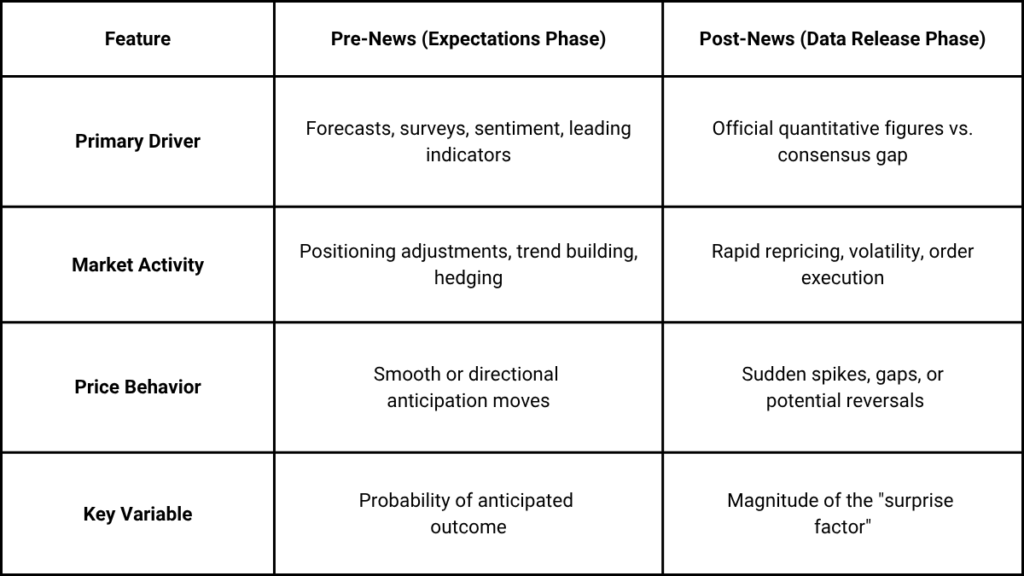
- Pre-News Price Action: The asset’s price trends or shifts toward the new equilibrium before the news breaks.
- Data Release: The official number is published.
- Comparison & Surprise Evaluation: The market compares the actual data against the consensus baseline.
- Repricing / Realignment: The market rapidly reprices if there is a gap between expectations and reality, or stays flat if expectations were met.
What Happens When Actual Data Is Released?
When the scheduled clock hits the release time, the market reaction is determined by how closely the actual figure matches the pre-news expectations.
Actual Data Matches Expectations
When published data aligns perfectly with consensus forecasts, the release often produces a surprisingly muted market reaction. Because the news was already “priced in” during the preceding period, there is no new information to justify further price adjustments.
Actual Data Beats Expectations
When an economic indicator surpasses forecasts (e.g., employment growth comes in much stronger than anticipated), it creates a positive surprise gap. Prices reprice quickly to account for the stronger macroeconomic environment or the increased probability of tighter monetary policy.
Actual Data Misses Expectations
If data falls short of expectations, it triggers a negative surprise. Assets that had rallied in anticipation of strong data may experience sharp sell-offs as traders rapidly unwind their long positions.
Why “Good News” Can Sometimes Cause Prices to Fall
A common point of confusion occurs when a positive economic report causes an asset’s price to drop. This typically happens for two reasons:
- Interest Rate Implications: Abundantly strong economic growth or employment data can heighten fears that central banks will raise interest rates to combat inflation. Higher interest rates can weigh on stock valuations and gold.
- “Sell the Fact” Dynamics: If buyers aggressively bid up an asset prior to the report, they may use the official positive announcement as liquidity to close their positions and take profits, driving the price downward.
Why Price Can Move in the Opposite Direction After News
It is not uncommon to observe an asset trending upward for hours before a release, only to plummet instantly the moment favorable news is published. Several factors explain these post-news reversals:
- Result Was Already Fully Priced In: The pre-news trend exhausted the buying pressure; no additional buyers remain to push the price higher once the news is official.
- Insufficient Surprise Magnitude: While the data was positive, it was not “good enough” relative to aggressive pre-news market pricing.
- Focusing on Forward Guidance: Traders often look beyond the main headline figure to examine underlying details (e.g., wage growth figures inside a broader jobs report) or forward-looking central bank guidance.
- Crowded Positioning: When too many participants hold the exact same position, even a minor discrepancy in the news report can trigger a cascade of stop-loss orders and profit-taking in the opposite direction.
- Cross-Asset Interactions: A simultaneous shift in benchmark government bond yields, foreign exchange rates, or energy prices can override the immediate reaction to a single headline report.
How Economic Expectations Affect Different Markets
Changing macroeconomic expectations impact various financial asset classes in distinct ways.
1. Currency Markets
In Forex markets, exchange rates are heavily driven by comparative interest rate differentials and monetary policy outlooks. If upcoming inflation data is expected to force a central bank to maintain higher interest rates, domestic currency demand often increases well before the official rate announcement. Because interest-rate and economic expectations can influence currency valuations, understanding how Forex markets respond to changing expectations is an important part of interpreting pre-news price action.
2. Precious Metals Markets
Precious metals like gold and silver are sensitive to real interest rates, inflation projections, and global economic uncertainty. Changes in interest-rate expectations can also influence precious metals markets, particularly when traders reassess the potential direction of central bank monetary policy prior to key policy updates.
3. Equity Markets and Global Indices
Stock indices reflect expected corporate earnings and macroeconomic financial conditions. Changes in growth and interest-rate expectations can influence global indices as investors reassess the outlook for corporate profitability and cost of capital ahead of major economic reports.
The Role of Economic Calendars
To navigate market expectations effectively, market participants rely on structured tools to track upcoming announcements.
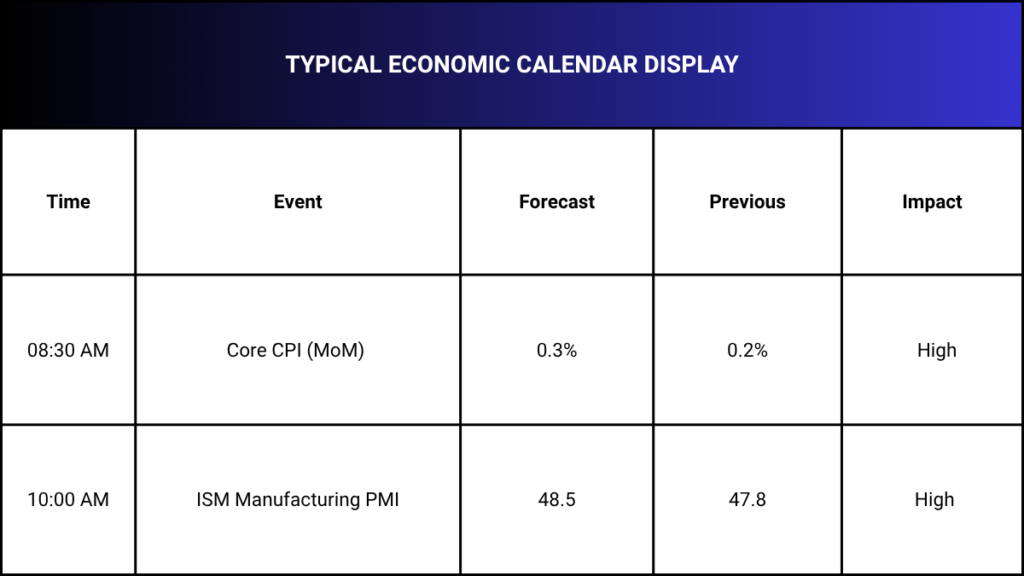
Before analyzing potential market reactions, beginners should understand how to read an economic calendar, including forecasts, previous readings, and scheduled release times.
Understanding how economic calendars impact markets can help clarify why expectations begin influencing prices well before official releases take place.
A Practical Example: The Inflation Report Scenario
To illustrate how pre-news price movements work in practice, consider a hypothetical Consumer Price Index (CPI) release:
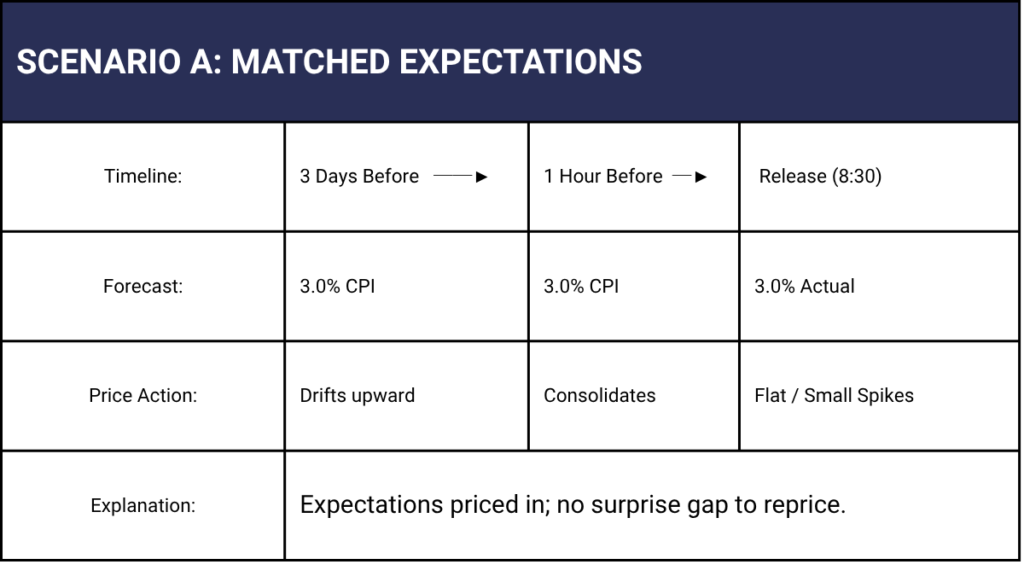
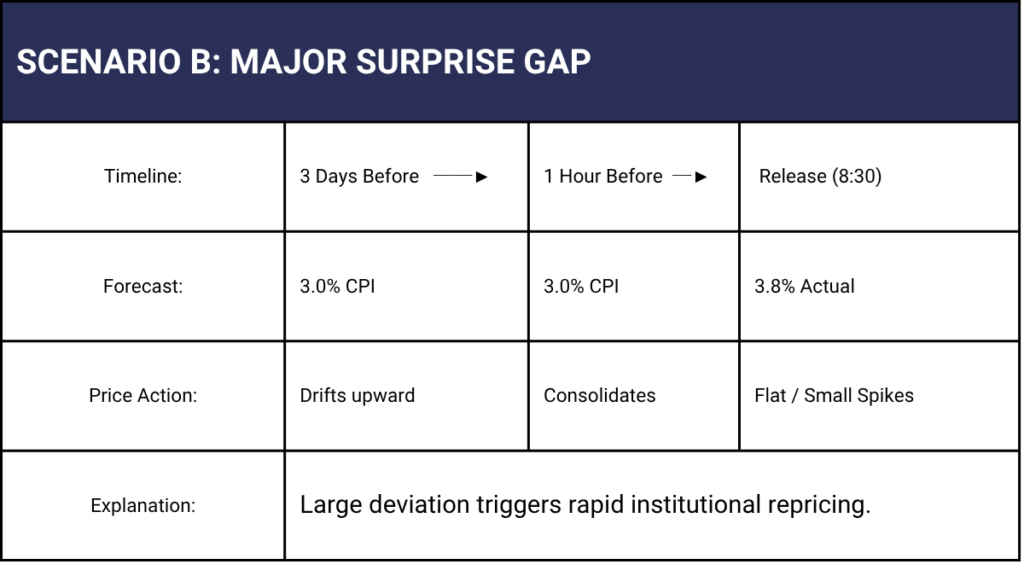
In Scenario A, because the official release yields no new information beyond what was already forecast, the immediate price reaction remains contained. In Scenario B, the significant divergence forces immediate and widespread portfolio adjustments.
Economic Expectations vs. Actual Data
Should Traders Trade Before the News?
Navigating markets prior to major news events carries distinct structural risks that require careful risk management.
Anticipating vs. Reacting
- Anticipating an Event: Entering a trade before the release based on expected data forecasts. This approach carries higher uncertainty, as an unexpected data outcome can trigger rapid losses.
- Reacting to an Event: Waiting for official data to be published, assessing the market’s initial reaction, and identifying structured entries after the initial volatility subsides.
Structural Risks During News Releases
- Spread Widening: During high-impact releases, liquidity providers often widen bid-ask spreads to protect against sudden market jumps.
- Slippage: Extremely rapid price movements can result in trade orders being executed at prices different from the requested levels.
- Severe Volatility & Whipsaws: Sharp, multi-directional price spikes can trigger stop-loss orders on both long and short positions within seconds.
How Beginners Can Read Pre-News Price Moves
Rather than attempting to guess exact economic numbers, beginners can evaluate pre-news conditions using an analytical framework:
- Upcoming Events: Which scheduled report is approaching on the economic calendar?
- Consensus Benchmark: What is the exact forecast consensus among analysts?
- Historical Baseline: What was the previous reading, and what is the broader multi-month trend?
- Chart Behavior: Is the market trending in a direction that suggests a specific outcome is already priced in?
- Surprise Threshold: What specific data figure would constitute a significant surprise gap?
- Risk Parameters: Are stop-loss levels placed to handle temporary spread widening or elevated volatility?
Common Misconceptions About Pre-News Price Moves
- Myth 1: “Pre-news movement means someone leaked the data.”
- Fact: While illegal leaks are rare exceptions, pre-news price movements are almost universally driven by standard market participants adjusting positions based on public forecasts and changing probabilities.
- Myth 2: “If price rises before good news, it will automatically keep rising after.”
- Fact: If the good news was already fully priced in, the release can trigger profit-taking and a sharp downward reversal.
- Myth 3: “Only the headline number matters.”
- Fact: Markets analyze underlying components (e.g., revisions to prior months, wage growth sub-indexes, or secondary survey details) alongside the main headline figure.
- Myth 4: “A strong economic report always increases currency value.”
- Fact: The market’s reaction depends on how the economic report influences central bank interest rate projections and broader macroeconomic sentiment.
Key Takeaways
- Financial markets are forward-looking and constantly price in expected future events.
- Prices adjust leading up to news releases as traders position around consensus forecasts.
- When actual data matches forecasts, post-news market movement is often limited because the event was already “priced in.”
- Market volatility during releases is primarily driven by the surprise gap between actual numbers and consensus expectations.
- Understanding market expectations across currencies, metals, and indices helps explain why prices move before economic announcements occur.
FAQ
What are market expectations in trading?
Market expectations represent the collective consensus of analysts, investors, and traders regarding upcoming economic metrics, interest rate decisions, or corporate earnings reports.
What does "priced in" mean in trading?
"Priced in" describes a scenario where an asset's current price already reflects an anticipated future event or data outcome, resulting in minimal price movement when the event officially occurs.
Why do markets sometimes fall after positive economic news?
Markets may fall after positive news if the result was already fully priced in (prompting "sell the fact" profit-taking) or if strong economic data increases expectations that central banks will raise interest rates.
How do economic forecasts affect markets?
Economic forecasts serve as the benchmark baseline for pricing assets. If a forecast shifts significantly prior to a report, asset prices adjust ahead of time to align with the new consensus.