

Economic recessions drastically alter financial markets, changing how capital flows across global economies. While equities often face broad selling pressure during a downturn, currency markets behave differently. Because currencies are traded in relative pairs, a recession in one country or region does not automatically mean every currency declines. Instead, recessions trigger shifts in interest rates, monetary policy, central bank guidance, and investor sentiment, making Forex Recession Trading a distinct discipline that requires a specialized approach.
Navigating currency markets during an economic slowdown presents both significant structural risks and unique tactical opportunities. Understanding how slower economic growth influences relative currency strength and applying disciplined risk management is essential for evaluating the market environment. This comprehensive guide outlines how recessions impact currency values, key economic indicators to monitor, defensive trading strategies, and actionable frameworks to help you analyze recession-driven forex volatility.
For a broader perspective on current macroeconomic trends, explore our Forex Market Outlook
What Happens to Forex Markets During an Economic Recession?
An economic recession is broadly defined as a sustained period of declining economic activity across an economy, typically visible in GDP, employment, manufacturing, and trade data. In foreign exchange, however, the primary driver of price action is not just the decline itself, but how central banks, institutional investors, and global capital markets react to it.
       Economic Slowdown / Negative Data
                     │
                     ▼
       Central Bank Monetary Easing
         (Interest Rate Cuts / QE)
                     │
                     ▼
       Shifts in Interest-Rate Differentials
                     │
                     ▼
       Reallocation of Global Capital Flows
                     │
        ┌────────────┴────────────┐
        ▼                         ▼
Risk-Off Sentiment       Search for Yield /
(Safe-Haven Inflows)    Relative Growth Assets
Slower Economic Growth
When a country enters a recession, consumer spending contracts, business investment slows, and corporate earnings drop. Weak domestic growth weakens the fundamental backing of a currency, reducing international demand for domestic assets and corporate investments.
Changing Interest-Rate Expectations
Currency valuations are heavily driven by expectations of future interest rates. During an economic downturn, central banks often pivot toward monetary easing lowering benchmark interest rates to stimulate borrowing and investment. When market participants anticipate rate cuts, the yields on fixed-income assets tied to that currency drop, making the currency less attractive to global yield-seeking capital. Learn more about how interest rate decisions
drive market expectations.
Shifts in Investor Risk Sentiment
Recessions alter risk appetite across financial markets. Periods of elevated market uncertainty generally trigger “risk-off” environment cycles, where capital moves away from higher-yielding or emerging market currencies toward traditionally defensive assets and major liquidity hubs.
Increased Forex Volatility
Economic downturns rarely unfold in a smooth, predictable fashion. High-impact data releases, unexpected central bank interventions, and sudden shifts in market narrative frequently cause sharp price swings, leading to heightened volatility across major and cross currency pairs.
How Recession Changes Currency Valuations
To evaluate currency movements during a recession, traders must look beyond broad economic headlines and assess the specific fundamental drivers that influence supply and demand dynamics in the forex market.
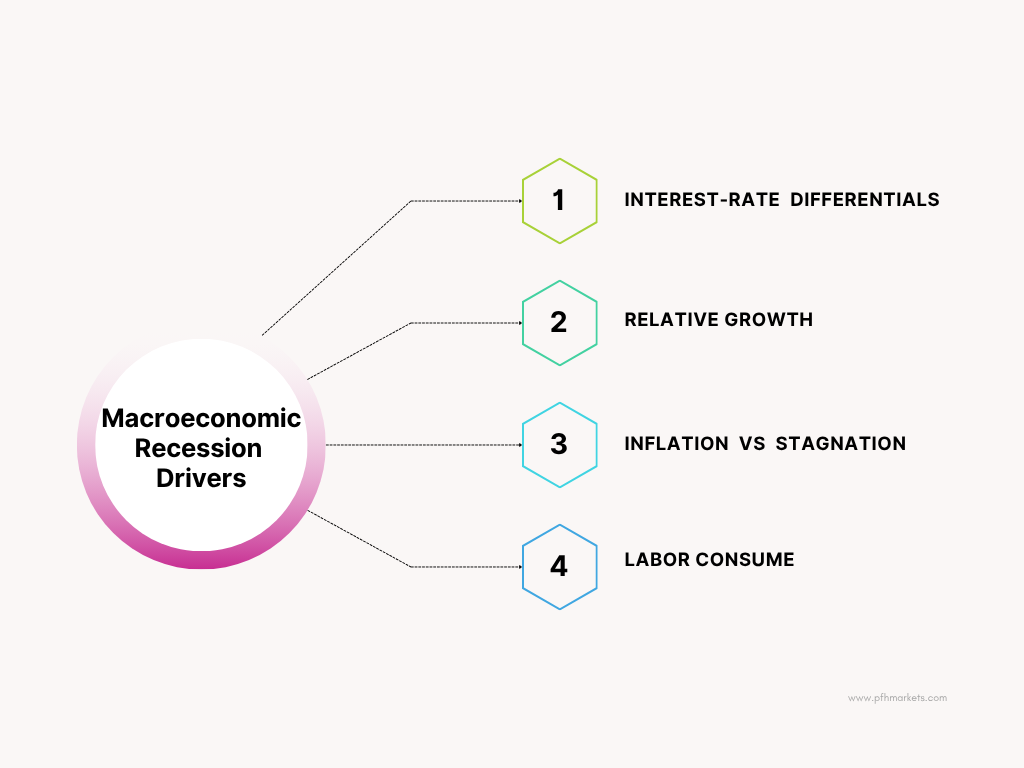
- Interest-Rate Differentials: The yield gap between two currencies is a primary driver of long-term exchange rates. If Central Bank A cuts interest rates while Central Bank B maintains or raises rates, capital tends to flow toward Currency B, exerting downward pressure on Currency A.
- Relative Economic Growth Expectations: Forex is a relative market. A country experiencing a mild recession may see its currency appreciate against a country undergoing a deeper or more prolonged contraction. Currency strength depends on relative economic resilience, not absolute performance.
- Inflation and Monetary Policy: Recessions are usually disinflationary, but “stagflation” a combination of stagnant economic growth and high inflation complicates central bank policy. If inflation remains elevated despite weak growth, central banks may delay interest rate cuts, creating complex, multi-directional currency movements.
- Employment and Consumer Spending: Labor market indicators, such as Non-Farm Payrolls (NFP) and unemployment rates, provide immediate insights into economic health. Weakening labor conditions often serve as an early catalyst for central bank policy shifts.
- Government and Fiscal Responses: Large-scale fiscal stimulus, public spending programs, or rising sovereign debt burdens influence long-term currency confidence. While fiscal stimulus can support short-term growth, excessive government borrowing can weigh on currency valuations.
Forex Recession Trading: Potential Opportunities
While recessions increase overall market risk, they also create specific structural scenarios where trends and volatility emerge across currency pairs.
1. Trading Changes in Monetary-Policy Expectations
Discrepancies between expected central bank policy and actual policy decisions often yield significant market moves. Traders monitor hawkish or dovish shifts in central bank rhetoric to position ahead of policy adjustments.
2. Identifying Relative Economic Strength
By evaluating global macroeconomic indicators, traders can identify economies that are handling contractionary pressures better than others. Coupling a resilient currency against an economically vulnerable currency can reveal clear directional trends.
3. Monitoring Risk-On and Risk-Off Conditions
When global growth slows, market sentiment fluctuates between risk appetite and risk aversion. Tracking shifts in risk sentiment helps traders align currency strategies with broader capital flows across global equities, commodities, and bonds.
4. Safe-Haven Currency Demand
During severe economic stress or financial instability, institutional capital flows into Safe-Haven Currencies like the US Dollar (USD), Swiss Franc (CHF), and Japanese Yen (JPY) to mitigate market risk.
5. Short-Term Volatility Opportunities
Elevated volatility around economic data releases creates opportunities for tactical, short-term positioning. Managing these volatility spikes requires waiting for price confirmation, ensuring deep liquidity, and enforcing strict position sizing.
Defensive Trading During a Recession
Navigating volatile markets successfully requires a risk-first mindset. Defensive trading strategies aim to protect capital, minimize drawdowns, and maintain control during periods of high market uncertainty.
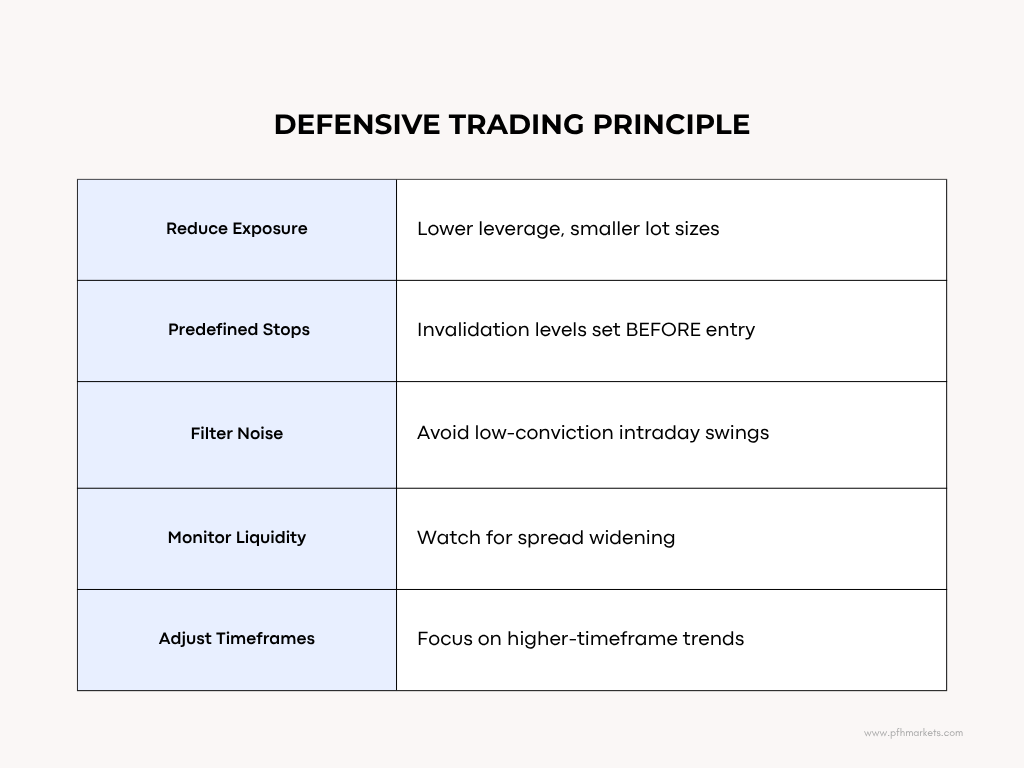
- Reduce Excessive Position Exposure: Larger market swings can magnify losses if leverage is not managed carefully. Lowering position sizes helps keep account risk consistent during periods of wider daily price ranges.
- Use Defined Risk Levels: Every trade should have a clear invalidation point before entry. Placing stop-loss orders based on key technical levels helps prevent manageable losses from escalating.
- Avoid Overtrading Market Noise: High volatility creates intra-day price swings that lack follow-through. Focusing on high-conviction trade setups based on fundamental alignment reduces unnecessary turnover.
- Consider Liquidity Conditions: During high-impact economic releases or off-peak trading hours, spreads can widen and execution slippage may increase. Factoring liquidity into execution timing is essential.
- Adapt Trading Timeframes: Short-term intraday charts often contain elevated noise during economic shocks. Moving to higher timeframes (4-hour, Daily) can help isolate clearer macro trends driven by fundamental policy shifts. Review best practices in managing forex trading risk.
Which Economic Indicators Should Forex Traders Watch?
Tracking high-impact economic indicators is vital for monitoring macroeconomic health and anticipating central bank policy shifts. Keep track of upcoming data releases using our Economic Calendar
| Economic Indicator | Market Importance & Forex Impact | Primary Currency Impact |
| Gross Domestic Product (GDP) | Measures total economic output; primary indicator of growth or contraction. | All major currencies |
| Consumer Price Index (CPI) | Primary inflation metric; directly shapes central bank interest-rate expectations. | All major currencies |
| Interest-Rate Decisions | Direct policy action that alters currency yields and yield differentials. | All major currencies |
| Employment / NFP Data | Indicates labor market health; weak data accelerates rate-cut expectations. | USD, EUR, GBP, AUD |
| Purchasing Managers’ Index (PMI) | Leading economic indicator reflecting business activity in manufacturing/services. | EUR, GBP, USD, JPY |
| Retail Sales | Measures consumer spending strength, which drives a large portion of GDP. | USD, GBP, AUD |
| Central Bank Statements | Forward guidance and press conferences signal future policy changes. | All major currencies |
| Economic Sentiment Indices | Surveys (e.g., ZEW, IFO, Michigan Confidence) gauge business and consumer optimism. | EUR, USD |
| Trade Balance | Net flow of goods and services; affects trade-related currency supply and demand. | CAD, AUD, JPY, CNY |
Recession Investing vs. Forex Trading
It is common to confuse long-term recession investing with active forex trading, but the underlying mechanisms and strategic goals are distinct.
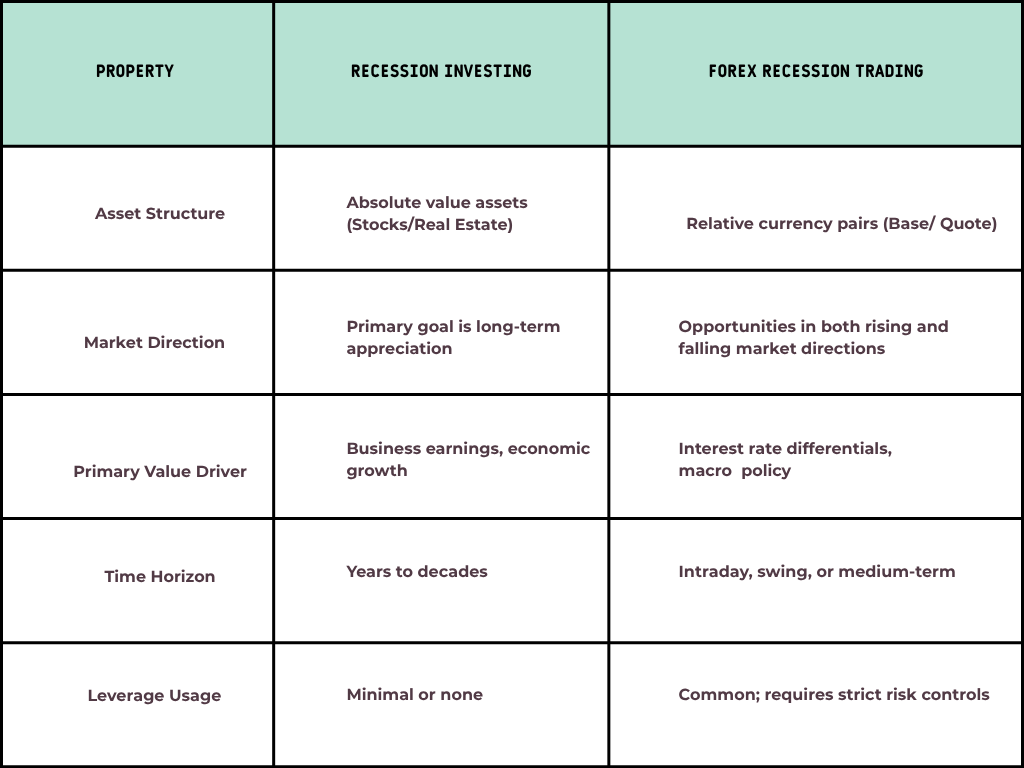
Understanding both sides of a currency pair is critical: when you sell one currency, you are simultaneously buying another. Unlike equity investing—where a general economic downturn can lower asset prices across the board—forex markets revolve around relative divergence. If Economy A is contracting faster than Economy B, Pair A/B can trend strongly regardless of global economic conditions.
Risks of Forex Trading During a Recession
Focusing exclusively on potential opportunities while ignoring structural risks is a frequent mistake in volatile markets. Competitively managing your exposure requires a clear assessment of market hazards.
- Higher Market Volatility: Rapid price expansion can quickly trigger stop losses or cause slippage during execution.
- Unexpected Central-Bank Decisions: Emergency rate cuts, unconventional monetary policies, or sudden liquidity injections can immediately reverse established price trends.
- Economic Data Surprises: High divergence between consensus estimates and actual data releases leads to elevated gap risk.
- Correlated Market Moves: Macroeconomic shocks often cause multiple currency pairs to move in tandem, accidentally increasing risk exposure if positions are not properly diversified across base currencies.
- False Breakouts: High intraday volatility can push price beyond key support or resistance levels, only to reverse sharply once institutional liquidity clears.
- Liquidity and Execution Risks: Extreme volatility can lead to temporary order-book thinning, resulting in wider spreads and partial fills.
- Emotional Decision-Making: Heightened market speed and unpredictable news flow can trigger impulsive trading habits, such as over-leveraging or revenge trading.
How Geopolitical Developments Amplify Recession Moves
Economic downturns rarely occur in isolation. External shocks such as trade disputes, energy supply disruptions, electoral changes, or regional conflicts frequently interact with existing recessionary pressures.
           [ Macroeconomic Slowdown ]
                        │
                        ▼
       + [ Geopolitical / Supply Shock ]
                        │
                        ▼
       ===================================
          Amplified Volatility Spike &
          Rapid Risk Sentiment Shifts
       ===================================
When unexpected geopolitical developments
occur during a recession, they can rapidly reshape trade balances, inflation projections, and central bank timelines. For example, energy price spikes during an economic slowdown can induce stagflationary pressures, forcing central banks to choose between combating inflation or supporting growth. Analyzing economic indicators alongside broader global developments provides a clearer picture of market sentiment.
A Practical Forex Recession Trading Framework
To navigate recessionary market conditions effectively, traders can apply a structured, step-by-step process before committing capital to a position.
  ┌────────────────────────────────────────────────────────────┐
  │ STEP 1: Assess Global Macro Environment                   │
  └─────────────────────────────┬──────────────────────────────┘
                                │
  ┌─────────────────────────────▼──────────────────────────────┐
  │ STEP 2: Check Economic Calendar & High-Impact Events       │
  └─────────────────────────────┬──────────────────────────────┘
                                │
  ┌─────────────────────────────▼──────────────────────────────┐
  │ STEP 3: Map Central Bank Expectations & Rate Trajectories  │
  └─────────────────────────────┬──────────────────────────────┘
                                │
  ┌─────────────────────────────▼──────────────────────────────┐
  │ STEP 4: Gauge Overall Risk Sentiment (Risk-On / Risk-Off)  │
  └─────────────────────────────┬──────────────────────────────┘
                                │
  ┌─────────────────────────────▼──────────────────────────────┐
  │ STEP 5: Identify Divergent Currency Pairs                 │
  └─────────────────────────────┬──────────────────────────────┘
                                │
  ┌─────────────────────────────▼──────────────────────────────┐
  │ STEP 6: Define Trade Setup (Entry, Invalidation, Target)   │
  └─────────────────────────────┬──────────────────────────────┘
                                │
  ┌─────────────────────────────▼──────────────────────────────┐
  │ STEP 7: Calculate Position Size & Apply Risk Controls      │
  └─────────────────────────────┬──────────────────────────────┘
                                │
  ┌─────────────────────────────▼──────────────────────────────┐
  │ STEP 8: Post-Trade Review & Process Audit                  │
  └────────────────────────────────────────────────────────────┘
- Assess Global Macro Conditions: Evaluate whether key economies are expanding, stagnating, or contracting by reviewing GDP growth trends and PMI readings.
- Check the Economic Calendar: Identify upcoming interest rate announcements, employment figures, and inflation releases to avoid unexpected volatility.
- Review Central-Bank Expectations: Compare rate forecasts across major central banks to locate policy divergences.
- Evaluate Market Sentiment: Determine whether broader global capital markets are displaying risk-seeking or risk-averse behavior.
- Identify Relative Currency Drivers: Select currency pairs where one country shows macroeconomic stability relative to a weaker counter-currency.
- Define Trade Execution Parameters: Clearly map entry triggers, technical invalidation levels, and realistic risk-reward targets on your charts.
- Manage Position Exposure: Calculate correct lot sizes based on account risk percentages, accounting for wider price swings.
- Conduct Post-Trade Analysis: Log trade performance and evaluate whether execution aligned with your fundamental thesis, regardless of trade outcome.
Common Mistakes When Trading Forex During a Recession
- Assuming Every Currency Declines: Treating forex like equities by assuming all currencies fall simultaneously during a recession.
- Viewing Safe-Havens as Guaranteed Winners: Assuming currencies like JPY, CHF, or USD will always appreciate during a downturn, regardless of underlying yields.
- Ignoring Central-Bank Guidance: Trading solely on technical patterns while overlooking major monetary policy shifts.
- Trading Data Releases Impulsively: Opening market orders immediately upon high-impact releases without price confirmation or plan.
- Using Excessive Leverage: Over-leveraging during volatile conditions, leading to early stop-outs on temporary price spikes.
- Confusing Volatility with High-Probability Setups: Assuming large price swings guarantee actionable trends.
- Relying on a Single Indicator: Making trading decisions based on one data point (e.g., CPI alone) without considering broader economic data.
- Ignoring Geopolitical Context: Failing to account for geopolitical shocks that can invalidate fundamental assumptions.
- Overtrading After Losses: Increasing position frequency or size to recover drawdown during erratic market conditions.
- Failing to Adjust Position Sizing: Maintaining standard lot sizes despite significantly wider daily average true ranges (ATR).
Is Forex Recession Trading Suitable for Beginners?
Trading currency markets during an economic contraction requires a strong understanding of both technical and fundamental market mechanics. For beginners, elevated volatility can present significant learning challenges.
Before executing trades during high-volatility environments, new traders should build a foundational understanding of key concepts:
- Base and quote currency mechanics
- Spread dynamics, margin, and leverage calculations
- How economic reports impact asset values
- Executing stop-loss orders and managing position risk
Practicing strategies in a risk-free demo trading environment allows novice traders to observe price behavior around major data releases, test technical frameworks, and understand order execution without risking capital.
How to Prepare for Future Economic Recessions
Preparing for recession-driven market volatility involves building structured habits across every stage of the economic cycle.
Before the Downturn
- Build a clear risk-management plan with strict limits on drawdown and exposure.
- Study past recession cycles to understand how specific currency pairs reacted to central bank rate-cutting cycles.
- Establish daily routines for reviewing economic calendars and policy statements.
During the Downturn
- Monitor monetary policy expectations continuously rather than relying on stale data.
- Reduce leverage and position sizes to accommodate wider market volatility.
- Focus on fundamental policy divergence rather than short-term market noise.
After Market Recovery
- Review performance logs to evaluate execution quality and risk management adherence.
- Assess how central bank interventions impacted specific currency cross-rates.
- Refine trade execution frameworks based on empirical market data for future cycles.
Forex Recession Trading: Risks vs. Opportunities
| Potential Opportunities | Key Market Risks |
| Monetary-Policy Divergence: Clear trends from differing central bank rate policies. | High Volatility: Rapid price movements that can trigger stops unexpectedly. |
| Relative Growth Discrepancies: Trading stronger economies against weaker counterparts. | Central Bank Interventions: Sudden, unannounced monetary policy changes or easing. |
| Safe-Haven Inflows: Directional capital flows into defensive assets during risk-off events. | False Breakouts: Volatile intraday swings that quickly reverse. |
| Increased Liquidity: Major economic events bring increased institutional volume. | Execution Slippage: Spread widening and order execution delays during high-impact news releases. |
| Macro-Driven Trends: Sustained directional trends driven by long-term economic shifts. | Systemic Risk: Unexpected geopolitical or fiscal crises altering market dynamics. |
Conclusion
Economic recessions transform the foreign exchange landscape, replacing range-bound conditions with macro-driven trends and elevated volatility. Successfully navigating Forex Recession Trading requires moving away from simplified assumptions and focusing on relative economic performance, interest-rate expectations, central bank policy, and market sentiment.
While macroeconomic shifts create distinct opportunities across currency pairs, elevated volatility demands disciplined risk management. Maintaining conservative position sizing, using predefined stop-loss levels, and relying on structured analytical frameworks help traders evaluate risks and opportunities methodically.
Ready to apply macro analysis to live market conditions? Explore forex trading with PFH Markets, an FSC Mauritius regulated broker. Access competitive spreads across major, minor, and exotic pairs, and open a trading account today to build your trading strategies.